How Ray-Ban Display Glasses Put a Screen in a Lens
How a picture appears inside a clear glasses lens: light, a tiny projector, mirrors hidden in glass, a wristband that reads muscles, and the whole system.
You are walking to a café. A message arrives: "Running 10 minutes late, order me a coffee?" You do not take out your phone. A small card with the message simply appears in the air, a little to the right of where you are looking. You tap your thumb against your finger, and a reply goes back. The street, the people and the traffic stay in full view the whole time.
That is what the Meta Ray-Ban Display glasses do. They went on sale in the United States on 30 September 2025 for $799, a price that includes a wristband called the Meta Neural Band. From the outside they look like a thick pair of Ray-Bans. The right lens looks clear. Yet a sharp, full-colour picture floats inside it.
How can a lens that looks like ordinary glass show a picture? A screen needs pixels and light. A lens has neither, and it sits only about 2 cm from your eye, far too close to read anything. This piece answers the puzzle one step at a time. Each step uses only what the steps before it built. You can start with no physics at all and finish knowing how the whole system works.
Meet the glasses
Before the physics, here is the object itself. Every number below is cited, and the sources are at the end. When a number comes from Meta, it says "Meta says". When it comes from a review, a teardown or a supplier, it says "reported".
| What | Value | Source |
|---|---|---|
| Launch | 30 September 2025, United States, $799 with the Neural Band | Meta newsroom |
| Display | Full colour, right eye only, 600 x 600 pixels | Meta, via Road to VR and UploadVR |
| Field of view | 20 degrees (diagonal) | Meta, via Road to VR; diagonal per Karl Guttag |
| Sharpness | 42 pixels per degree | Meta blog |
| Brightness | 30 to 5,000 nits | Meta, via Road to VR |
| Refresh | 90 Hz display, content updated at 30 Hz | Meta, via Road to VR |
| Light leakage to the outside | 2% | Meta blog |
| Weight | 69 g | Meta blog |
| Battery | Up to 6 hours mixed use; up to 30 hours with the case | Meta newsroom |
| Lenses | Transitions (light-darkening) lenses on all models | Meta blog |
| Prescriptions | -4.00 to +4.00 dioptres | Meta, via UploadVR and Road to VR |
| Camera, audio | 12 MP camera, five microphones, two off-ear speakers | Road to VR |
| Neural Band | sEMG wristband, up to 18 hours, IPX7 water rating | Meta newsroom |
Meta describes the optics in one sentence: "a highly custom light engine and geometric waveguide". Everything else about the optics comes from outside. A teardown by iFixit found the projector chip. The optics analyst Karl Guttag took the projector apart and measured it. The waveguide maker Lumus later said in a press release that Meta "adopted our geometric waveguide technology" for these glasses. We will use all three, and say each time which one a fact comes from.
The words in that table (waveguide, field of view, nits, pixels per degree) are the subject of the rest of this piece. Start with the most basic question of all: what does your eye need to see anything sharp?
Step 1: what the eye needs
Light, a lens, and a screen at the back
Your eye is a small camera. Light comes in through a clear window at the front (the cornea) and passes a hole that opens and closes (the pupil). Then it goes through a soft, clear lens. At the back is the retina, a sheet of light-sensitive cells. The cornea and the lens bend the light so that every point in the world lands on exactly one point of the retina. That is what "in focus" means.
Think about one point of a distant street lamp. It sends light out in every direction, but only a narrow pencil of it enters your pupil. By the time that pencil reaches you from far away, its rays are almost parallel. The eye's job is to bend those parallel rays so they meet again at one spot on the retina.
Now bring the lamp close. A nearby point sends rays into your pupil that spread apart, because the pupil sees them from a wider angle. Spreading rays are harder to bring together. The eye copes by squeezing its lens into a fatter, stronger shape. This is called accommodation, and it has a limit.
Why a screen on the lens cannot work
To focus on something at a distance , the eye must add focusing power equal to one over that distance:
Here is the extra power in dioptres, and is the distance to the object in metres. For a street sign 2 m away, dioptres, which is easy. For a book at 25 cm, it is 4 dioptres. A young adult's eye can just about manage this; 25 cm is the usual textbook value for the closest comfortable focus.
A display sitting on a glasses lens is about 2 cm from the eye. The eye would need dioptres. No human eye can add that. A picture printed on the lens, or a tiny screen glued to it, would be a blur.
So the first problem is clear. The glasses must take light from a source very close to the eye and make it look as if it comes from far away. Opticians solved that problem long ago, with a lens.
A lens can move a picture far away
Put a small picture at exactly the focal point of a magnifying lens, and look through the lens. Every point of the picture sends out spreading rays. The lens bends each spray into a bundle of parallel rays. To your eye, parallel rays mean "far away", so it relaxes and sees the picture sharp, as if it were a big poster across the room.
There is a second, quieter trick in the same picture. Each point of the display leaves the lens as a bundle at its own angle. The top of the display becomes rays tilted one way, and the bottom becomes rays tilted the other way. Position on the display has become direction. Hold on to this idea. It is the reason the rest of the system can work at all.
The thin-lens rule makes this exact. A lens with focal length takes an object at distance in front of it and makes an image at distance :
Read it as "the bending power of the lens, minus the spread of the incoming light, gives the convergence of the outgoing light". With mm and the display exactly at mm, the right side is zero, so the image is at infinity. Move the display to 9.9 mm and the numbers in our script give a virtual image about 0.99 m in front of the eye. At 9.5 mm the image comes to 0.19 m.
A shift of a tenth of a millimetre moves the picture by a metre, which shows how precise these optics must be. (These are example values to show the rule; Meta does not publish the distance at which the Ray-Ban Display picture appears.)
Research notes: why "far away" is not "infinitely far away"
Display makers often set the virtual image at a finite distance, such as one or two metres, rather than at infinity. A picture at infinity is relaxing for the eye. But text you glance at while talking to someone nearby can feel more natural a little closer. Each choice also changes how the picture lines up with the real world for the other eye. Meta has not published the image distance of the Ray-Ban Display. The thin-lens numbers above come from numbers.py, section 2.
So now we know what to build: a tiny bright picture, and optics that make its light parallel. But one thing is still wrong. A magnifier must sit right in front of the eye. In glasses, the space in front of the eye is taken by the lens you look through. The light must come from the side, travel across the lens, and turn towards the eye, while the lens stays clear. That needs the physics of light inside glass.
Step 2: how light behaves in glass
Rays, reflection and the normal
For everything in this piece, light can be treated as rays: straight lines that carry energy. A ray changes direction only where it meets a surface between two materials. At that surface two things can happen. Some light bounces back (reflection), and some goes through but changes direction (refraction).
Reflection follows the rule you know from a game of pool. The angle going out equals the angle coming in, on the other side of the normal.
Refraction and the refractive index
Light travels more slowly in glass than in air. Imagine a line of marching students walking from a paved square onto a muddy field at a slant. The students who reach the mud first slow down first, so the whole line swings round. Light does the same at a surface. The part of the wave that enters the glass first slows first, and the ray turns towards the normal.
The rule that gives the new angle is Snell's law:
Read it left to right. is the refractive index of the material the ray starts in, and is its angle from the normal there. and are the same two things in the material it enters. The product of index and sine stays the same across the surface. The slower side must have the smaller angle.
A tiny example. A ray in air () hits glass () at . The sine of 30° is 0.5. So , which gives and . The ray turns towards the normal, from 30° to 19.5°.
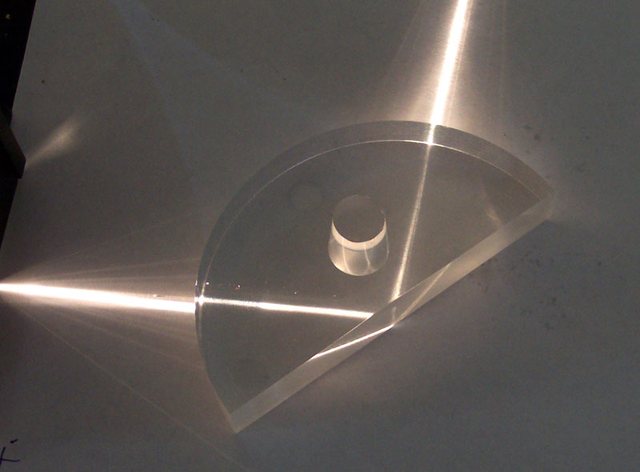
Total internal reflection: light that cannot get out
Now run the same law backwards, from glass out into air. A ray inside the glass at 30° gives , so it leaves at 48.6°. Going from slow to fast, the ray bends away from the normal.
Tilt the ray more. At 45° inside the glass, . But the sine of an angle can never be larger than 1, so there is no angle in the air that satisfies the law. No ray can leave. All of the light reflects back into the glass, with no loss at all at a clean surface. This is total internal reflection, often shortened to TIR.
The boundary is the critical angle. It is the angle at which the escaping ray would just skim along the surface, at 90° in the air:
Here is the critical angle inside the denser material, is that material's index and is the index outside. For glass against air, , so . Any ray inside the glass steeper than 41.8° from the normal is trapped.
The higher the index, the smaller the critical angle, and the wider the range of angles that stay trapped. That range is the "room" a waveguide has for the picture, which is why material makers chase high index. Meta wrote in 2025 that the best glass it had in 2016 had an index of 1.8. Its Orion prototype instead uses silicon carbide, with an index of 2.7.
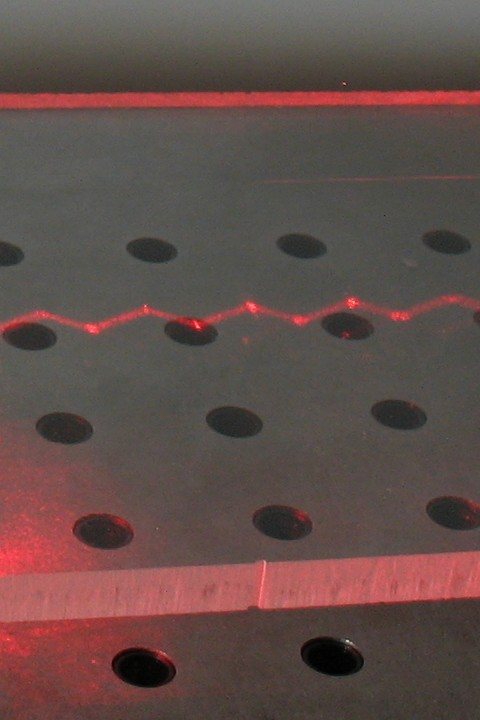
A plate that carries light
That laser photo is the heart of the glasses. A flat plate of glass, with light entering at a steep angle, becomes a pipe for light. The light walks along the plate in zigzags. How far it moves along the plate between two touches of the same face depends only on the thickness and the angle :
is the plate thickness and is the ray's angle from the normal. With an example 1 mm plate and a ray at 60°, the stride is mm. Over 30 mm of lens, the light makes about 8.7 round trips. (The thickness of the Ray-Ban Display waveguide is not public. These are example values.)
Now we have every idea we need for the rest. A lens makes a tiny picture look far away. Each pixel becomes a direction. Glass can trap light by total internal reflection and carry it sideways. The glasses join these three ideas. The first part of the machine is the thing that makes the picture.
Step 3: the tiny projector
Four ways to make a very small picture
The picture starts on a microdisplay: a display about the size of a fingernail or smaller, with pixels a few micrometres across. A microdisplay pixel is far thinner than a human hair.
There are four main families. Two of them make their own light; one reflects light from a lamp; one draws the picture with a single beam.
LCoS (liquid crystal on silicon) is a mirror chip. Each pixel is a tiny mirror under a thin layer of liquid crystal. It controls how much of the incoming light comes back in a usable form. It needs a separate light source, usually LEDs.
Micro-OLED builds organic light-emitting pixels straight onto a silicon chip, so each pixel glows and black pixels are truly off. MicroLED makes each pixel a tiny inorganic LED, which can be very bright. Making millions of them small and in three colours is still hard. Laser scanning uses one beam of light steered by a fast moving mirror to draw the picture line by line.
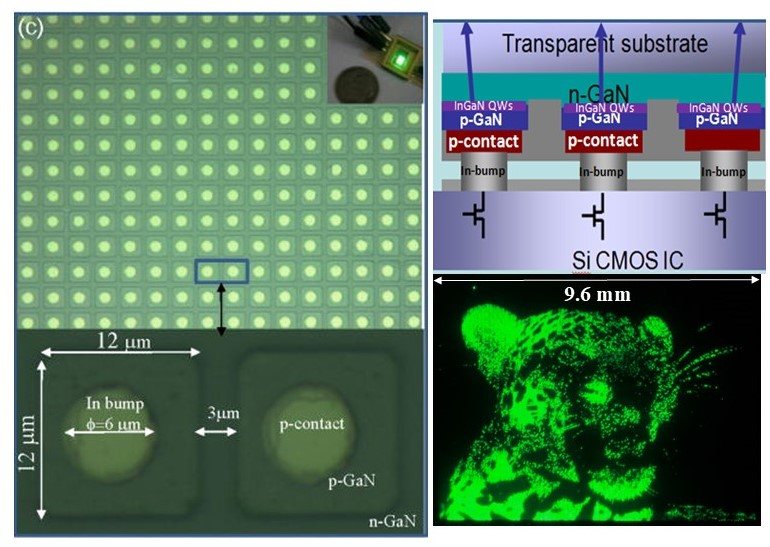
What the Ray-Ban Display uses
Meta has not said which microdisplay it uses. The iFixit teardown found an OmniVision OP03010 LCoS panel in the projector, with a grid of 600 x 600 pixels and three LEDs. Karl Guttag reports that it is the same device as OmniVision's catalogue part OP03011, on a different flexible cable. Meta chose LCoS here, while its Orion prototype uses microLED projectors, according to Road to VR's report of Meta's 2024 announcement.
OmniVision's product brief for the OP03011 gives the size. The chip has 648 x 648 pixels at a pitch of 3.8 micrometres, so the active area is 2.462 mm on each side. If the glasses use 600 x 600 of them, as the specs say, the picture on the chip is mm wide. The whole picture you see starts on a square about 2.3 mm wide.
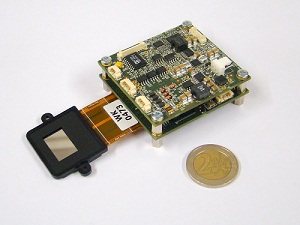
How an LCoS pixel makes light or dark
To follow LCoS, you need one more property of light: polarisation.
Inside the chip, under a cover glass, is a thin layer of liquid crystal. Under that, each pixel has a polished aluminium mirror, and under the mirror sits the silicon circuit that sets its voltage. Polarised light comes in, passes the liquid crystal, bounces off the pixel mirror and passes the liquid crystal again on the way out.
If a pixel's voltage leaves its polarisation unchanged, the light comes back the way it went in. If the voltage makes the crystal turn the polarisation by 90 degrees over the round trip, it comes back turned. Values in between give grey levels. The chip itself makes no picture you could see: it only paints the picture into the polarisation of the light.
A polarising beam splitter turns that hidden picture into a visible one. It is a glass cube with a special coating on its diagonal that reflects one polarisation and passes the other. It sends the LED light onto the chip, and when the light comes back, it passes only the turned light onwards. Turned pixels become bright, unturned pixels become dark.
Colour from one chip: field-sequential colour
An LCD in a laptop has three sub-pixels (red, green, blue) at every point. A 3.8 micrometre LCoS pixel has no room for that. Instead, the chip shows the colours one after the other. It shows the red part of the picture while only the red LED is on. Then it shows the green part with the green LED, then the blue part.
Your eye blends the quick flashes into one full-colour picture. OmniVision's brief says the OP03011 is "designed for color field sequential operation".
Road to VR lists a 90 Hz display refresh with content refreshing at 30 Hz. At 90 frames a second with three colour fields each, the chip must show at least 270 colour fields every second. Each field lasts at most 3.7 ms. Guttag notes that the chip itself can run up to 120 frames a second, and that colour break-up is visible on the glasses.
The light engine
Guttag's teardown describes the whole projector, which Goertek reportedly designed. It is an unusual layout. The red and blue LEDs sit side by side on one ceramic base, so only one colour-combining mirror is needed. A pair of tiny lens arrays (a "fly-eye" homogeniser) spreads the light evenly. The polarising beam splitter sends it to the LCoS chip. A curved mirror and lenses then collimate the returning picture and send it into the waveguide.
At full brightness, Guttag reports that a colleague measured about 1 lumen of light coming out of this projector. That is very little light. Remember this number; it will matter when we follow where the light goes. Meta calls the whole unit "a highly custom light engine", and that is as much as Meta has said about it.
Step 4: the waveguide
The job: in, along, out
At the exit of the projector we have what the eye needs. Each pixel is a bundle of parallel light at its own angle. The waveguide has three jobs. It must take that light in at the edge of the lens (in-coupling) and carry it across without spoiling the picture (propagation by TIR). Then it must send it out towards the eye (out-coupling). It must do all of this while you see the world clearly through it.
In-coupling is the easy part to picture. A mirror at an angle near the edge of the plate turns the incoming beams. Now they hit the faces at steep angles, past the critical angle, and they are trapped. A pixel at the top of the picture and one at the bottom enter at slightly different angles. They keep that difference all the way across.
Why does that matter? Because a flat mirror changes the direction of all rays in the same way. A ray that enters 3 degrees above another still leaves 3 degrees above it, after any number of bounces off flat, parallel faces. The plate keeps the picture, because the picture lives in the angles. This is why "position becomes direction" was so important.
Out-coupling with partial mirrors
To get the light out, a geometric waveguide (also called a reflective waveguide) has a row of slanted, partly reflecting mirrors buried in the glass. When the trapped light passes through the first one, a small share of it reflects at a new angle. That angle is steep enough to escape through the face of the plate towards the eye. The rest passes through and travels on to the next mirror, and so on.
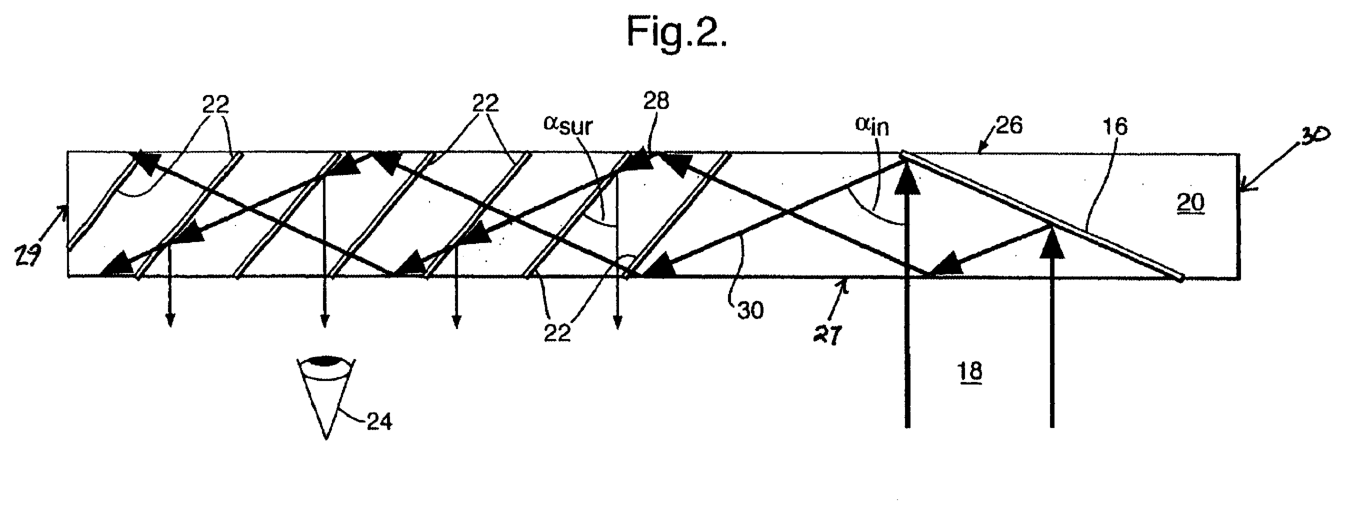
These mirrors are so thin and so clear from your side that you look through them at the world. Lumus, whose design Meta adopted, has worked on this idea since its early patents. The drawing below is Figure 2 of a Lumus patent from 2004. Light from a display (18) enters at the right and reflects off an in-coupling mirror (16). It zigzags along the plate (20) and meets partial mirrors (22) that send it to the eye (24).
Sharing the light fairly
There is a catch. The first mirror sees all the light, but the last mirror sees only what the others let through. If every mirror reflected the same share, the picture would be bright near the projector and dim on the far side. So each mirror must reflect a larger share than the one before it.
The same patent gives the rule, for mirrors that spread the light sideways in a second direction:
The eyebox: why the picture is copied many times
Why have many mirrors at all? Why not one mirror right in front of the eye? The answer is that your eye moves, and so do the glasses on your nose.
The beam that comes out of a small projector is only a few millimetres wide. Your pupil is also a few millimetres wide: about 1.5 to 4 mm in daylight. With only one exit beam, the picture would vanish as soon as your eye rolled a little. It would also vanish if the frame slid down your nose, or sat on a face with wider-set eyes. Each partial mirror sends out its own copy of the beam, and side by side the copies fill a wider box of light.
The copies do not make a confusing jumble, because of the same trick as before. Each pixel is a direction, not a place. Every copy of the beam carries every pixel at its own angle. Wherever your pupil sits in the eyebox, it catches some copy, and inside that copy each pixel arrives from its correct direction. The picture stays in the same spot in your view.
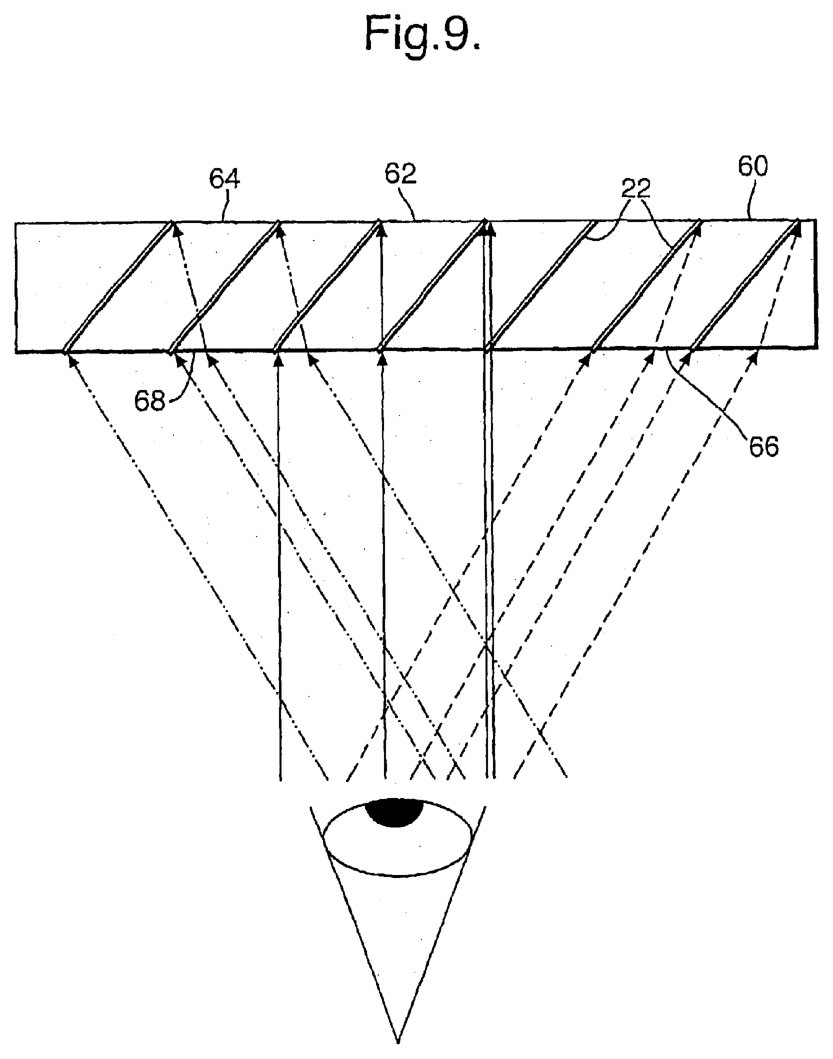
The patent's Figure 9 shows the same idea from the eye's side. Three groups of rays (solid, dashed and dotted lines) are three directions, so three pixels. Each leaves the plate from several mirrors, and all of them reach the one eye.
Copying in two directions
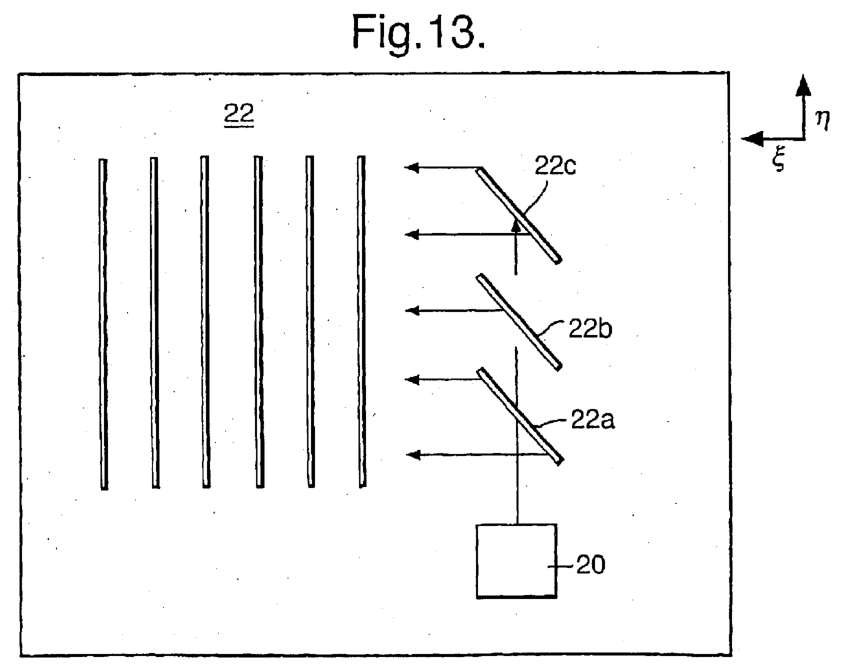
A single row of mirrors widens the beam in one direction only, say left to right. The eye also moves up and down. So the light must be copied in two directions. The 2004 patent already sketches a second set of angled mirrors (its Figure 13 below). It spreads the light sideways before the main set spreads it down. Later Lumus patents describe "multiple-axis" expansion in more compact forms.
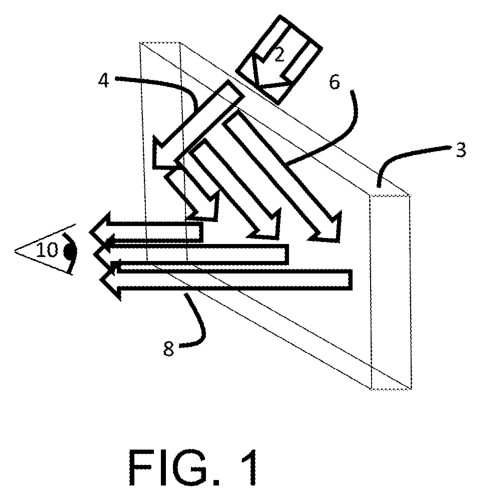
Guttag judges the Ray-Ban Display waveguide to be "clearly a variation on Lumus's Z-Lens Geometric waveguide", though he could not see the usual Z-Lens mirror stripes. Neither Meta nor Lumus has published the exact layout, so the sketch below shows the principle, not the real mirror counts.
The other way: diffraction gratings
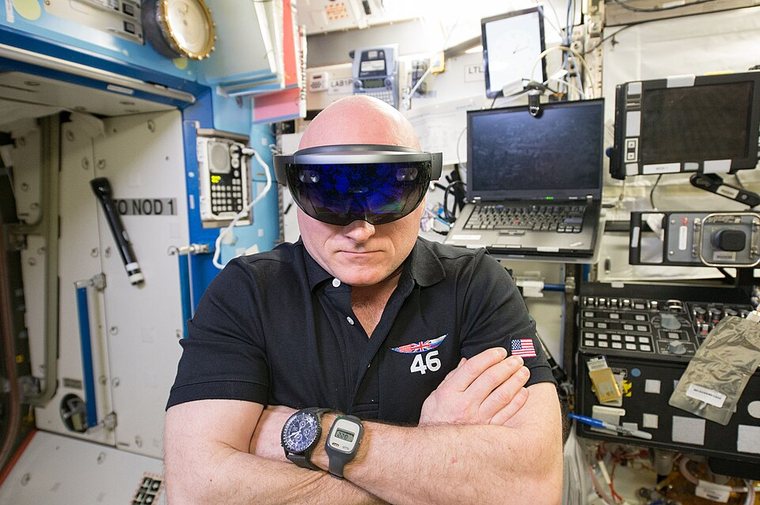
Many smart glasses with a picture in the lens, including Microsoft's HoloLens headsets and Meta's own Orion prototype, use a different kind of waveguide. Instead of buried mirrors, they use diffraction gratings: patterns of ridges so fine that their spacing is close to the wavelength of light. Light that meets a grating splits into a few beams at new angles, much like the rainbow you see on the back of a CD.
The rule for a grating, for light arriving head-on and bent into the glass, is the grating equation:
Here is the refractive index of the glass and is the angle of the bent ray inside it. (lambda) is the wavelength of the light, and (capital lambda) is the spacing of the grating lines. Longer wavelengths bend more.
Take an example grating with a 400 nm spacing on glass with . Blue light at 450 nm gives , so it enters at 48.6°. Green at 530 nm enters at 62.0°. Both are past the critical angle of 41.8°, so both are trapped. Red at 630 nm gives , which is impossible: red has no ray inside the glass at all.
This tiny example shows the core weakness of diffractive designs. One grating cannot treat three colours alike. Designers work around it with two or three stacked plates, one per colour range, careful grating shapes, and high-index materials. Meta's 2025 article on Orion says its silicon carbide waveguides remove the "rainbows" that ambient light makes on a grating. A mirror, by contrast, reflects every colour at the same angle, so a geometric waveguide carries full colour through one plate.
Light that leaks out of the front
A waveguide does not send light only to the eye. A grating bends light both ways, so some of it leaves through the front of the lens, towards the people around you. In some glasses you can see a glowing patch on the wearer's lens. This is called eye glow, and it is a privacy problem as much as a looks problem: someone facing you might read your messages.
Meta says the Ray-Ban Display has only 2% light leakage. Guttag measured the forward glow at about 1.5% of the brightness reaching the eye, directed downwards. He contrasts it with 50% to 100% for typical diffractive waveguides. At full brightness, 1.5% of 5,000 nits is about 75 nits leaving the front, aimed at the ground.
| Geometric (reflective) | Diffractive | |
|---|---|---|
| How light gets out | Buried partial mirrors | Surface gratings |
| Colour | All colours alike, one plate | Each colour differs; often two or three plates |
| Forward leak | Low (about 1.5% measured here) | Often high (50 to 100%, per Guttag) |
| Rainbows from room light | Few | A known problem |
| Efficiency | Lumus-type designs "typically 3 to 7 times" better, per Guttag | Lower |
| Manufacturing | Many coated slices, cut and glued; hard to scale | Stamping or etching; scales well |
| Examples | Meta Ray-Ban Display (Lumus design, reported to be made by Schott) | HoloLens, Orion prototype |
The last row has a supply story. Schott, the German glass maker, said shortly before the launch that it was the "first company capable of handling geometric reflective waveguide manufacturing in production volumes". iFixit calls Schott and Lumus "almost certain" to be the supplier. In January 2026, Meta paused its planned launch in four more countries, citing "unprecedented demand and limited inventory".
How little of the light reaches you
Now we can put the projector's one lumen together with the 5,000 nits at the eye. First, what is a nit?
A small amount of light, spread over a small area and a small cone of directions, can still look very bright. The light that enters your pupil is:
(phi) is the light flux in lumens. is the luminance in nits. is the pupil area in square metres. (omega) is the solid angle of the picture, the size of the cone of directions it fills, in steradians.
Our script works it out for the real numbers. The picture spans about 14.1° x 14.1° (we derive that in Step 5), a solid angle of 0.0606 steradians. A 3 mm pupil has an area of 7.07 square millimetres. At 5,000 nits, lumens. That is 2.14 millilumens, or about 0.21% of the 1 lumen that leaves the projector.
Where does the other 99.8% go? Most of it lights the rest of the eyebox, the places your pupil could be but is not. More is lost at partial mirrors that send light the wrong way and at the edges of the plate. A little more leaks forward. This is the price of pupil expansion: the system lights a whole window so that your small pupil can find it anywhere. It is also why efficiency matters so much in glasses that run on a tiny battery.
Step 5: seeing the world and the picture at once
Contrast against a bright world
A see-through display has a problem a phone does not have. It cannot make black. A "black" pixel simply sends no light, and you see the world through it. The display can only add light on top of the world. So what matters is not the display's brightness alone, but how it compares with what is behind it.
is the display luminance at the eye. is the luminance of the world behind the picture, and is the fraction of world light that the lens lets through. A contrast of 1 means the picture is invisible. The higher the contrast, the easier the picture is to read.
Try it at the brightest setting. A 5,000-nit picture on an average clear sky of 8,000 nits, through a clear lens, gives . That is weak but readable. A display with the 250 nits of a typical monitor would give : on a sunny day it would be all but invisible. This is why Meta made the display so bright. The range goes from 30 nits for a dark room up to 5,000 for the street.
The darkening lens
All Meta Ray-Ban Display glasses ship with Transitions lenses, which darken in sunlight. This is not just a style choice. Look at the contrast formula again. Dimming the world (making smaller) raises the contrast, as long as the display light is not dimmed with it.
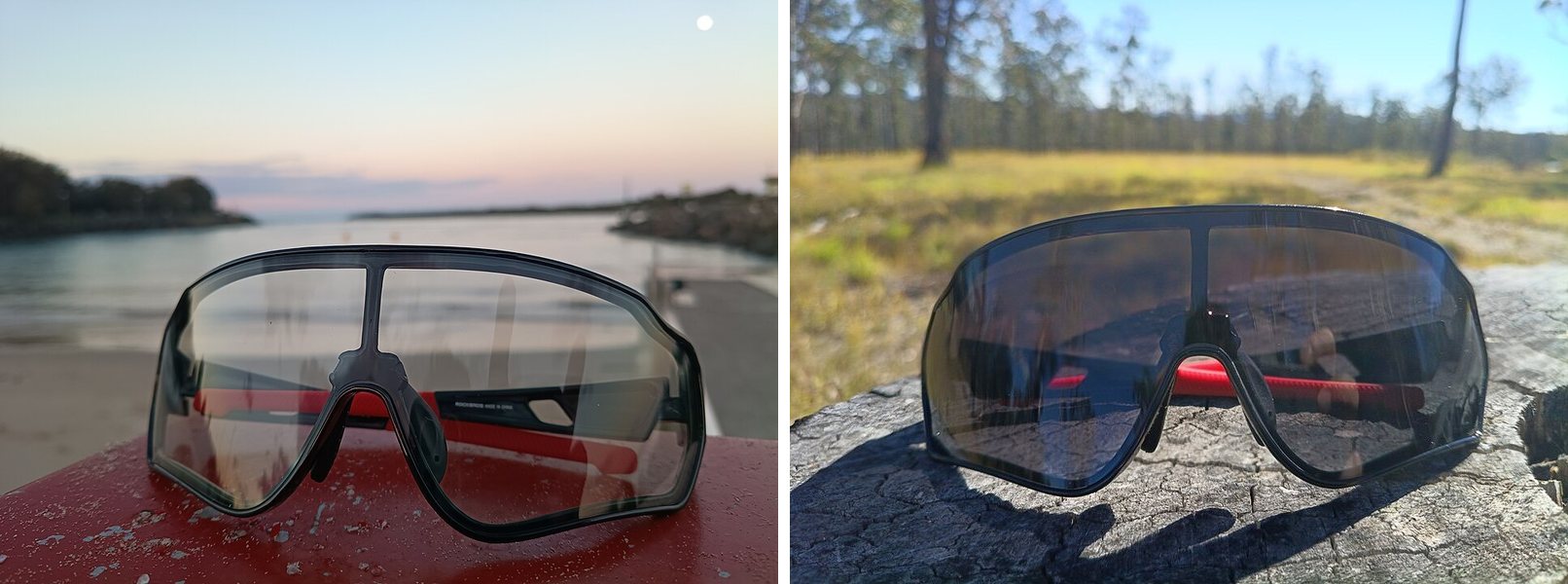
A lens dark enough to count as typical sunglasses (European filter category 3, which lets 8% to 18% through) changes the numbers a lot. With the lens at 18%, the sky behind the picture drops to 1,440 nits, and the contrast rises to 4.47. At 8%, it is 8.81. The darkening lens is part of the display system.
The lens sandwich
The trick works only if the darkening part sits on the world side of the waveguide. The iFixit teardown found lenses glued on both sides of the waveguide, and one of them darkens. Light from the world passes the outer lens, the waveguide and the inner lens. Light from the display starts inside the waveguide, so it passes only the inner lens on its way to the eye. The darkening dims the street but not the message.
The inner lens is also where a prescription goes. UploadVR reports that Meta supports short sight, long sight and astigmatism from -4 to +4 dioptres of total power. Up to 4 dioptres of cylinder correct astigmatism. A 4-dioptre lens has a focal length of 25 cm. The prescription is bonded to the lens during manufacturing, at a cost UploadVR reports as $200. You cannot simply pop in new lenses later.
The order of the sandwich matters for the picture too. The display light leaves the waveguide as parallel rays, which look far away. A short-sighted wearer's inner lens spreads that light a little, so the far picture comes into focus. Their normal glasses do exactly the same for a far street sign. The picture is corrected along with the world.
One eye, and how the brain copes
The Ray-Ban Display shows its picture to the right eye only. Displays like this are called monocular. The left eye sees only the world.
Your brain is used to merging two slightly different views into one. Here one eye sees a small card and the other does not, yet most people perceive one view with a card in it. Some find that it takes a little getting used to. UploadVR calls the picture "a small fixed HUD", a head-up display that stays put as you turn, rather than graphics fixed to objects in the room.
Meta has not explained the choice of one eye. The likely reasons follow from everything above. A second display means a second projector, a second waveguide, more weight and more battery drain. Two pictures must also line up to a small fraction of a degree, or the eyes strain to fuse them. And glasses flex on a head. One display avoids that problem entirely.
Field of view and pixels per degree
How big is the picture? Optics measures size as an angle. A small picture close up and a big one far away look the same if they fill the same angle.
A square picture 20 degrees across the diagonal is degrees on each side. At a reading distance of 40 cm, that is the size of a square about 9.9 cm wide. (This uses the small-angle approximation, which is close at these sizes.)
The sharpness then follows from two specs:
Along the diagonal there are pixels, over 20 degrees. That gives pixels per degree, which matches Meta's figure of 42. One pixel spans arcminutes. Normal vision resolves about 1 arcminute, so you could just see the pixels on a perfect display. To reach 60 ppd over the same square, it would need about 849 x 849 pixels.
The optics do not deliver every pixel perfectly. Guttag estimates that the picture resolves "closer to 400x400 pixels", which would be about 28 effective pixels per degree. He also says that in most use the display shows about 16 degrees or less. That is an outside estimate, not a Meta figure, but it is a reminder that a spec sheet number is a ceiling. On brightness, Guttag says he could confirm Meta's figure of about 5,000 nits.
Why so small, and why off to the side
Twenty degrees is a small window. Your two eyes together take in a view many times wider. Why not a bigger picture?
Every part of the system gets harder with field of view. The waveguide must trap a wider range of angles, which needs a higher refractive index. The pixel count grows with the square of the width. At the same 42 ppd, a square 70 degrees on the diagonal would need about 2,079 x 2,079 pixels: 12 times as many. The light needed to fill a bigger picture at the same brightness grows with its solid angle. Each step costs size, heat and battery.
Meta says it placed the display "off to the side, so it doesn't obstruct your view". A card in the corner of your vision is easy to glance at and easy to ignore. A picture in the centre would block the very street you are walking along. Together with the small size, this placement makes the display a place to check, not a place to live, which suits messages, directions and captions.
Step 6: the hand as the input
A screen with no touchscreen
You can speak to Meta AI through the glasses, but talking aloud is not always possible or polite. Meta's answer is the Meta Neural Band, a fabric wristband worn on the writing hand. It turns small finger movements into commands, even with the hand resting at your side.
Meta's help page lists the gestures. A tap of the index finger on the thumb selects. A tap of the middle finger on the thumb goes back. A swipe of the thumb along the side of the index finger scrolls, like swiping a phone. Holding the index finger to the thumb and turning the wrist changes the volume or zooms. A double tap of the thumb on the side of the index finger calls Meta AI.
Muscles are electrical
To move a finger, your brain sends a signal down your spinal cord to motor neurons. Each motor neuron connects to a group of muscle fibres in your forearm, which move your fingers through long tendons. When a motor neuron fires, all its fibres fire together, and each fibre makes a tiny electrical pulse as it contracts.
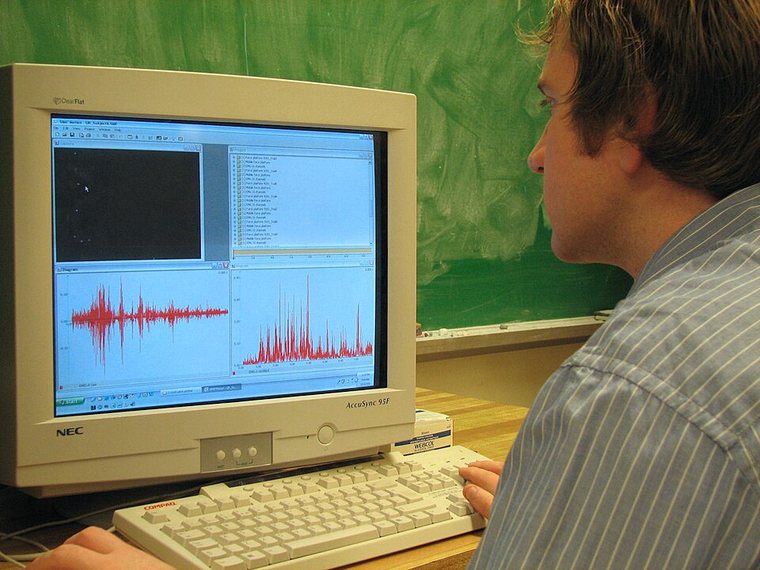
The pulses of many fibres add up and spread through the tissue to the skin, where electrodes can pick them up. They are tiny: Figure 1 of the paper below uses scale bars of 10 and 400 microvolts (millionths of a volt). The spike that one motor unit makes is called a motor-unit action potential. It is not a brain signal: the wristband listens to the muscles, at the end of the chain.
The research behind the band
Meta's Reality Labs published the science behind the band in Nature in 2025. The paper describes a research wristband and the models that decode it, tested on people who had never used it before.
The excerpts from this paper come from the open-access article, which is licensed CC BY-NC-ND 4.0.
The wristband itself is a careful piece of engineering. It must pick up signals of a few microvolts through dry skin, with no gel, while you move.
The paper's Figure 1 shows the whole setup. You see a participant with the band, the prompts on screen and the electrodes around a slice of the wrist. You also see raw signals from all the channels during gestures.
From signals to a gesture
A network reads the 16 channels as a stream over time. For discrete gestures, the paper uses a 1D convolution layer, three LSTM layers and a classifier. For handwriting it uses frequency-power features and a conformer, a model that mixes attention with convolution.
The models are honest about the cost of a band versus a hand-held device. The paper compares each task with a baseline:
The product goes further than the paper. Meta says the Neural Band's models were trained on data from nearly 200,000 consenting research participants. In January 2026, Meta began an early-access test of "neural handwriting" for WhatsApp and Messenger, limited at first to the United States and to English. The paper's research device recorded at 2 kHz with a battery life of more than 4 hours; Meta says the product band lasts up to 18 hours.
Step 7: the whole system
What is inside the frame
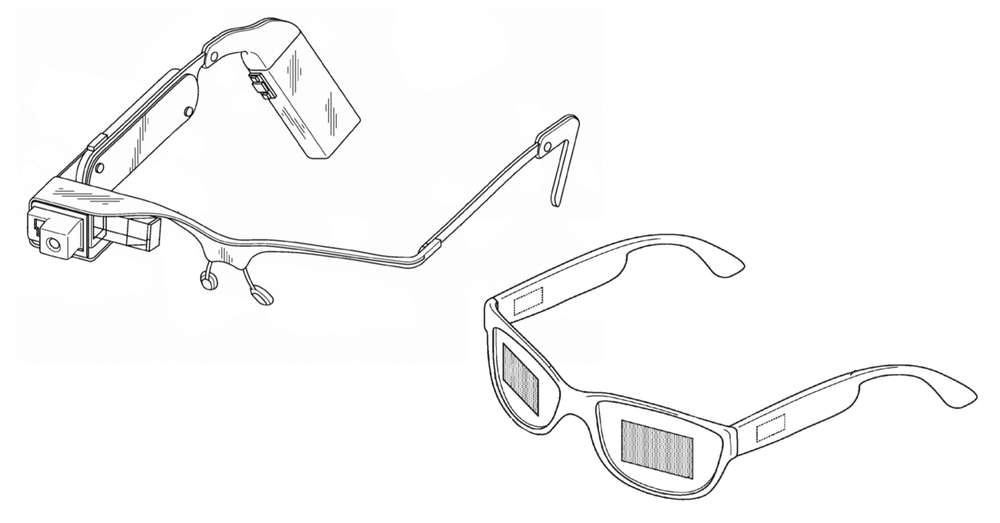
Now step back and see the glasses as one machine. iFixit's teardown found the parts. The left arm holds the battery, the open-ear speakers and microphones. The right arm holds a Qualcomm Snapdragon AR1 chip with 2 GB of memory and 32 GB of storage, next to the projector. Road to VR lists a 12-megapixel camera and five microphones in total.
The glasses connect without wires to your phone and its Meta AI app, and through the phone to the internet. Meta says the display shows Meta AI answers with pictures, and messages from WhatsApp, Messenger and Instagram. It also shows live video calls and a camera viewfinder with zoom. In supported cities it gives walking directions with a map, and it shows live captions, translation and music controls.
The power budget
The battery is small. iFixit reports a 960 milliwatt-hour battery, glued into the left arm. Meta says the glasses last up to six hours of mixed use. Divide the two:
is the average power, the stored energy, and the run time. The glasses average about 160 milliwatts over a day of mixed use, much of it with the display off. At a steady 1 watt, the same battery would last about an hour. (The two numbers come from different sources, so this is an estimate.)
That budget explains many design choices we met. A display that sends only 0.21% of its light to your pupil must be efficient everywhere else. A geometric waveguide that Guttag calls 3 to 7 times more efficient than a diffractive one saves battery directly. Field-sequential LCoS needs only three small LEDs. A monocular display needs one projector, not two. And because everything sits on your face, every milliwatt also becomes heat near your skin.
The weight
Meta says the glasses weigh 69 grams. Every part competes for that budget: battery, chip, projector, waveguide, speakers, frame and lenses. A heavier frame is tiring on the nose, and a larger battery means a thicker arm. Most trade-offs in this piece are one trade-off seen from different angles. The goal is a picture that is good enough, in glasses that people will wear all day.
Step 8: limits, and what comes next
What the glasses do not do
The picture is a small, fixed window. It is not augmented reality in the full sense: graphics do not stick to objects in the room, and there is no depth. UploadVR put it plainly at launch: "not AR". The colours can break up when your eyes move fast, because of field-sequential colour. The picture is sharp by the spec sheet, softer by Guttag's estimate.
The prescription range of -4 to +4 dioptres leaves out people with stronger prescriptions. And the glasses are only as useful as the apps that draw on the display.
What changed in 2026
At CES in January 2026, Meta announced a teleprompter feature and early access to neural handwriting. It also paused its planned international launch because of limited stock.
In September 2026, at Connect, Meta added online ordering in the United States. It opened sales in Canada and the UK, with France, Italy and Germany from 13 October 2026. Road to VR reports prices from £749, CA$1,149 and €899. Meta also announced cycling and transit directions, a photorealistic "hologram" of your face for video calls, and an Explore app. No new display hardware was announced.
Wider fields of view, in the lab
Two lines of work point to bigger pictures. Meta's Orion glasses, shown in 2024, are a prototype, not a product. They use silicon carbide waveguides, microLED projectors and a field of view of about 70 degrees, according to Meta and Road to VR.
At CES 2026, Lumus showed ZOE, made from standard optical glass. Lumus calls it the first geometric waveguide with a field of view over 70 degrees. It also showed an updated 30-degree module, the Z-30. These are waveguide demonstrations by a supplier, not products you can buy, and no one has announced which glasses will use them.
The path forward is visible in the physics. Wider pictures need materials with a higher refractive index, so more angles stay trapped. They need more pixels, so microdisplays with smaller pixels. They need more light, so more efficient waveguides and emitters. True AR, with graphics fixed in the room, needs two displays that agree with each other. It also needs cameras that track the world, all inside about the same weight.
References
- Meta (2025). Meta Ray-Ban Display: Breakthrough AI Glasses Available Now (42 ppd, 2% leakage, 69 g, geometric waveguide).
- Meta Newsroom (2025). Meta Ray-Ban Display and Meta Neural Band (price, launch, battery, features).
- Road to VR (2025). Meta Ray-Ban Display specs (resolution, brightness range, refresh, camera, microphones).
- UploadVR (2025). Meta Ray-Ban Display officially announced and prescription support.
- iFixit (2025). Teardown: groundbreaking waveguide tech inside Meta's $800 AR glasses.
- Karl Guttag (2025). Meta Ray-Ban Display Part 1: Lumus waveguide, OmniVision LCOS, and Goertek projection engine.
- OmniVision (2023). OP03011 LCOS product brief.
- Lumus (2026). Next-generation waveguides at CES 2026.
- Patents: US 6,829,095 B2 (Amitai, Lumus, 2004) and US 10,551,544 B2 (Danziger and Sharlin, Lumus, 2020).
- Meta (2025). Silicon carbide waveguides and the path to Orion's large field of view; Road to VR (2024), Orion prototype.
- Kaifosh, Reardon et al. (2025). A generic non-invasive neuromotor interface for human-computer interaction, Nature 645, 702 to 711. Open access, CC BY-NC-ND 4.0.
- Meta. How to use Meta Neural Band (gestures).
- Meta (2026). CES 2026: teleprompter and neural handwriting; Meta Newsroom (2026), new features at Connect 2026; Road to VR (2026), international launch.
- Background values from Wikipedia: orders of magnitude of luminance, total internal reflection, sunglass filter categories, pupil size, near point, visual acuity.
- Our code:
code/writings/rayban-display/(numbers.pyand its saved output, figures, screenshots).