What SAM must learn: a valid mask for any prompt. We read §2 and Figure 3 of the paper, and we test ambiguous clicks, extra points, boxes and the paper's training game on the cat photo.
Segment Anything. Alexander Kirillov, Eric Mintun, Nikhila Ravi, Hanzi Mao, Chloe Rolland, Laura Gustafson, Tete Xiao, Spencer Whitehead, Alexander C. Berg, Wan-Yen Lo, Piotr Dollár, Ross Girshick. ICCV 2023, 2023. arXiv:2304.02643
GPT-3 learned one task: predict the next word. That one task let it do many others, and the paper's §2 looks for a task with the same power for masks.
Five kinds of prompt for the same object. A point says "here". A negative point says "not here". A box says "inside this frame". A rough mask gives the approximate shape. Text gives a name.
The released SAM accepts points, boxes and masks. Text was a separate experiment in §7.5 of the paper, and the released weights do not include a text encoder. In the Hugging Face version of SAM, each kind of prompt has its own input. Our script sam_part2.py uses all of them:
python
emb = sam.get_image_embeddings(proc(images=image, return_tensors='pt')['pixel_values']) # once per picture# points: (x, y) in pixels of the photo; label 1 = foreground, 0 = backgroundp = proc(images=image, input_points=[[[[180, 305], [100, 200]]]], input_labels=[[[1, 0]]], return_tensors='pt')# a box: (x0, y0, x1, y1)p = proc(images=image, input_boxes=[[[140, 285, 220, 345]]], return_tensors='pt')# a mask: the 256 x 256 logits of an earlier answerout = sam(image_embeddings=emb, input_points=..., input_labels=..., input_masks=prev_logits.reshape(1, 1, 256, 256), multimask_output=True) # True: 3 masks and 3 scores; False: 1 mask and 1 score
The paper gives the rule in words. We can write it as a formula. Think of a prompt as a finger on the photo, and list all the things that the finger can mean. A mask is valid if it matches at least one item of that list well.
M is valid for P⟺O∈O(P)maxIoU(M,O)≥τ
Read it from left to right:
M is the mask that the model gives, and P is the prompt.
⟺ means "exactly when".
O(P) is the set of objects that the prompt can mean. For a finger on a shirt, O(P)={shirt,person}.
maxO∈O(P)IoU(M,O) computes the IoU of the mask with each possible object (Part 1 explains IoU), and keeps the largest value.
τ (the Greek letter tau) is a threshold: the lowest IoU that we accept as "a reasonable mask". The paper gives no number. We use τ=0.5 here.
A small example. A mask with IoU 0.20 with the shirt and 0.90 with the person is valid, because the maximum, 0.90, is more than 0.5. It is a good mask of the person. A mask of half the shirt and part of the wall has 0.30 and 0.10. Its maximum is 0.30, so it is not valid.
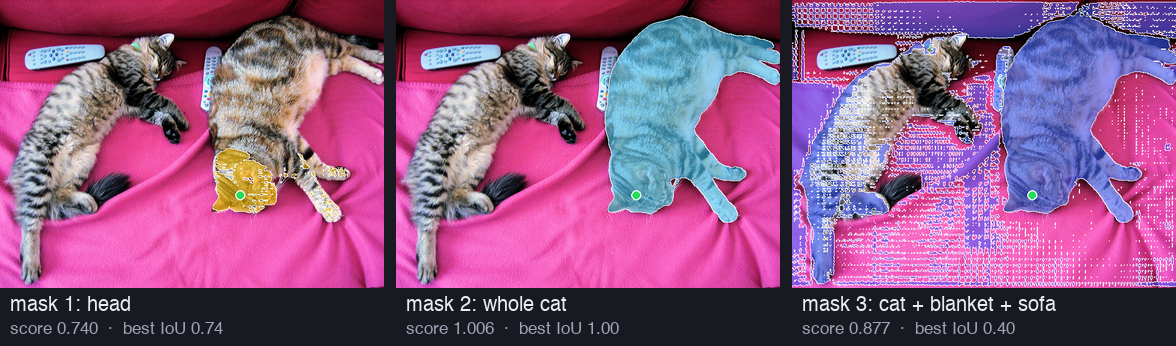
Now a real click. We clicked once on the head of the right cat, at pixel (400, 325). The click can mean the head or the whole cat. As the reference for the head, we took SAM's best mask for a box around the head. For the cat, we took the Part 1 mask from a box around the whole cat:
plain text
reference "head": box [350, 262, 475, 362], the best of its 3 masks, 8,633 pixels (predicted IoU 0.904)reference "cat": Part 1 box mask of the right cat, 58,209 pixelsclick at (400, 325): mask 1: 8,803 pixels, predicted IoU 0.740 IoU with head 0.739, with cat 0.151 -> best 0.739 (head) mask 2: 58,124 pixels, predicted IoU 1.006 IoU with head 0.149, with cat 0.996 -> best 0.996 (cat) mask 3: 144,150 pixels, predicted IoU 0.877 IoU with head 0.060, with cat 0.401 -> best 0.401 (cat) mask 3 covers 46.9% of the picture; 99.6% of the cat is inside it, and 86,200 of its pixels are not the cat
One click on the right cat's head. Mask 1 is the head and mask 2 is the whole cat: both are valid. Mask 3 covers the cat and also 86,200 pixels of blanket and sofa, so it matches no sensible meaning of the click.
Apply the formula with τ=0.5:
mask 1:mask 2:mask 3:max(0.739,0.151)=0.739≥0.5max(0.149,0.996)=0.996≥0.5max(0.060,0.401)=0.401<0.5valid (the head)valid (the cat)not valid
Mask 3 contains almost all of the cat, but IoU punishes its 86,200 extra pixels. So "valid" asks for one good mask among the answers, not for three. SAM ranks mask 2 first, so an application that keeps the top mask gets a valid answer here. Its score, 1.006, is a little above 1, because the score is only an estimate of the IoU.
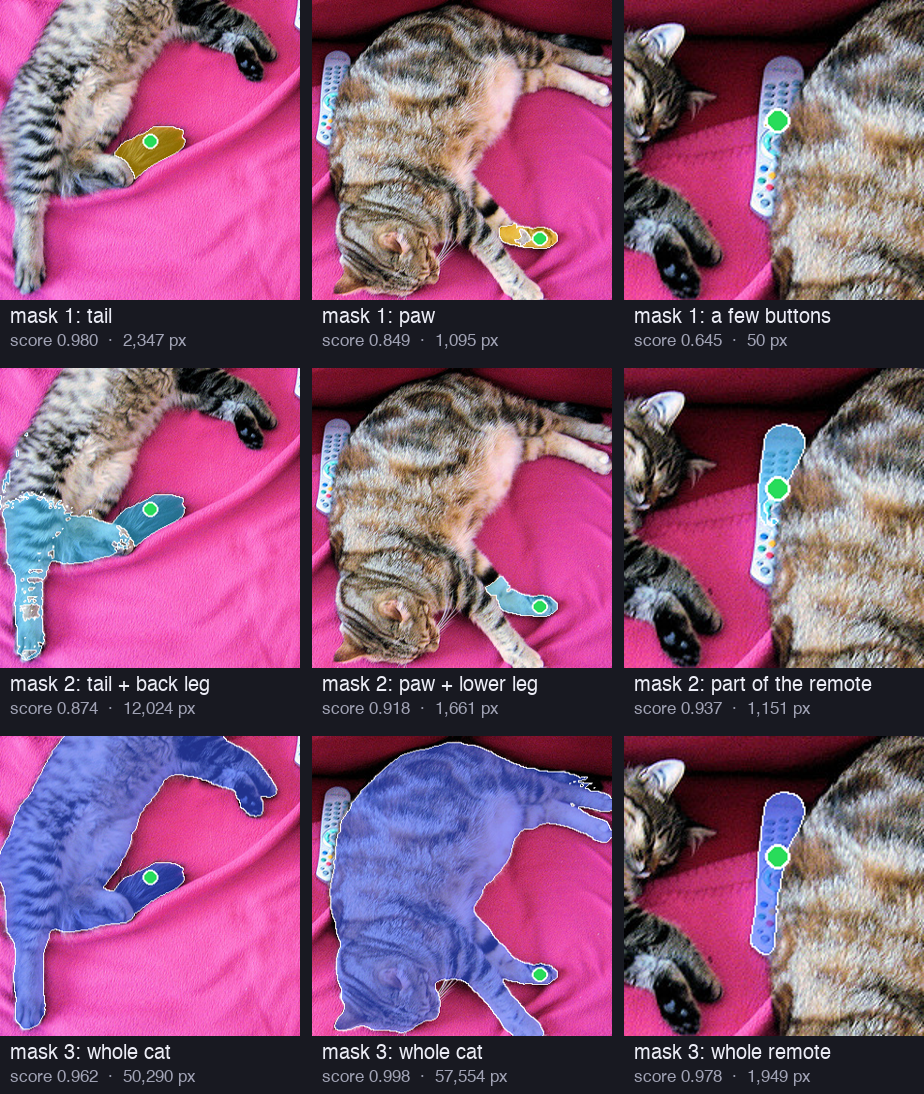
We did the same on our photo with three new clicks. They are on the dark tail of the left cat, a back paw of the right cat and the right remote control. This is the log of the tail click:
plain text
click at (180, 305) on the dark tail of the left cat:
  mask 1 (tail              )   2,347 pixels =  0.76%   predicted IoU 0.980
  mask 2 (tail + back leg   )  12,024 pixels =  3.91%   predicted IoU 0.874
  mask 3 (whole cat         )  50,290 pixels = 16.37%   predicted IoU 0.962
  nested: 99.7% of mask 1 is inside mask 2, 99.4% of mask 2 is inside mask 3
  IoU between the masks: 1-2: 0.194, 1-3: 0.045, 2-3: 0.237
Our version of Figure 3. Each column is one click (green dot), and each row is one of SAM's three masks. The masks grow from subpart to part to whole, and each one sits inside the next.
The numbers show the structure of Figure 3. More than 99% of each mask lies inside the next one, and the size grows 5.1 times and then 4.2 times. The IoU between mask 1 and mask 3 is only 0.045, so these are really different answers.
The tail click as three nested regions. The area of each circle is in proportion to the number of pixels: 2,347 for the tail, 12,024 for the tail and back leg, 50,290 for the whole cat.
The ranking changes from click to click. On the tail, SAM puts the tail first (0.980). On the paw, it puts the whole cat first (0.998). So SAM has learned which level people usually mean for each kind of click.
§2 only asks for a valid mask. Why does SAM give three? One paragraph of §3 answers, and it explains why Figure 3 exists.
The averaging shows clearly in the numbers of one pixel. Take a pixel on the cat's back: it is part of the cat, but not part of the tail. A fraction q of the people want the whole cat, so for them the correct answer at this pixel is 1. For the other people it is 0. A single output gives the pixel a probability p. Its average penalty is the pixel loss of the Background page, weighted by how often each answer occurs:
L(p)=q⋅(−lnp)+(1−q)⋅(−ln(1−p))
Read it from left to right:
q⋅(−lnp) is the penalty when the person wants the cat (correct answer 1), times how often that happens.
(1−q)⋅(−ln(1−p)) is the penalty when the person wants only the tail (correct answer 0), times how often that happens.
ln is the natural logarithm. −ln of a number near 1 is near 0, and −ln of a small number is large.
With q=0.5, a confident "yes" (p=0.99) costs 0.5×0.010+0.5×4.605=2.308. A confident "no" (p=0.01) costs the same 2.308. A shrug (p=0.5) costs only 0.693. With q=0.8, the best value is p=0.8 with a loss of 0.500. In general, the smallest loss is always at p=q. The output learns the average answer.
The loss of one pixel for a single output. When half of the people want the cat (q = 0.5), the best probability is 0.5, exactly on the threshold. When 80% want the cat, the best probability is 0.8. One output learns the average of the answers.
The released SAM has a fourth output for one mask (multimask_output=False). Training used it only for prompts with more than one point or box, so one click is new to it. We tried it anyway. We counted the pixels of its 256 × 256 output with a probability between 0.25 and 0.75: the pixels where the model hedges.
plain text
tail 1 mask: 2,369 pixels, predicted IoU 0.999; IoU with masks 1/2/3: 0.991 / 0.195 / 0.045; low-res pixels with probability 0.25-0.75: 11 of 65,536paw 1 mask: 1,851 pixels, predicted IoU 0.658; IoU with masks 1/2/3: 0.589 / 0.895 / 0.032; low-res pixels with probability 0.25-0.75: 2,746 of 65,536paw 3 masks: low-res pixels with probability 0.25-0.75: 31 / 55 / 325
For the tail, the single output picks one level and is confident. For the paw, it hedges: 2,746 unsure pixels, against 325 or fewer in each normal mask, and a score of only 0.658. That is the blurred student. In §7.1, people gave a SAM trained with one output clearly lower ratings (Part 5).
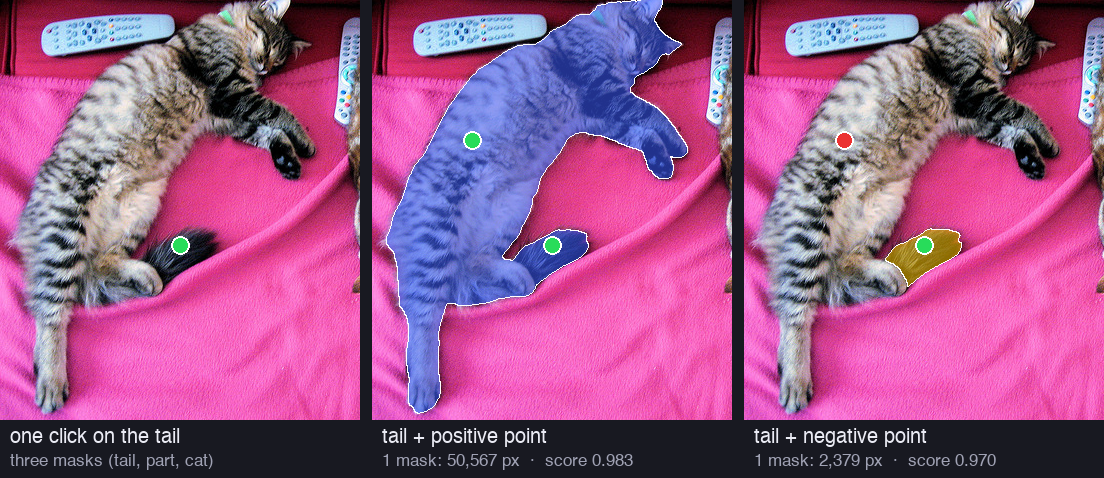
Ambiguity is a property of the prompt, not of the model. Add information, and the ambiguity goes away. We gave the tail click a second point on the body of the left cat. We tried it once as a foreground point and once as a background point:
The same tail click with a second point on the body. A foreground point (green) says "the body is part of it", and SAM gives the whole cat. A background point (red) says "the body is not part of it", and SAM gives only the tail.
The second point picks the level: the whole cat (IoU 0.991 with mask 3 of the first click) or the tail (0.987 with mask 1).
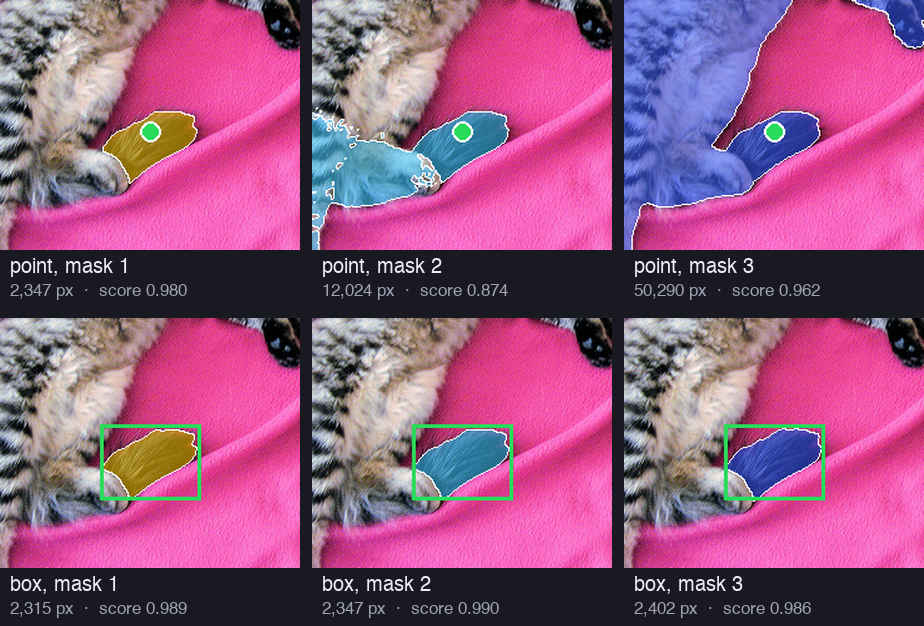
A box also removes most of the ambiguity, because it tells the size of the object. We drew a box around the tail only:
Top: a point gives three levels, from 2,347 to 50,290 pixels. Bottom: a box around the tail gives three almost identical tail masks. The largest of them is only 1.04 times the smallest.
With a point, the largest mask is 21.4 times the smallest. With a box, it is 1.04 times, and the three masks overlap with an IoU of 0.96 to 0.99. The box already answered the question "how large?". This is why SAM gives one mask for prompts with more than one element.
Now the first of the two jobs: how does this task train a model?
Part 1 defined the ground truth: the correct mask of a training example. Appendix A of the paper gives the exact rules of the game.
The box noise in symbols, for the left edge x0 of a box of width w:
x~0=x0+ε,ε∼N(0,(0.1w)2),∣ε∣≤20 pixels
Read it from left to right:
x~0 (say "x-nought tilde") is the noisy left edge, and x0 is the true left edge.
ε (epsilon) is the random shift. ∼N(0,σ2) means "is drawn from a normal distribution with centre 0 and standard deviation σ". Here σ=0.1w.
∣ε∣≤20 is the limit. The same rule applies to the other three edges, with the height for y0 and y1.
A small example: a box 100 pixels wide gets σ=10. Its left edge usually moves by up to 10 pixels, and rarely by up to 20. Our right cat has a tight box of 291 × 343 pixels, so σ=29.1 for the x edges and 34.3 for the y edges. Here the 20-pixel limit cuts the larger shifts. (The paper's sentence can also mean a limit on σ itself. Our script limits each shift.) We test these boxes in the zero-shot section below.
How likely is the next point to be a foreground point? The point is a random pixel of the error region, so the answer is the share of missed pixels in that region:
E=missed(Y∖M)∪extra(M∖Y),Pr(next point is foreground)=∣E∣∣Y∖M∣
Read it from left to right:
Y is the ground truth mask and M is the model's mask.
Y∖M (say "Y without M") is the set of pixels in the truth but not in the mask: the false negatives. M∖Y is the false positives.
∪ joins the two sets into the error region E, and ∣…∣ counts pixels, as in Part 1.
A small example: the mask missed 30 pixels and added 10 extra pixels. Then ∣E∣=40, and the next point is a foreground point with probability 30/40=0.75. Large errors attract more points, because they hold more pixels.
The training game for one mask. The first prompt goes to SAM. The mask is compared with the ground truth. A point from the error region, plus the last mask logits, makes the next prompt. Only the light decoder runs again in each round.
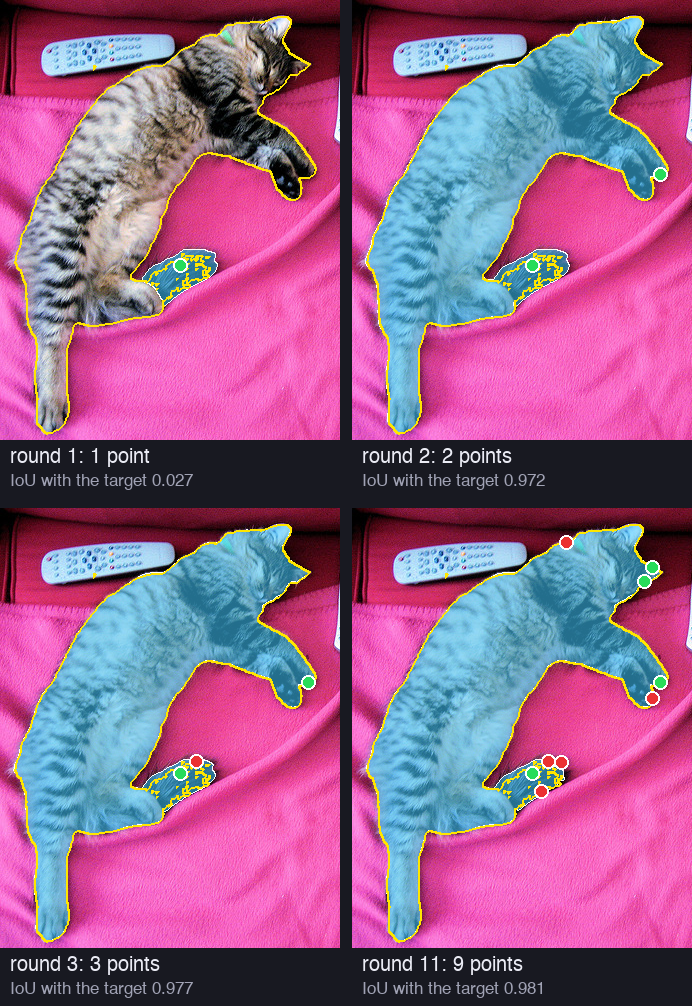
We cannot train SAM again, but we can play the same game with the trained model and watch the IoU after each round. We have no hand-drawn mask for our photo, so the target was the whole left cat from Part 1 (49,520 pixels). The first point was the tail click, and all later points came from the error region.
plain text
target: the whole left cat (Part 1, ear click, mask 3), 49,520 pixels; its tight box [14, 56, 314, 472]
  round  1: first prompt: point (180, 305)                                                   ->   2,347 px, IoU 0.027 (score 0.980)
  round  2: + point (308, 214); error region 48,170 missed + 997 extra, P(+) = 0.980         ->  50,826 px, IoU 0.972 (score 0.998)
  round  3: - point (196, 293); error region 65 missed + 1,371 extra, P(+) = 0.045           ->  50,341 px, IoU 0.977 (score 0.996)
  round  4: - point (209, 294); error region 160 missed + 981 extra, P(+) = 0.140            ->  50,216 px, IoU 0.979 (score 0.993)
  ...
  round  8: no new point, only the previous mask                                             ->  50,318 px, IoU 0.978 (score 0.997)
  ...
  round 11: no new point, only the previous mask                                             ->  50,052 px, IoU 0.981 (score 0.993)
Rounds 1, 2, 3 and 11 of the game. The yellow line is the target, the whole left cat. Green dots are foreground points and red dots are background points. One foreground point in round 2 changes the tail into the whole cat.
Use the formula on round 2. After round 1, the mask is the tail: it missed 48,170 pixels of the cat and added 997 extra pixels. So ∣E∣=49,167, and the next point is a foreground point with probability 48,170/49,167=0.980. It was: a point on the front paw. In round 3, almost all of the error is extra pixels. The probability falls to 0.045, and the game sent a background point.
After round 2, the IoU stays near 0.98. The error that remains is a thin band of about 1,100 pixels along the edge of the fur. A point in that band adds little. The paper saw the same effect: "diminishing returns after 8 iteratively sampled points".
We also played 20 games with random first prompts, as the paper does: 7 started with a point and 13 with a noisy box. We played each game twice, with and without the mask prompt.
The IoU with the target after each round. The run from the tail click jumps from 0.027 to 0.972 in round 2. The mean of 20 games ends at 0.979 with the mask prompt and at 0.967 without it.
A random first prompt on the whole cat is rarely ambiguous, so the mean starts high, at 0.974. The mask prompt keeps the answer steady. Without it, each new point on the fuzzy edge can push the mask the wrong way. The mean then ends at 0.967 instead of 0.979. Our target came from SAM itself, so this game cannot show how close SAM gets to a human mask. Part 5 does that.
Our game shows both views. As an interactive tool, SAM was poor in round 1 (IoU 0.027) and good from round 2 (0.972). As a promptable model, SAM was right in every round. The tail was a valid answer to a click on the tail, and SAM was sure of it (0.980).
Now the second job of the task: use the model for new jobs.
A detector's box is never perfect. This is where the noisy boxes of the training game pay off. We took the tight box of the right cat and shook it 30 times with the training noise, and 30 times each with larger noise. We compared each answer with the mask of the tight box:
plain text
tight box of the Part 1 cat mask: [348, 26, 639, 369] (width 291, height 343); its mask: 58,087 px, score 0.991, IoU with the Part 1 mask 0.998
  noise sd 10% of the side, at most 20 px (training)    mean corner shift  15.6 px: mean IoU 0.995, worst 0.970, 30/30 above 0.9
  noise sd 10% of the side, no limit                    mean corner shift  25.2 px: mean IoU 0.889, worst 0.000, 22/30 above 0.9
  noise sd 20% of the side, no limit                    mean corner shift  50.3 px: mean IoU 0.514, worst 0.000, 8/30 above 0.9
  noise sd 40% of the side, no limit                    mean corner shift 100.7 px: mean IoU 0.225, worst 0.000, 3/30 above 0.9
Noisy boxes around the right cat. With the noise of training, the masks hardly change (mean IoU 0.995). With larger noise, the boxes cut off parts of the cat or become very loose, and the mean IoU falls to 0.889, 0.514 and 0.225.
With the training noise, the corners moved 15.6 pixels on average, and all 30 masks stayed above IoU 0.9 (mean 0.995). SAM ignores a small error in the box, and a detector box needs exactly that. With larger noise, the boxes cut off the head or the legs, or become much too loose. Then the box no longer says "this cat".
The worst box without the limit, (377, 5, 692, 324), cuts off the cat's head. Its mask has no pixel of the cat (IoU 0.000), and SAM's score is low, 0.474. But a loose box with 20% noise gave a wrong 2,035-pixel mask with a score of 0.824. The training made SAM robust to the errors that it saw, not to all errors.
The table gives each task in one line, and the prompt that can turn it into a job for SAM. Part 1 defined semantic and instance segmentation.
Task
What it gives
How SAM can do it
Interactive segmentation
a mask from a person's clicks
the clicks are the prompts
Edge detection
the lines where objects meet
a grid of points, then the edges of all the masks (§7.2)
Superpixelization
small groups of similar neighbour pixels
not a goal of the paper
Object proposal generation
about 1,000 masks of things that may be objects
a dense grid of points (§7.3)
Foreground segmentation
the main object against the background
a point or box on the main object
Semantic segmentation
a class name for each pixel
not alone: SAM gives no class names
Instance segmentation
a mask and a class for each object
detector boxes as prompts (§7.4)
Panoptic segmentation
semantic and instance segmentation together
not alone: it needs class names
Left: a multi-task model learns three fixed tasks and is tested on the same three. Right: SAM learns one task, and each new task comes from the part that makes its prompts: a detector, a grid of points or a person.
Two examples of composition. CLIP is one block in the DALL·E image generator: it ranks the candidate pictures. SAM is one block in a cat instance segmenter: a cat detector gives the boxes, and SAM gives one mask for each box.
Next, in Part 3: §3 of the paper, the model. Part 3 opens the image encoder, the prompt encoder and the mask decoder, and explains the training loss with the minimum over the three masks.
Run it yourself
The script code/papers/sam/sam_part2.py runs SAM ViT-H on the cat photo. It makes the three masks of each click, checks which masks are valid, and tries one output, a second point and a box. It plays the training game of Appendix A and tests noisy boxes. Every number goes to results/part2.json.
bash
pip install torch transformers datasets pillowpython sam_part1.py # Part 2 uses two masks that Part 1 savespython sam_part2.py # downloads facebook/sam-vit-huge (2.6 GB) if it is not cached
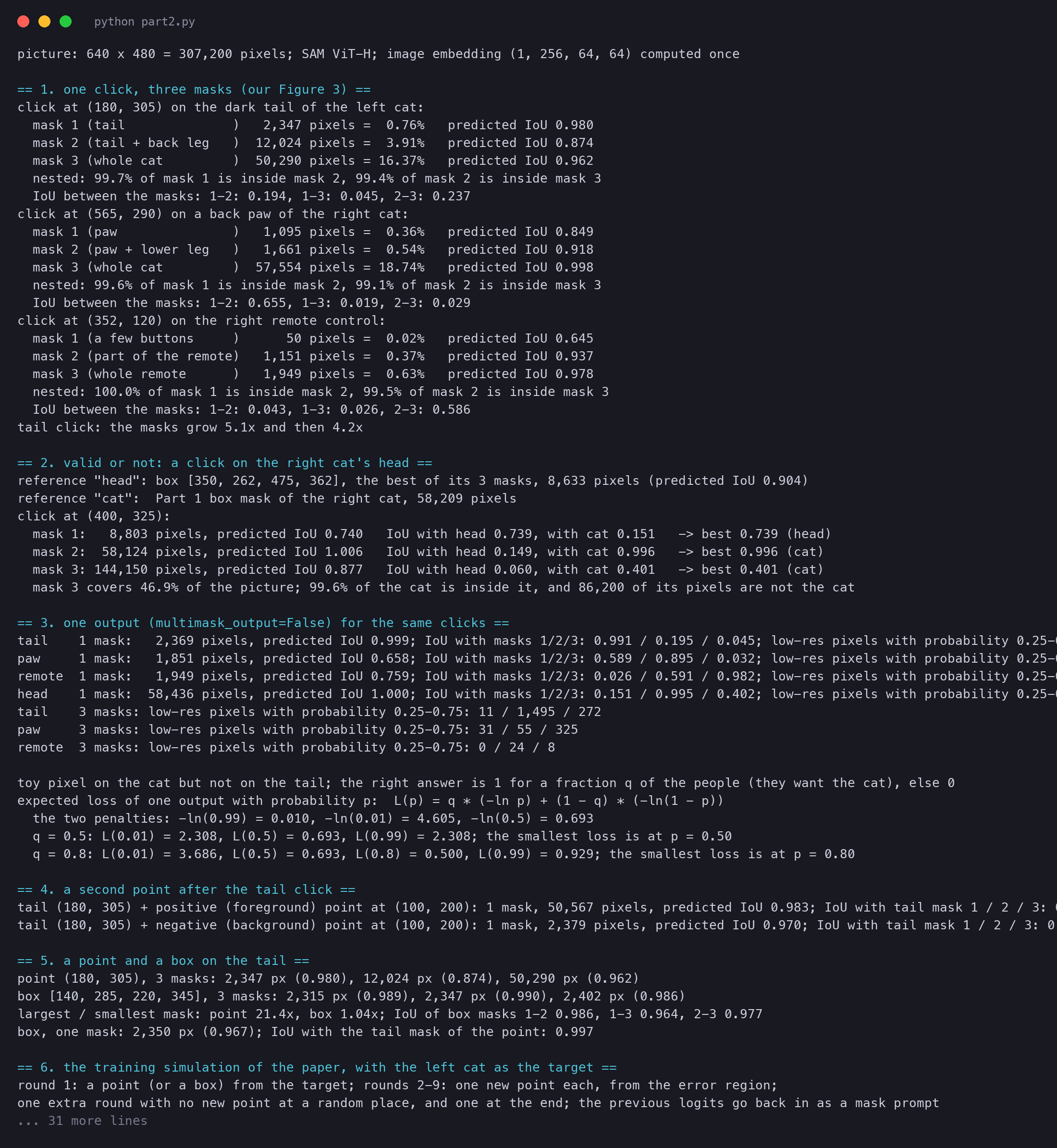
The first 60 lines of the output of sam_part2.py, as it ran for this article.