# Induction Heads

Author: Ishwar Jangid
Canonical URL: https://ishwarj.com/papers/transformer-circuits/part-6-induction-heads/
Updated: 2026-10-17
Source: https://github.com/ishwar6/ishwar-books/blob/main/content/papers/transformer-circuits/part-6-induction-heads.md


Read "Mrs Brindlewick" once, and you can finish "Mrs Br..." the next time it appears. A two-layer transformer learns to do the same with two attention heads that work as a team. This part takes that team apart, in the paper's order and on a real model.

The paper calls the second head of the team an **induction head**. It is the best-known result of the paper, and later work found the same kind of head in large models. We use the open two-layer model `attn-only-2l` from the earlier parts. Each piece below shows the exact lines of the paper, then explains them.

> [!DEFINITION] In-context learning
> A model does **in-context learning** when it uses earlier parts of the present text to make a better prediction, with no change to its weights. If a made-up name appears once, and the model then predicts the rest of the name the second time, that is in-context learning. The "context" is the text the model can see.

## The model we study

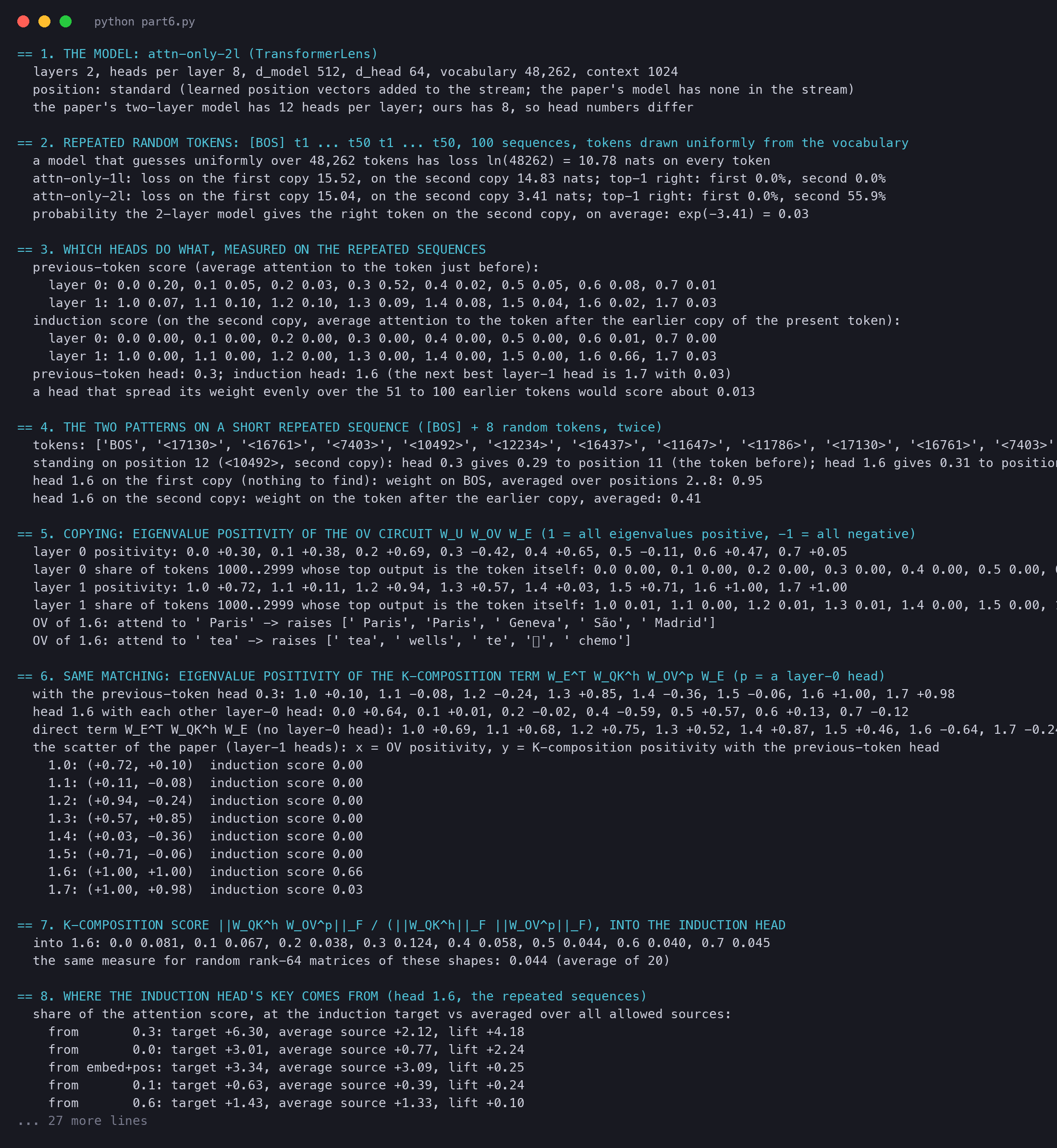
The paper's two-layer model has 12 heads per layer and no position vectors in the stream. We cannot get those weights. Our model is the open `attn-only-2l`: two attention layers, eight heads per layer, and no MLP layers. It has one difference that matters later: it adds a learned **position vector** to the stream of each token.

```text
== 1. THE MODEL: attn-only-2l (TransformerLens)
  layers 2, heads per layer 8, d_model 512, d_head 64, vocabulary 48,262, context 1024
  position: standard (learned position vectors added to the stream; the paper's model has none in the stream)
  the paper's two-layer model has 12 heads per layer; ours has 8, so head numbers differ
```

We name heads as in Part 2: head **0.3** is head 3 of layer 0, and head **1.6** is head 6 of layer 1. Head numbers in our model have no link to the numbers in the paper's model.

## A narrow mystery {§Analyzing a Two-Layer Model}

[Part 5](https://ishwarj.com/papers/transformer-circuits/part-5-two-layer-models/) showed three ways in which a layer-1 head can read what a layer-0 head wrote. The paper now looks at one real two-layer model and asks which of those ways it uses.

> [!PAPER] · Analyzing a Two-Layer Model
> [![The paragraphs that open the analysis: without composition a two-layer model is a one-layer model with extra heads; small models often use only K-composition between one first-layer head and some second-layer heads; that first-layer head attends to the previous token, and the second-layer heads are induction heads](https://ishwarj.com/img/papers/circuits/p6-analyzing.pngts/p6-analyzing.png)](/img/papers/circuits/p6-analyzing.png)
>
> **What it says:** "Without composition, the model is just a one-layer model with extra heads." In small two-layer models, often "the only type of composition is K-composition between a single first layer head and some of the second layer heads." That first-layer head "primarily attends to the previous token". The second-layer heads "are what we call induction heads".
>
> **What it means:**
>
> A second layer is only useful if it builds on the first one. If the layer-1 heads ignore what the layer-0 heads wrote, then each of them reads only token embeddings. The model is then sixteen independent heads, which is a one-layer model with more heads.
>
> The paper reports that its model uses almost none of the possible connections. One layer-0 head feeds the **keys** of a few layer-1 heads, and that is all. That is K-composition, the second of the three kinds from Part 5.
>
> So the mystery is small. Most of the model is skip-trigrams, which [Part 4](https://ishwarj.com/papers/transformer-circuits/part-4-one-layer-models/) explained. Only one connection is new, and the rest of this part explains what it does.

> [!DEFINITION] Skip-trigram
> A rule of the form "A ... B → C": when the present token is B and an earlier token is A, raise C. A single head of a one-layer model is a large table of such rules, read from its QK and OV circuits. Part 4 reads them in detail.

> [!DEFINITION] Previous-token head
> An attention head that, at each position, puts most of its weight on the position just before. Its job is to copy information about the previous token into the present token's stream. After it runs, each position "knows" which token came before it.

The paper shows the connections as a diagram. Each dot is a head, and a line joins two heads when a layer-1 head reads strongly from a layer-0 head.

> [!PAPER] · Analyzing a Two-Layer Model
> [![The paper's composition diagram: three panels for Q-, K- and V-composition, each with a row of layer-1 heads above a row of layer-0 heads; only the K-composition panel has strong lines, from one red layer-0 head (the previous-token head) to a few teal layer-1 heads (induction heads)](https://ishwarj.com/img/papers/circuits/p6-composition-fig.pngcomposition-fig.png)](/img/papers/circuits/p6-composition-fig.png)
>
> **What it says:** the diagram shows Q-, K- and V-composition between the 12 heads of each layer. Only the K-composition panel has strong lines. They all start at one red layer-0 head, the previous-token head, and end at teal layer-1 heads, the induction heads.
>
> **What it means:**
>
> Think of a company chart where most lines are missing. Sixteen people work alone, and only one person reports to a few others. That one line is where the interesting work happens.
>
> A thick line means that the layer-1 head's key reads from the subspace where the layer-0 head writes. Part 5 explains the score behind the line widths. The paper later found a bug in this exact diagram; we come back to it in the correction section.

We measured the same score on our model, from the previous-token head into the head we will call the induction head. Part 5 defines it. Here it is enough to know that random matrices of the same shapes score 0.044:

```text
== 7. K-COMPOSITION SCORE ||W_QK^h W_OV^p||_F / (||W_QK^h||_F ||W_OV^p||_F), INTO THE INDUCTION HEAD
  into 1.6: 0.0 0.081, 0.1 0.067, 0.2 0.038, 0.3 0.124, 0.4 0.058, 0.5 0.044, 0.6 0.040, 0.7 0.045
  the same measure for random rank-64 matrices of these shapes: 0.044 (average of 20)
```

Head 0.3 scores 0.124, almost three times the random level. Head 0.0 is second with 0.081. The other layer-0 heads are near the random level. So our model has the same shape as the paper's: one main layer-0 head feeds the key of head 1.6.

> [!PAPER] · Analyzing a Two-Layer Model
> [![The paragraph observing that most attention heads are not involved in any substantive composition and can be thought of as a larger collection of skip tri-grams](https://ishwarj.com/img/papers/circuits/p6-most-heads.pngs/p6-most-heads.png)](/img/papers/circuits/p6-most-heads.png)
>
> **What it says:** "most attention heads are not involved in any substantive composition." They are "a larger collection of skip tri-grams". The paper guesses that a couple of induction heads "outcompetes" a few skip-trigram heads, and that no other kind of composition did.
>
> **What it means:**
>
> A small model has few heads, so each head must earn its place. Training found that one more skip-trigram head was usually worth more than any composed circuit. The one exception was the induction head.
>
> This tells us something about value. An induction head is so useful that training gives up skip-trigram heads to build it. Later in this part we remove it and measure the cost.

### Looking at the patterns

The paper then invites the reader to look at the attention patterns on the first paragraph of a well-known novel. It shows a special kind of pattern there.

> [!PAPER] · Analyzing a Two-Layer Model
> [![The caption explaining the value-weighted attention pattern: attention weights scaled by the norm of the value vector at the source position; heads often use some tokens as a default or resting position whose value vectors are small](https://ishwarj.com/img/papers/circuits/p6-value-weighted.png-value-weighted.png)](/img/papers/circuits/p6-value-weighted.png)
>
> **What it says:** the diagram shows the **value-weighted attention pattern**: "attention weights scaled by the norm of the value vector at the source position". Heads often use some tokens as "a kind of default or resting position" when nothing matches. The value vectors there are small, so the value-weighted pattern is more informative.
>
> **What it means:**
>
> In Part 2 a head had to spend all its weight, because each row of the pattern adds up to 1. When nothing is worth reading, the weight must go somewhere. Many heads park it on the first token.
>
> A plain pattern then shows a bright column on the first token, and that column hides the real work. If the value vector there is tiny, almost nothing moves. Multiply each weight by the size of its value vector, and the parking spot fades. What is left shows "how big a vector is moved from each position".

> [!DEFINITION] Value-weighted attention pattern
> The attention pattern with each weight $$A_{ij}$$ multiplied by the size $$\lVert v_j\rVert$$ of the value vector at the source. A large entry means that a lot of information really moves from $$j$$ to $$i$$. A head can give a large weight to a source and still move almost nothing, if that source's value vector is small.

## What an induction head does {§Function of Induction Heads}

> [!PAPER] · Induction Heads
> [![The opening of the Induction Heads section: in small two-layer attention-only transformers, composition is primarily used for the creation of induction heads, a much more powerful mechanism for in-context learning than the copying heads of the one-layer model](https://ishwarj.com/img/papers/circuits/p6-intro.pngrcuits/p6-intro.png)](/img/papers/circuits/p6-intro.png)
>
> **What it says:** in small two-layer models, composition is mainly used for "the creation of what we call induction heads". The one-layer model used copying heads as a crude form of in-context learning. Induction heads are "a much more powerful mechanism for achieving in-context learning".
>
> **What it means:**
>
> Part 4 showed the one-layer version. A copying head sees a token earlier in the text and raises the chance that the same token comes again. That helps a little, but it is a guess: it does not know where the token should come.
>
> An induction head knows where. The next box gives its rule, and the rest of this part shows how two layers build it.

> [!PAPER] · Function of Induction Heads
> [![The paragraph describing the function of induction heads: they search over the context for previous examples of the present token; if they don't find it they attend to the first token and do nothing; if they do, they look at the next token and copy it](https://ishwarj.com/img/papers/circuits/p6-function.pngits/p6-function.png)](/img/papers/circuits/p6-function.png)
>
> **What it says:** "Induction heads search over the context for previous examples of the present token." If they find none, "they attend to the first token" and do nothing. If they find one, they look at the next token "and copy it". So they can repeat earlier sequences, "both exactly and approximately".
>
> **What it means:**
>
> Think of reading a story aloud. You reach the word "Mrs" and wonder what comes next. You look back for the last "Mrs", see that "Brindlewick" came after it, and guess "Brindlewick" again.
>
> That is the whole rule, in two steps. Step one: find an earlier copy of the present token. Step two: read the token **after** that copy, and predict it. The first token is the parking spot from the last box. When there is no earlier copy, the head parks there and adds almost nothing.

> [!DEFINITION] Induction head
> An attention head that, standing on a token A, attends to the token that came right after an earlier A, and raises the logit of that token. In short: it completes the pattern [A][B] ... [A] → [B]. The name comes from logical induction: the head assumes that what happened after A before will happen again.

<figure class="fig"><svg viewBox="0 0 800 300" role="img" aria-label="Two steps of an induction head. In layer 0 a previous-token head writes into the position of indle a note that the token before it was Br. In layer 1, the induction head standing on the second Br has the query Br; it matches the note at indle, attends there, and copies indle as the prediction."><defs><marker id="ah" viewBox="0 0 10 10" refX="9" refY="5" markerWidth="7" markerHeight="7" orient="auto-start-reverse"><path class="arrow" d="M0,0L10,5L0,10z"/></marker><marker id="ah-on" viewBox="0 0 10 10" refX="9" refY="5" markerWidth="6" markerHeight="6" orient="auto-start-reverse"><path class="arrow-on" d="M0,0L10,5L0,10z"/></marker><marker id="ah-2" viewBox="0 0 10 10" refX="9" refY="5" markerWidth="6" markerHeight="6" orient="auto-start-reverse"><path class="arrow-2" d="M0,0L10,5L0,10z"/></marker></defs><text class="t-title" x="24.0" y="26.0" text-anchor="start">An induction head on "... Mrs Brindlewick ... Mrs Br" (two steps, two layers)</text><rect class="box" x="40.0" y="150.0" width="78.0" height="30.0" rx="6"/><text class="t-tick" x="79.0" y="169.5" text-anchor="middle">Mrs</text><rect class="box" x="132.0" y="150.0" width="78.0" height="30.0" rx="6"/><text class="t-tick" x="171.0" y="169.5" text-anchor="middle">Br</text><rect class="box-2" x="224.0" y="150.0" width="78.0" height="30.0" rx="6"/><text class="t-tick" x="263.0" y="169.5" text-anchor="middle">indle</text><rect class="box" x="316.0" y="150.0" width="78.0" height="30.0" rx="6"/><text class="t-tick" x="355.0" y="169.5" text-anchor="middle">wick</text><rect class="box-ghost" x="408.0" y="150.0" width="78.0" height="30.0" rx="6"/><text class="t-tick" x="447.0" y="169.5" text-anchor="middle">...</text><rect class="box" x="500.0" y="150.0" width="78.0" height="30.0" rx="6"/><text class="t-tick" x="539.0" y="169.5" text-anchor="middle">Mrs</text><rect class="box-1" x="592.0" y="150.0" width="78.0" height="30.0" rx="6"/><text class="t-tick" x="631.0" y="169.5" text-anchor="middle">Br</text><rect class="box-ghost" x="684.0" y="150.0" width="78.0" height="30.0" rx="6"/><text class="t-tick" x="723.0" y="169.5" text-anchor="middle">?</text><text class="t-note" x="40.0" y="66.0" text-anchor="start">Layer 0, previous-token head: each token gets a note "the token before me was ...".</text><text class="t-s2" x="309.0" y="128.0" text-anchor="start">note: "Br"</text><path class="key-line" d="M171.0,146 C171.0,120 263.0,116 263.0,147" marker-end="url(#ah-2)"/><text class="t-s1" x="631.0" y="134.0" text-anchor="middle">query: "Br"</text><path class="path" d="M631.0,184 C631.0,250 263.0,250 263.0,188" marker-end="url(#ah-on)"/><text class="t-on" x="447.0" y="254.0" text-anchor="middle">Layer 1, induction head: the query "Br" matches the note "Br", so it attends to "indle"</text><text class="t-note" x="447.0" y="276.0" text-anchor="middle">and its OV circuit copies "indle": the prediction for "?" is "indle".</text></svg><figcaption>The two heads of an induction circuit on a made-up name. In layer 0, a previous-token head gives each position a note that says which token came before it; the position of "indle" gets the note "Br". In layer 1, the induction head stands on the second "Br". Its query looks for the note "Br", finds it at "indle", attends there, and copies "indle" as the prediction.</figcaption></figure>

### Why this beats a copying head

> [!PAPER] · Function of Induction Heads
> [![The comparison: a one-layer copying head does [b] … [a] → [b], or [ab] … [a] → [b] when tokenization allows; a two-layer induction head does [a][b] … [a] → [b]; the two-layer algorithm knows how the token was previously used and is less vulnerable to distributional shift](https://ishwarj.com/img/papers/circuits/p6-compare.pnguits/p6-compare.png)](/img/papers/circuits/p6-compare.png)
>
> **What it says:** a one-layer copying head does [b] … [a] → [b]. An induction head does [a][b] … [a] → [b]. The two-layer algorithm "knows how the token was previously used and looks out for similar cases". It is also "less vulnerable to distributional shift", because it does not depend on learned statistics about which tokens follow which.
>
> **What it means:**
>
> Read the one-layer pattern slowly. The head stands on [a], sees [b] somewhere earlier, and raises [b]. It needs the weights to know that [b] can follow [a]. Part 4 called this a skip-trigram, and its bugs came from the same place.
>
> The induction pattern needs no such knowledge. It uses only one fact from the text itself: [b] followed [a] before. It would work for two tokens that never met in training.
>
> That is what "less vulnerable to distributional shift" means. Distributional shift is text unlike the training text, such as new names or random strings. Statistics learned in training say nothing about such text, but the rule "repeat what came before" still works.

Our sentence with a made-up name shows the difference. The tokenizer splits " Brindlewick" into " Br", "indle" and "wick". We gave both models the text "The new teacher was Mrs Brindlewick. On Monday the class met Mrs Brindlewick", and looked at the second copy of the name:

```text
== 10. A MADE-UP NAME IN A SENTENCE
  attn-only-1l: at ' Mrs' (pos 15) the next token ' Br' gets probability 0.01
  attn-only-1l: at ' Br' (pos 16) the next token 'indle' gets probability 0.82
  attn-only-1l: at 'indle' (pos 17) the next token 'wick' gets probability 0.00
  attn-only-2l: at ' Mrs' (pos 15) the next token ' Br' gets probability 0.63; head 1.6 reads '<|BOS|>' (pos 0) with 0.55, adds +4.84 to the logit of ' Br'
  attn-only-2l: at ' Br' (pos 16) the next token 'indle' gets probability 0.93; head 1.6 reads 'indle' (pos 7) with 0.93, adds +11.95 to the logit of 'indle'
  attn-only-2l: at 'indle' (pos 17) the next token 'wick' gets probability 0.98; head 1.6 reads 'wick' (pos 8) with 0.75, adds +13.82 to the logit of 'wick'
```

The two-layer model gets all three pieces: 0.63, 0.93 and 0.98. On "indle", head 1.6 reads the earlier "wick" with weight 0.75 and adds +13.82 to the logit of "wick". That is the rule from the paper, exactly.

The one-layer model gets "indle" right (0.82), which is a skip-trigram at work: "indle" appeared earlier, so a copying head raised it. But it gives "wick" a probability of 0.00. Its copying heads cannot tell which earlier token is the one to repeat.

The first row of the two-layer model is less clean. On " Mrs", head 1.6's largest single weight (0.55) is on the first token, its parking spot. Yet it still adds +4.84 to " Br". Our log does not show where the rest of its weight went, so we only report what it shows.

### The paper's examples

> [!PAPER] · Function of Induction Heads
> [![Two example strips from the paper: on the novel's first paragraph, at the second "D" of "Dursley" the induction head 1:8 attends to "urs" after the first "D" and raises it; at the later "Pot" of "Potters" it attends to "ters" and raises it](https://ishwarj.com/img/papers/circuits/p6-examples-fig.pngp6-examples-fig.png)](/img/papers/circuits/p6-examples-fig.png)
>
> **What it says:** the strips show the raw attention (red) and the logit effect (blue) of induction head 1:8 on the novel's first paragraph. At a later "D" of "Dursley", the head attends to "urs" after an earlier "D" and raises "urs". At "Pot" of "Potters", it attends to "ters" and raises "ters".
>
> **What it means:**
>
> Each row of a strip is one present token, framed in a box. Red marks where the head looks, and blue marks what it pushes up. In the good rows the red and the blue sit on the same token. The head reads the token after the earlier copy, and predicts that token.
>
> The "logit effect" is the head's output read through the unembedding, as in Part 2. It is the same number our log prints as "adds +13.82 to the logit of 'wick'". Note also the rows where the red sits on the first token: there was nothing to repeat, so the head parked.

## The hardest test: random tokens {§Function of Induction Heads}

Text from a novel has a weakness as evidence. A name like "Dursley" is also a common pattern in training text, so other heads may help. The paper removes that help.

> [!PAPER] · Function of Induction Heads
> [![The paragraph proposing the test on totally random repeated patterns: the hardest test one can give induction heads, since they cannot rely on normal statistics; the tokens are uniformly sampled from the vocabulary, which is totally off distribution](https://ishwarj.com/img/papers/circuits/p6-random.pngcuits/p6-random.png)](/img/papers/circuits/p6-random.png)
>
> **What it says:** if induction heads attend to earlier copies and shift forward, "they should be able to do this on" totally random repeated patterns. "This is likely the hardest test one can give them". The tokens are uniformly sampled from the vocabulary, which is "totally off distribution".
>
> **What it means:**
>
> A random string of tokens is nonsense, such as "<21549> <15231> <1396> ...". No statistic from training predicts the next one. So on the first copy, any model must fail.
>
> On the second copy, one thing changes: the string has appeared before. A head that follows the rule "repeat what came after the last copy" should now be right. No other head can be. So the test isolates the induction mechanism.

> [!PAPER] · Function of Induction Heads
> [![The paper's interactive diagram on a random sequence of tokens repeated three times: the attention pattern panel shows off-diagonal stripes, with the previous-token head 0:7 in red and induction heads such as 1:3 and 1:8 in teal](https://ishwarj.com/img/papers/circuits/p6-random-fig.pngs/p6-random-fig.png)](/img/papers/circuits/p6-random-fig.png)
>
> **What it says:** the value-weighted patterns on a random sequence, repeated three times. Head 0:7 is the previous-token head (red), and heads such as 1:8 are induction heads (teal). The pattern shows straight stripes below the diagonal.
>
> **What it means:**
>
> Each stripe is a fixed distance below the diagonal. The string is 20 tokens long, so the token after an earlier copy is always 19 places back. A stripe 19 places below the diagonal means "every token reads the token 19 places back". In the third copy a token can also reach the first copy, 39 places back, which makes a second stripe.
>
> A stripe is the picture of the rule. A head that reads by meaning would make scattered dots. A head that reads by "the token after my last copy" makes a perfect line, because the distance is the same for every token.

### Our run

We built 100 sequences. Each is the first token, then 50 random tokens, then the same 50 tokens again. We measure the **loss** of each model on each copy.

> [!DEFINITION] Loss (in nats)
> For one token, the loss is $$-\ln p$$, where $$p$$ is the probability the model gave to the right next token. A sure and right model ($$p=1$$) has loss 0. Lower is better. The unit is the **nat**, because the logarithm is the natural one.

The loss of one token is

$$
\ell=-\ln p_{\text{right}}
$$

Here $$p_{\text{right}}$$ is the probability the model gave to the token that really came next. Take three small cases by hand. If $$p=0.5$$, the loss is $$\ln 2\approx0.69$$. If $$p=0.05$$, it is about 3.0. A model that guesses evenly over our 48,262 tokens gives each one $$p=1/48{,}262$$, so its loss is $$\ln 48{,}262\approx10.78$$.

```python
logits = model(toks)                                        # toks: [100, 101] = BOS + 50 random + the same 50
loss = -logits.log_softmax(-1)[:, :-1].gather(-1, toks[:, 1:, None])[..., 0]
first, second = loss[:, 1:50].mean(), loss[:, 51:].mean()    # first copy, second copy
```

```text
== 2. REPEATED RANDOM TOKENS: [BOS] t1 ... t50 t1 ... t50, 100 sequences, tokens drawn uniformly from the vocabulary
  a model that guesses uniformly over 48,262 tokens has loss ln(48262) = 10.78 nats on every token
  attn-only-1l: loss on the first copy 15.52, on the second copy 14.83 nats; top-1 right: first 0.0%, second 0.0%
  attn-only-2l: loss on the first copy 15.04, on the second copy 3.41 nats; top-1 right: first 0.0%, second 55.9%
  probability the 2-layer model gives the right token on the second copy, on average: exp(-3.41) = 0.03
```

On the first copy both models do worse than an even guess: about 15 nats against 10.78. They are sure of next tokens that real text would have, and random text punishes that. On the second copy the one-layer model barely moves, from 15.52 to 14.83. The two-layer model drops to 3.41 nats, and its top guess is right 55.9% of the time.

Read 3.41 back as a probability: $$e^{-3.41}\approx0.03$$. That number is an average of logarithms, so it is pulled down by the hard tokens. More than half of the tokens are the top guess, which shows that most predictions are much better than 0.03.

<figure class="fig"><svg viewBox="0 0 800 330" role="img" aria-label="Loss at each position of 50 random tokens repeated twice, averaged over 100 sequences and smoothed over 5 positions. The one-layer model stays near 15 nats on both copies. The two-layer model drops from about 15 to about 3 nats as soon as the second copy starts at position 51."><defs><marker id="ah" viewBox="0 0 10 10" refX="9" refY="5" markerWidth="7" markerHeight="7" orient="auto-start-reverse"><path class="arrow" d="M0,0L10,5L0,10z"/></marker><marker id="ah-on" viewBox="0 0 10 10" refX="9" refY="5" markerWidth="6" markerHeight="6" orient="auto-start-reverse"><path class="arrow-on" d="M0,0L10,5L0,10z"/></marker><marker id="ah-2" viewBox="0 0 10 10" refX="9" refY="5" markerWidth="6" markerHeight="6" orient="auto-start-reverse"><path class="arrow-2" d="M0,0L10,5L0,10z"/></marker></defs><line class="grid" x1="64" y1="280.0" x2="650" y2="280.0"/><text class="t-tick" x="56.0" y="284.0" text-anchor="end">0</text><line class="grid" x1="64" y1="217.5" x2="650" y2="217.5"/><text class="t-tick" x="56.0" y="221.5" text-anchor="end">5</text><line class="grid" x1="64" y1="155.0" x2="650" y2="155.0"/><text class="t-tick" x="56.0" y="159.0" text-anchor="end">10</text><line class="grid" x1="64" y1="92.5" x2="650" y2="92.5"/><text class="t-tick" x="56.0" y="96.5" text-anchor="end">15</text><line class="grid" x1="64" y1="30.0" x2="650" y2="30.0"/><text class="t-tick" x="56.0" y="34.0" text-anchor="end">20</text><text class="t-tick" x="64.0" y="300.0" text-anchor="middle">1</text><text class="t-tick" x="206.1" y="300.0" text-anchor="middle">25</text><text class="t-tick" x="360.0" y="300.0" text-anchor="middle">51</text><text class="t-tick" x="502.0" y="300.0" text-anchor="middle">75</text><text class="t-tick" x="650.0" y="300.0" text-anchor="middle">100</text><line class="axis" x1="64" y1="280" x2="650" y2="280"/><polyline class="l2" points="64.0,97.0 81.8,87.1 99.5,84.9 117.3,84.8 135.0,83.3 152.8,84.5 170.5,85.0 188.3,83.5 206.1,85.2 223.8,86.3 241.6,85.5 259.3,87.0 277.1,87.0 294.8,89.5 312.6,86.9 330.4,87.8 348.1,90.9 365.9,97.2 383.6,98.4 401.4,96.2 419.2,97.3 436.9,95.2 454.7,95.7 472.4,95.2 490.2,91.7 507.9,93.3 525.7,93.2 543.5,94.8 561.2,93.6 579.0,94.7 596.7,94.1 614.5,94.2 632.2,94.2 650.0,95.0"/><g class="mark"><title>one layer, 1: 14.6</title><circle class="s2 ring" cx="64.0" cy="97.0" r="5"/></g><g class="mark"><title>one layer, 4: 15.4</title><circle class="s2 ring" cx="81.8" cy="87.1" r="5"/></g><g class="mark"><title>one layer, 7: 15.6</title><circle class="s2 ring" cx="99.5" cy="84.9" r="5"/></g><g class="mark"><title>one layer, 10: 15.6</title><circle class="s2 ring" cx="117.3" cy="84.8" r="5"/></g><g class="mark"><title>one layer, 13: 15.7</title><circle class="s2 ring" cx="135.0" cy="83.3" r="5"/></g><g class="mark"><title>one layer, 16: 15.6</title><circle class="s2 ring" cx="152.8" cy="84.5" r="5"/></g><g class="mark"><title>one layer, 19: 15.6</title><circle class="s2 ring" cx="170.5" cy="85.0" r="5"/></g><g class="mark"><title>one layer, 22: 15.7</title><circle class="s2 ring" cx="188.3" cy="83.5" r="5"/></g><g class="mark"><title>one layer, 25: 15.6</title><circle class="s2 ring" cx="206.1" cy="85.2" r="5"/></g><g class="mark"><title>one layer, 28: 15.5</title><circle class="s2 ring" cx="223.8" cy="86.3" r="5"/></g><g class="mark"><title>one layer, 31: 15.6</title><circle class="s2 ring" cx="241.6" cy="85.5" r="5"/></g><g class="mark"><title>one layer, 34: 15.4</title><circle class="s2 ring" cx="259.3" cy="87.0" r="5"/></g><g class="mark"><title>one layer, 37: 15.4</title><circle class="s2 ring" cx="277.1" cy="87.0" r="5"/></g><g class="mark"><title>one layer, 40: 15.2</title><circle class="s2 ring" cx="294.8" cy="89.5" r="5"/></g><g class="mark"><title>one layer, 43: 15.5</title><circle class="s2 ring" cx="312.6" cy="86.9" r="5"/></g><g class="mark"><title>one layer, 46: 15.4</title><circle class="s2 ring" cx="330.4" cy="87.8" r="5"/></g><g class="mark"><title>one layer, 49: 15.1</title><circle class="s2 ring" cx="348.1" cy="90.9" r="5"/></g><g class="mark"><title>one layer, 52: 14.6</title><circle class="s2 ring" cx="365.9" cy="97.2" r="5"/></g><g class="mark"><title>one layer, 55: 14.5</title><circle class="s2 ring" cx="383.6" cy="98.4" r="5"/></g><g class="mark"><title>one layer, 58: 14.7</title><circle class="s2 ring" cx="401.4" cy="96.2" r="5"/></g><g class="mark"><title>one layer, 61: 14.6</title><circle class="s2 ring" cx="419.2" cy="97.3" r="5"/></g><g class="mark"><title>one layer, 64: 14.8</title><circle class="s2 ring" cx="436.9" cy="95.2" r="5"/></g><g class="mark"><title>one layer, 67: 14.7</title><circle class="s2 ring" cx="454.7" cy="95.7" r="5"/></g><g class="mark"><title>one layer, 70: 14.8</title><circle class="s2 ring" cx="472.4" cy="95.2" r="5"/></g><g class="mark"><title>one layer, 73: 15.1</title><circle class="s2 ring" cx="490.2" cy="91.7" r="5"/></g><g class="mark"><title>one layer, 76: 14.9</title><circle class="s2 ring" cx="507.9" cy="93.3" r="5"/></g><g class="mark"><title>one layer, 79: 14.9</title><circle class="s2 ring" cx="525.7" cy="93.2" r="5"/></g><g class="mark"><title>one layer, 82: 14.8</title><circle class="s2 ring" cx="543.5" cy="94.8" r="5"/></g><g class="mark"><title>one layer, 85: 14.9</title><circle class="s2 ring" cx="561.2" cy="93.6" r="5"/></g><g class="mark"><title>one layer, 88: 14.8</title><circle class="s2 ring" cx="579.0" cy="94.7" r="5"/></g><g class="mark"><title>one layer, 91: 14.9</title><circle class="s2 ring" cx="596.7" cy="94.1" r="5"/></g><g class="mark"><title>one layer, 94: 14.9</title><circle class="s2 ring" cx="614.5" cy="94.2" r="5"/></g><g class="mark"><title>one layer, 97: 14.9</title><circle class="s2 ring" cx="632.2" cy="94.2" r="5"/></g><g class="mark"><title>one layer, 100: 14.8</title><circle class="s2 ring" cx="650.0" cy="95.0" r="5"/></g><polyline class="l1" points="64.0,94.2 81.8,82.9 99.5,83.6 117.3,87.2 135.0,87.5 152.8,89.1 170.5,89.7 188.3,88.2 206.1,90.7 223.8,94.0 241.6,95.1 259.3,95.2 277.1,98.2 294.8,99.0 312.6,96.1 330.4,97.0 348.1,101.4 365.9,166.6 383.6,229.7 401.4,234.4 419.2,239.6 436.9,237.3 454.7,236.4 472.4,235.4 490.2,237.9 507.9,239.1 525.7,241.4 543.5,241.3 561.2,241.5 579.0,243.2 596.7,242.5 614.5,240.5 632.2,244.0 650.0,243.4"/><g class="mark"><title>two layers, 1: 14.9</title><circle class="s1 ring" cx="64.0" cy="94.2" r="5"/></g><g class="mark"><title>two layers, 4: 15.8</title><circle class="s1 ring" cx="81.8" cy="82.9" r="5"/></g><g class="mark"><title>two layers, 7: 15.7</title><circle class="s1 ring" cx="99.5" cy="83.6" r="5"/></g><g class="mark"><title>two layers, 10: 15.4</title><circle class="s1 ring" cx="117.3" cy="87.2" r="5"/></g><g class="mark"><title>two layers, 13: 15.4</title><circle class="s1 ring" cx="135.0" cy="87.5" r="5"/></g><g class="mark"><title>two layers, 16: 15.3</title><circle class="s1 ring" cx="152.8" cy="89.1" r="5"/></g><g class="mark"><title>two layers, 19: 15.2</title><circle class="s1 ring" cx="170.5" cy="89.7" r="5"/></g><g class="mark"><title>two layers, 22: 15.3</title><circle class="s1 ring" cx="188.3" cy="88.2" r="5"/></g><g class="mark"><title>two layers, 25: 15.1</title><circle class="s1 ring" cx="206.1" cy="90.7" r="5"/></g><g class="mark"><title>two layers, 28: 14.9</title><circle class="s1 ring" cx="223.8" cy="94.0" r="5"/></g><g class="mark"><title>two layers, 31: 14.8</title><circle class="s1 ring" cx="241.6" cy="95.1" r="5"/></g><g class="mark"><title>two layers, 34: 14.8</title><circle class="s1 ring" cx="259.3" cy="95.2" r="5"/></g><g class="mark"><title>two layers, 37: 14.5</title><circle class="s1 ring" cx="277.1" cy="98.2" r="5"/></g><g class="mark"><title>two layers, 40: 14.5</title><circle class="s1 ring" cx="294.8" cy="99.0" r="5"/></g><g class="mark"><title>two layers, 43: 14.7</title><circle class="s1 ring" cx="312.6" cy="96.1" r="5"/></g><g class="mark"><title>two layers, 46: 14.6</title><circle class="s1 ring" cx="330.4" cy="97.0" r="5"/></g><g class="mark"><title>two layers, 49: 14.3</title><circle class="s1 ring" cx="348.1" cy="101.4" r="5"/></g><g class="mark"><title>two layers, 52: 9.1</title><circle class="s1 ring" cx="365.9" cy="166.6" r="5"/></g><g class="mark"><title>two layers, 55: 4.0</title><circle class="s1 ring" cx="383.6" cy="229.7" r="5"/></g><g class="mark"><title>two layers, 58: 3.6</title><circle class="s1 ring" cx="401.4" cy="234.4" r="5"/></g><g class="mark"><title>two layers, 61: 3.2</title><circle class="s1 ring" cx="419.2" cy="239.6" r="5"/></g><g class="mark"><title>two layers, 64: 3.4</title><circle class="s1 ring" cx="436.9" cy="237.3" r="5"/></g><g class="mark"><title>two layers, 67: 3.5</title><circle class="s1 ring" cx="454.7" cy="236.4" r="5"/></g><g class="mark"><title>two layers, 70: 3.6</title><circle class="s1 ring" cx="472.4" cy="235.4" r="5"/></g><g class="mark"><title>two layers, 73: 3.4</title><circle class="s1 ring" cx="490.2" cy="237.9" r="5"/></g><g class="mark"><title>two layers, 76: 3.3</title><circle class="s1 ring" cx="507.9" cy="239.1" r="5"/></g><g class="mark"><title>two layers, 79: 3.1</title><circle class="s1 ring" cx="525.7" cy="241.4" r="5"/></g><g class="mark"><title>two layers, 82: 3.1</title><circle class="s1 ring" cx="543.5" cy="241.3" r="5"/></g><g class="mark"><title>two layers, 85: 3.1</title><circle class="s1 ring" cx="561.2" cy="241.5" r="5"/></g><g class="mark"><title>two layers, 88: 2.9</title><circle class="s1 ring" cx="579.0" cy="243.2" r="5"/></g><g class="mark"><title>two layers, 91: 3.0</title><circle class="s1 ring" cx="596.7" cy="242.5" r="5"/></g><g class="mark"><title>two layers, 94: 3.2</title><circle class="s1 ring" cx="614.5" cy="240.5" r="5"/></g><g class="mark"><title>two layers, 97: 2.9</title><circle class="s1 ring" cx="632.2" cy="244.0" r="5"/></g><g class="mark"><title>two layers, 100: 2.9</title><circle class="s1 ring" cx="650.0" cy="243.4" r="5"/></g><line class="grid" x1="656.0" y1="95.0" x2="666.0" y2="95.0"/><rect class="s2" x="670.0" y="90.0" width="10" height="10" rx="2"/><text class="t-note" x="686.0" y="99.0" text-anchor="start">one layer: 14.8</text><line class="grid" x1="656.0" y1="243.4" x2="666.0" y2="243.4"/><rect class="s1" x="670.0" y="238.4" width="10" height="10" rx="2"/><text class="t-note" x="686.0" y="247.4" text-anchor="start">two layers: 2.9</text><text class="t-tick" x="357.0" y="320.0" text-anchor="middle">position in the sequence (the second copy starts at 51)</text><text class="t-tick" x="14.0" y="18.0" text-anchor="start">loss (nats)</text></svg><figcaption>Loss at each position, averaged over 100 sequences. The one-layer model stays near 15 nats on both copies. The two-layer model falls from about 15 to about 3 nats right where the second copy starts, at position 51.</figcaption></figure>

The drop is sharp and happens at once. The model does not slowly get used to the string. One token into the repeat, it can already use the rule. A one-layer model cannot, which matches the paper's claim that induction heads need two layers.

### Finding the two heads

Which heads do this? We give every head two scores on the repeated sequences. The **previous-token score** is the average weight a head puts on the position just before. The **induction score** is the average weight, on the second copy, on the token right after the earlier copy of the present token.

```text
== 3. WHICH HEADS DO WHAT, MEASURED ON THE REPEATED SEQUENCES
  previous-token score (average attention to the token just before):
    layer 0: 0.0 0.20, 0.1 0.05, 0.2 0.03, 0.3 0.52, 0.4 0.02, 0.5 0.05, 0.6 0.08, 0.7 0.01
    layer 1: 1.0 0.07, 1.1 0.10, 1.2 0.10, 1.3 0.09, 1.4 0.08, 1.5 0.04, 1.6 0.02, 1.7 0.03
  induction score (on the second copy, average attention to the token after the earlier copy of the present token):
    layer 0: 0.0 0.00, 0.1 0.00, 0.2 0.00, 0.3 0.00, 0.4 0.00, 0.5 0.00, 0.6 0.01, 0.7 0.00
    layer 1: 1.0 0.00, 1.1 0.00, 1.2 0.00, 1.3 0.00, 1.4 0.00, 1.5 0.00, 1.6 0.66, 1.7 0.03
  previous-token head: 0.3; induction head: 1.6 (the next best layer-1 head is 1.7 with 0.03)
  a head that spread its weight evenly over the 51 to 100 earlier tokens would score about 0.013
```

The answer is clear. Head 0.3 puts 0.52 of its weight on the previous token, and head 0.0 is a weaker second with 0.20. Head 1.6 puts 0.66 of its weight on the exact right source, out of 51 to 100 choices. An even spread would score about 0.013, so 0.66 is about fifty times more. No layer-0 head scores above 0.01, which is expected: one layer cannot do this.

This is the same pair as the composition scores showed: head 0.3 feeds head 1.6. Here is what the two patterns look like on a short string of 8 random tokens, repeated:

<figure class="fig"><svg viewBox="0 0 800 400" role="img" aria-label="Attention patterns of head 0.3 and head 1.6 on BOS followed by 8 random tokens t1 to t8, repeated. Rows are destinations and columns are sources. Head 0.3 puts weight just left of the diagonal: the previous token. Head 1.6 puts weight on BOS during the first copy, and on a stripe 7 positions back during the second copy: the token after the earlier copy of the present token."><defs><marker id="ah" viewBox="0 0 10 10" refX="9" refY="5" markerWidth="7" markerHeight="7" orient="auto-start-reverse"><path class="arrow" d="M0,0L10,5L0,10z"/></marker><marker id="ah-on" viewBox="0 0 10 10" refX="9" refY="5" markerWidth="6" markerHeight="6" orient="auto-start-reverse"><path class="arrow-on" d="M0,0L10,5L0,10z"/></marker><marker id="ah-2" viewBox="0 0 10 10" refX="9" refY="5" markerWidth="6" markerHeight="6" orient="auto-start-reverse"><path class="arrow-2" d="M0,0L10,5L0,10z"/></marker></defs><text class="t-title" x="194.5" y="38.0" text-anchor="middle">head 0.3 (previous token)</text><text class="t-tick" x="42.0" y="62.5" text-anchor="end">BOS</text><g class="mark"><title>BOS → BOS: 1.00</title><rect class="cell" x="51.0" y="51.0" width="15.0" height="15.0" rx="2" style="fill-opacity:1.000"/></g><rect class="cell-masked" x="68.0" y="51.0" width="15.0" height="15.0" rx="2"/><rect class="cell-masked" x="85.0" y="51.0" width="15.0" height="15.0" rx="2"/><rect class="cell-masked" x="102.0" y="51.0" width="15.0" height="15.0" rx="2"/><rect class="cell-masked" x="119.0" y="51.0" width="15.0" height="15.0" rx="2"/><rect class="cell-masked" x="136.0" y="51.0" width="15.0" height="15.0" rx="2"/><rect class="cell-masked" x="153.0" y="51.0" width="15.0" height="15.0" rx="2"/><rect class="cell-masked" x="170.0" y="51.0" width="15.0" height="15.0" rx="2"/><rect class="cell-masked" x="187.0" y="51.0" width="15.0" height="15.0" rx="2"/><rect class="cell-masked" x="204.0" y="51.0" width="15.0" height="15.0" rx="2"/><rect class="cell-masked" x="221.0" y="51.0" width="15.0" height="15.0" rx="2"/><rect class="cell-masked" x="238.0" y="51.0" width="15.0" height="15.0" rx="2"/><rect class="cell-masked" x="255.0" y="51.0" width="15.0" height="15.0" rx="2"/><rect class="cell-masked" x="272.0" y="51.0" width="15.0" height="15.0" rx="2"/><rect class="cell-masked" x="289.0" y="51.0" width="15.0" height="15.0" rx="2"/><rect class="cell-masked" x="306.0" y="51.0" width="15.0" height="15.0" rx="2"/><rect class="cell-masked" x="323.0" y="51.0" width="15.0" height="15.0" rx="2"/><text class="t-tick" x="42.0" y="79.5" text-anchor="end">t1</text><g class="mark"><title>t1 → BOS: 0.88</title><rect class="cell" x="51.0" y="68.0" width="15.0" height="15.0" rx="2" style="fill-opacity:0.881"/></g><g class="mark"><title>t1 → t1: 0.12</title><rect class="cell" x="68.0" y="68.0" width="15.0" height="15.0" rx="2" style="fill-opacity:0.119"/></g><rect class="cell-masked" x="85.0" y="68.0" width="15.0" height="15.0" rx="2"/><rect class="cell-masked" x="102.0" y="68.0" width="15.0" height="15.0" rx="2"/><rect class="cell-masked" x="119.0" y="68.0" width="15.0" height="15.0" rx="2"/><rect class="cell-masked" x="136.0" y="68.0" width="15.0" height="15.0" rx="2"/><rect class="cell-masked" x="153.0" y="68.0" width="15.0" height="15.0" rx="2"/><rect class="cell-masked" x="170.0" y="68.0" width="15.0" height="15.0" rx="2"/><rect class="cell-masked" x="187.0" y="68.0" width="15.0" height="15.0" rx="2"/><rect class="cell-masked" x="204.0" y="68.0" width="15.0" height="15.0" rx="2"/><rect class="cell-masked" x="221.0" y="68.0" width="15.0" height="15.0" rx="2"/><rect class="cell-masked" x="238.0" y="68.0" width="15.0" height="15.0" rx="2"/><rect class="cell-masked" x="255.0" y="68.0" width="15.0" height="15.0" rx="2"/><rect class="cell-masked" x="272.0" y="68.0" width="15.0" height="15.0" rx="2"/><rect class="cell-masked" x="289.0" y="68.0" width="15.0" height="15.0" rx="2"/><rect class="cell-masked" x="306.0" y="68.0" width="15.0" height="15.0" rx="2"/><rect class="cell-masked" x="323.0" y="68.0" width="15.0" height="15.0" rx="2"/><text class="t-tick" x="42.0" y="96.5" text-anchor="end">t2</text><g class="mark"><title>t2 → BOS: 0.24</title><rect class="cell" x="51.0" y="85.0" width="15.0" height="15.0" rx="2" style="fill-opacity:0.237"/></g><g class="mark"><title>t2 → t1: 0.71</title><rect class="cell" x="68.0" y="85.0" width="15.0" height="15.0" rx="2" style="fill-opacity:0.713"/></g><g class="mark"><title>t2 → t2: 0.05</title><rect class="cell" x="85.0" y="85.0" width="15.0" height="15.0" rx="2" style="fill-opacity:0.051"/></g><rect class="cell-masked" x="102.0" y="85.0" width="15.0" height="15.0" rx="2"/><rect class="cell-masked" x="119.0" y="85.0" width="15.0" height="15.0" rx="2"/><rect class="cell-masked" x="136.0" y="85.0" width="15.0" height="15.0" rx="2"/><rect class="cell-masked" x="153.0" y="85.0" width="15.0" height="15.0" rx="2"/><rect class="cell-masked" x="170.0" y="85.0" width="15.0" height="15.0" rx="2"/><rect class="cell-masked" x="187.0" y="85.0" width="15.0" height="15.0" rx="2"/><rect class="cell-masked" x="204.0" y="85.0" width="15.0" height="15.0" rx="2"/><rect class="cell-masked" x="221.0" y="85.0" width="15.0" height="15.0" rx="2"/><rect class="cell-masked" x="238.0" y="85.0" width="15.0" height="15.0" rx="2"/><rect class="cell-masked" x="255.0" y="85.0" width="15.0" height="15.0" rx="2"/><rect class="cell-masked" x="272.0" y="85.0" width="15.0" height="15.0" rx="2"/><rect class="cell-masked" x="289.0" y="85.0" width="15.0" height="15.0" rx="2"/><rect class="cell-masked" x="306.0" y="85.0" width="15.0" height="15.0" rx="2"/><rect class="cell-masked" x="323.0" y="85.0" width="15.0" height="15.0" rx="2"/><text class="t-tick" x="42.0" y="113.5" text-anchor="end">t3</text><g class="mark"><title>t3 → BOS: 0.17</title><rect class="cell" x="51.0" y="102.0" width="15.0" height="15.0" rx="2" style="fill-opacity:0.166"/></g><g class="mark"><title>t3 → t1: 0.10</title><rect class="cell" x="68.0" y="102.0" width="15.0" height="15.0" rx="2" style="fill-opacity:0.100"/></g><g class="mark"><title>t3 → t2: 0.65</title><rect class="cell" x="85.0" y="102.0" width="15.0" height="15.0" rx="2" style="fill-opacity:0.650"/></g><g class="mark"><title>t3 → t3: 0.08</title><rect class="cell" x="102.0" y="102.0" width="15.0" height="15.0" rx="2" style="fill-opacity:0.084"/></g><rect class="cell-masked" x="119.0" y="102.0" width="15.0" height="15.0" rx="2"/><rect class="cell-masked" x="136.0" y="102.0" width="15.0" height="15.0" rx="2"/><rect class="cell-masked" x="153.0" y="102.0" width="15.0" height="15.0" rx="2"/><rect class="cell-masked" x="170.0" y="102.0" width="15.0" height="15.0" rx="2"/><rect class="cell-masked" x="187.0" y="102.0" width="15.0" height="15.0" rx="2"/><rect class="cell-masked" x="204.0" y="102.0" width="15.0" height="15.0" rx="2"/><rect class="cell-masked" x="221.0" y="102.0" width="15.0" height="15.0" rx="2"/><rect class="cell-masked" x="238.0" y="102.0" width="15.0" height="15.0" rx="2"/><rect class="cell-masked" x="255.0" y="102.0" width="15.0" height="15.0" rx="2"/><rect class="cell-masked" x="272.0" y="102.0" width="15.0" height="15.0" rx="2"/><rect class="cell-masked" x="289.0" y="102.0" width="15.0" height="15.0" rx="2"/><rect class="cell-masked" x="306.0" y="102.0" width="15.0" height="15.0" rx="2"/><rect class="cell-masked" x="323.0" y="102.0" width="15.0" height="15.0" rx="2"/><text class="t-tick" x="42.0" y="130.5" text-anchor="end">t4</text><g class="mark"><title>t4 → BOS: 0.53</title><rect class="cell" x="51.0" y="119.0" width="15.0" height="15.0" rx="2" style="fill-opacity:0.533"/></g><g class="mark"><title>t4 → t1: 0.00</title><rect class="cell" x="68.0" y="119.0" width="15.0" height="15.0" rx="2" style="fill-opacity:0.040"/></g><g class="mark"><title>t4 → t2: 0.05</title><rect class="cell" x="85.0" y="119.0" width="15.0" height="15.0" rx="2" style="fill-opacity:0.051"/></g><g class="mark"><title>t4 → t3: 0.30</title><rect class="cell" x="102.0" y="119.0" width="15.0" height="15.0" rx="2" style="fill-opacity:0.305"/></g><g class="mark"><title>t4 → t4: 0.11</title><rect class="cell" x="119.0" y="119.0" width="15.0" height="15.0" rx="2" style="fill-opacity:0.107"/></g><rect class="cell-masked" x="136.0" y="119.0" width="15.0" height="15.0" rx="2"/><rect class="cell-masked" x="153.0" y="119.0" width="15.0" height="15.0" rx="2"/><rect class="cell-masked" x="170.0" y="119.0" width="15.0" height="15.0" rx="2"/><rect class="cell-masked" x="187.0" y="119.0" width="15.0" height="15.0" rx="2"/><rect class="cell-masked" x="204.0" y="119.0" width="15.0" height="15.0" rx="2"/><rect class="cell-masked" x="221.0" y="119.0" width="15.0" height="15.0" rx="2"/><rect class="cell-masked" x="238.0" y="119.0" width="15.0" height="15.0" rx="2"/><rect class="cell-masked" x="255.0" y="119.0" width="15.0" height="15.0" rx="2"/><rect class="cell-masked" x="272.0" y="119.0" width="15.0" height="15.0" rx="2"/><rect class="cell-masked" x="289.0" y="119.0" width="15.0" height="15.0" rx="2"/><rect class="cell-masked" x="306.0" y="119.0" width="15.0" height="15.0" rx="2"/><rect class="cell-masked" x="323.0" y="119.0" width="15.0" height="15.0" rx="2"/><text class="t-tick" x="42.0" y="147.5" text-anchor="end">t5</text><g class="mark"><title>t5 → BOS: 0.51</title><rect class="cell" x="51.0" y="136.0" width="15.0" height="15.0" rx="2" style="fill-opacity:0.510"/></g><g class="mark"><title>t5 → t1: 0.00</title><rect class="cell" x="68.0" y="136.0" width="15.0" height="15.0" rx="2" style="fill-opacity:0.040"/></g><g class="mark"><title>t5 → t2: 0.00</title><rect class="cell" x="85.0" y="136.0" width="15.0" height="15.0" rx="2" style="fill-opacity:0.040"/></g><g class="mark"><title>t5 → t3: 0.04</title><rect class="cell" x="102.0" y="136.0" width="15.0" height="15.0" rx="2" style="fill-opacity:0.040"/></g><g class="mark"><title>t5 → t4: 0.36</title><rect class="cell" x="119.0" y="136.0" width="15.0" height="15.0" rx="2" style="fill-opacity:0.359"/></g><g class="mark"><title>t5 → t5: 0.09</title><rect class="cell" x="136.0" y="136.0" width="15.0" height="15.0" rx="2" style="fill-opacity:0.089"/></g><rect class="cell-masked" x="153.0" y="136.0" width="15.0" height="15.0" rx="2"/><rect class="cell-masked" x="170.0" y="136.0" width="15.0" height="15.0" rx="2"/><rect class="cell-masked" x="187.0" y="136.0" width="15.0" height="15.0" rx="2"/><rect class="cell-masked" x="204.0" y="136.0" width="15.0" height="15.0" rx="2"/><rect class="cell-masked" x="221.0" y="136.0" width="15.0" height="15.0" rx="2"/><rect class="cell-masked" x="238.0" y="136.0" width="15.0" height="15.0" rx="2"/><rect class="cell-masked" x="255.0" y="136.0" width="15.0" height="15.0" rx="2"/><rect class="cell-masked" x="272.0" y="136.0" width="15.0" height="15.0" rx="2"/><rect class="cell-masked" x="289.0" y="136.0" width="15.0" height="15.0" rx="2"/><rect class="cell-masked" x="306.0" y="136.0" width="15.0" height="15.0" rx="2"/><rect class="cell-masked" x="323.0" y="136.0" width="15.0" height="15.0" rx="2"/><text class="t-tick" x="42.0" y="164.5" text-anchor="end">t6</text><g class="mark"><title>t6 → BOS: 0.44</title><rect class="cell" x="51.0" y="153.0" width="15.0" height="15.0" rx="2" style="fill-opacity:0.439"/></g><g class="mark"><title>t6 → t1: 0.00</title><rect class="cell" x="68.0" y="153.0" width="15.0" height="15.0" rx="2" style="fill-opacity:0.040"/></g><g class="mark"><title>t6 → t2: 0.00</title><rect class="cell" x="85.0" y="153.0" width="15.0" height="15.0" rx="2" style="fill-opacity:0.040"/></g><g class="mark"><title>t6 → t3: 0.00</title><rect class="cell" x="102.0" y="153.0" width="15.0" height="15.0" rx="2" style="fill-opacity:0.040"/></g><g class="mark"><title>t6 → t4: 0.05</title><rect class="cell" x="119.0" y="153.0" width="15.0" height="15.0" rx="2" style="fill-opacity:0.049"/></g><g class="mark"><title>t6 → t5: 0.47</title><rect class="cell" x="136.0" y="153.0" width="15.0" height="15.0" rx="2" style="fill-opacity:0.465"/></g><g class="mark"><title>t6 → t6: 0.04</title><rect class="cell" x="153.0" y="153.0" width="15.0" height="15.0" rx="2" style="fill-opacity:0.044"/></g><rect class="cell-masked" x="170.0" y="153.0" width="15.0" height="15.0" rx="2"/><rect class="cell-masked" x="187.0" y="153.0" width="15.0" height="15.0" rx="2"/><rect class="cell-masked" x="204.0" y="153.0" width="15.0" height="15.0" rx="2"/><rect class="cell-masked" x="221.0" y="153.0" width="15.0" height="15.0" rx="2"/><rect class="cell-masked" x="238.0" y="153.0" width="15.0" height="15.0" rx="2"/><rect class="cell-masked" x="255.0" y="153.0" width="15.0" height="15.0" rx="2"/><rect class="cell-masked" x="272.0" y="153.0" width="15.0" height="15.0" rx="2"/><rect class="cell-masked" x="289.0" y="153.0" width="15.0" height="15.0" rx="2"/><rect class="cell-masked" x="306.0" y="153.0" width="15.0" height="15.0" rx="2"/><rect class="cell-masked" x="323.0" y="153.0" width="15.0" height="15.0" rx="2"/><text class="t-tick" x="42.0" y="181.5" text-anchor="end">t7</text><g class="mark"><title>t7 → BOS: 0.22</title><rect class="cell" x="51.0" y="170.0" width="15.0" height="15.0" rx="2" style="fill-opacity:0.221"/></g><g class="mark"><title>t7 → t1: 0.00</title><rect class="cell" x="68.0" y="170.0" width="15.0" height="15.0" rx="2" style="fill-opacity:0.040"/></g><g class="mark"><title>t7 → t2: 0.00</title><rect class="cell" x="85.0" y="170.0" width="15.0" height="15.0" rx="2" style="fill-opacity:0.040"/></g><g class="mark"><title>t7 → t3: 0.00</title><rect class="cell" x="102.0" y="170.0" width="15.0" height="15.0" rx="2" style="fill-opacity:0.040"/></g><g class="mark"><title>t7 → t4: 0.00</title><rect class="cell" x="119.0" y="170.0" width="15.0" height="15.0" rx="2" style="fill-opacity:0.040"/></g><g class="mark"><title>t7 → t5: 0.10</title><rect class="cell" x="136.0" y="170.0" width="15.0" height="15.0" rx="2" style="fill-opacity:0.097"/></g><g class="mark"><title>t7 → t6: 0.60</title><rect class="cell" x="153.0" y="170.0" width="15.0" height="15.0" rx="2" style="fill-opacity:0.603"/></g><g class="mark"><title>t7 → t7: 0.07</title><rect class="cell" x="170.0" y="170.0" width="15.0" height="15.0" rx="2" style="fill-opacity:0.069"/></g><rect class="cell-masked" x="187.0" y="170.0" width="15.0" height="15.0" rx="2"/><rect class="cell-masked" x="204.0" y="170.0" width="15.0" height="15.0" rx="2"/><rect class="cell-masked" x="221.0" y="170.0" width="15.0" height="15.0" rx="2"/><rect class="cell-masked" x="238.0" y="170.0" width="15.0" height="15.0" rx="2"/><rect class="cell-masked" x="255.0" y="170.0" width="15.0" height="15.0" rx="2"/><rect class="cell-masked" x="272.0" y="170.0" width="15.0" height="15.0" rx="2"/><rect class="cell-masked" x="289.0" y="170.0" width="15.0" height="15.0" rx="2"/><rect class="cell-masked" x="306.0" y="170.0" width="15.0" height="15.0" rx="2"/><rect class="cell-masked" x="323.0" y="170.0" width="15.0" height="15.0" rx="2"/><text class="t-tick" x="42.0" y="198.5" text-anchor="end">t8</text><g class="mark"><title>t8 → BOS: 0.25</title><rect class="cell" x="51.0" y="187.0" width="15.0" height="15.0" rx="2" style="fill-opacity:0.251"/></g><g class="mark"><title>t8 → t1: 0.00</title><rect class="cell" x="68.0" y="187.0" width="15.0" height="15.0" rx="2" style="fill-opacity:0.040"/></g><g class="mark"><title>t8 → t2: 0.00</title><rect class="cell" x="85.0" y="187.0" width="15.0" height="15.0" rx="2" style="fill-opacity:0.040"/></g><g class="mark"><title>t8 → t3: 0.00</title><rect class="cell" x="102.0" y="187.0" width="15.0" height="15.0" rx="2" style="fill-opacity:0.040"/></g><g class="mark"><title>t8 → t4: 0.00</title><rect class="cell" x="119.0" y="187.0" width="15.0" height="15.0" rx="2" style="fill-opacity:0.040"/></g><g class="mark"><title>t8 → t5: 0.01</title><rect class="cell" x="136.0" y="187.0" width="15.0" height="15.0" rx="2" style="fill-opacity:0.040"/></g><g class="mark"><title>t8 → t6: 0.05</title><rect class="cell" x="153.0" y="187.0" width="15.0" height="15.0" rx="2" style="fill-opacity:0.048"/></g><g class="mark"><title>t8 → t7: 0.65</title><rect class="cell" x="170.0" y="187.0" width="15.0" height="15.0" rx="2" style="fill-opacity:0.654"/></g><g class="mark"><title>t8 → t8: 0.04</title><rect class="cell" x="187.0" y="187.0" width="15.0" height="15.0" rx="2" style="fill-opacity:0.040"/></g><rect class="cell-masked" x="204.0" y="187.0" width="15.0" height="15.0" rx="2"/><rect class="cell-masked" x="221.0" y="187.0" width="15.0" height="15.0" rx="2"/><rect class="cell-masked" x="238.0" y="187.0" width="15.0" height="15.0" rx="2"/><rect class="cell-masked" x="255.0" y="187.0" width="15.0" height="15.0" rx="2"/><rect class="cell-masked" x="272.0" y="187.0" width="15.0" height="15.0" rx="2"/><rect class="cell-masked" x="289.0" y="187.0" width="15.0" height="15.0" rx="2"/><rect class="cell-masked" x="306.0" y="187.0" width="15.0" height="15.0" rx="2"/><rect class="cell-masked" x="323.0" y="187.0" width="15.0" height="15.0" rx="2"/><text class="t-tick" x="42.0" y="215.5" text-anchor="end">t1</text><g class="mark"><title>t1 → BOS: 0.43</title><rect class="cell" x="51.0" y="204.0" width="15.0" height="15.0" rx="2" style="fill-opacity:0.430"/></g><g class="mark"><title>t1 → t1: 0.00</title><rect class="cell" x="68.0" y="204.0" width="15.0" height="15.0" rx="2" style="fill-opacity:0.040"/></g><g class="mark"><title>t1 → t2: 0.00</title><rect class="cell" x="85.0" y="204.0" width="15.0" height="15.0" rx="2" style="fill-opacity:0.040"/></g><g class="mark"><title>t1 → t3: 0.00</title><rect class="cell" x="102.0" y="204.0" width="15.0" height="15.0" rx="2" style="fill-opacity:0.040"/></g><g class="mark"><title>t1 → t4: 0.00</title><rect class="cell" x="119.0" y="204.0" width="15.0" height="15.0" rx="2" style="fill-opacity:0.040"/></g><g class="mark"><title>t1 → t5: 0.00</title><rect class="cell" x="136.0" y="204.0" width="15.0" height="15.0" rx="2" style="fill-opacity:0.040"/></g><g class="mark"><title>t1 → t6: 0.01</title><rect class="cell" x="153.0" y="204.0" width="15.0" height="15.0" rx="2" style="fill-opacity:0.040"/></g><g class="mark"><title>t1 → t7: 0.05</title><rect class="cell" x="170.0" y="204.0" width="15.0" height="15.0" rx="2" style="fill-opacity:0.047"/></g><g class="mark"><title>t1 → t8: 0.44</title><rect class="cell" x="187.0" y="204.0" width="15.0" height="15.0" rx="2" style="fill-opacity:0.443"/></g><g class="mark"><title>t1 → t1: 0.07</title><rect class="cell" x="204.0" y="204.0" width="15.0" height="15.0" rx="2" style="fill-opacity:0.068"/></g><rect class="cell-masked" x="221.0" y="204.0" width="15.0" height="15.0" rx="2"/><rect class="cell-masked" x="238.0" y="204.0" width="15.0" height="15.0" rx="2"/><rect class="cell-masked" x="255.0" y="204.0" width="15.0" height="15.0" rx="2"/><rect class="cell-masked" x="272.0" y="204.0" width="15.0" height="15.0" rx="2"/><rect class="cell-masked" x="289.0" y="204.0" width="15.0" height="15.0" rx="2"/><rect class="cell-masked" x="306.0" y="204.0" width="15.0" height="15.0" rx="2"/><rect class="cell-masked" x="323.0" y="204.0" width="15.0" height="15.0" rx="2"/><text class="t-tick" x="42.0" y="232.5" text-anchor="end">t2</text><g class="mark"><title>t2 → BOS: 0.20</title><rect class="cell" x="51.0" y="221.0" width="15.0" height="15.0" rx="2" style="fill-opacity:0.201"/></g><g class="mark"><title>t2 → t1: 0.00</title><rect class="cell" x="68.0" y="221.0" width="15.0" height="15.0" rx="2" style="fill-opacity:0.040"/></g><g class="mark"><title>t2 → t2: 0.00</title><rect class="cell" x="85.0" y="221.0" width="15.0" height="15.0" rx="2" style="fill-opacity:0.040"/></g><g class="mark"><title>t2 → t3: 0.00</title><rect class="cell" x="102.0" y="221.0" width="15.0" height="15.0" rx="2" style="fill-opacity:0.040"/></g><g class="mark"><title>t2 → t4: 0.00</title><rect class="cell" x="119.0" y="221.0" width="15.0" height="15.0" rx="2" style="fill-opacity:0.040"/></g><g class="mark"><title>t2 → t5: 0.00</title><rect class="cell" x="136.0" y="221.0" width="15.0" height="15.0" rx="2" style="fill-opacity:0.040"/></g><g class="mark"><title>t2 → t6: 0.00</title><rect class="cell" x="153.0" y="221.0" width="15.0" height="15.0" rx="2" style="fill-opacity:0.040"/></g><g class="mark"><title>t2 → t7: 0.00</title><rect class="cell" x="170.0" y="221.0" width="15.0" height="15.0" rx="2" style="fill-opacity:0.040"/></g><g class="mark"><title>t2 → t8: 0.07</title><rect class="cell" x="187.0" y="221.0" width="15.0" height="15.0" rx="2" style="fill-opacity:0.065"/></g><g class="mark"><title>t2 → t1: 0.68</title><rect class="cell" x="204.0" y="221.0" width="15.0" height="15.0" rx="2" style="fill-opacity:0.679"/></g><g class="mark"><title>t2 → t2: 0.04</title><rect class="cell" x="221.0" y="221.0" width="15.0" height="15.0" rx="2" style="fill-opacity:0.045"/></g><rect class="cell-masked" x="238.0" y="221.0" width="15.0" height="15.0" rx="2"/><rect class="cell-masked" x="255.0" y="221.0" width="15.0" height="15.0" rx="2"/><rect class="cell-masked" x="272.0" y="221.0" width="15.0" height="15.0" rx="2"/><rect class="cell-masked" x="289.0" y="221.0" width="15.0" height="15.0" rx="2"/><rect class="cell-masked" x="306.0" y="221.0" width="15.0" height="15.0" rx="2"/><rect class="cell-masked" x="323.0" y="221.0" width="15.0" height="15.0" rx="2"/><text class="t-tick" x="42.0" y="249.5" text-anchor="end">t3</text><g class="mark"><title>t3 → BOS: 0.15</title><rect class="cell" x="51.0" y="238.0" width="15.0" height="15.0" rx="2" style="fill-opacity:0.154"/></g><g class="mark"><title>t3 → t1: 0.00</title><rect class="cell" x="68.0" y="238.0" width="15.0" height="15.0" rx="2" style="fill-opacity:0.040"/></g><g class="mark"><title>t3 → t2: 0.00</title><rect class="cell" x="85.0" y="238.0" width="15.0" height="15.0" rx="2" style="fill-opacity:0.040"/></g><g class="mark"><title>t3 → t3: 0.00</title><rect class="cell" x="102.0" y="238.0" width="15.0" height="15.0" rx="2" style="fill-opacity:0.040"/></g><g class="mark"><title>t3 → t4: 0.00</title><rect class="cell" x="119.0" y="238.0" width="15.0" height="15.0" rx="2" style="fill-opacity:0.040"/></g><g class="mark"><title>t3 → t5: 0.00</title><rect class="cell" x="136.0" y="238.0" width="15.0" height="15.0" rx="2" style="fill-opacity:0.040"/></g><g class="mark"><title>t3 → t6: 0.00</title><rect class="cell" x="153.0" y="238.0" width="15.0" height="15.0" rx="2" style="fill-opacity:0.040"/></g><g class="mark"><title>t3 → t7: 0.00</title><rect class="cell" x="170.0" y="238.0" width="15.0" height="15.0" rx="2" style="fill-opacity:0.040"/></g><g class="mark"><title>t3 → t8: 0.00</title><rect class="cell" x="187.0" y="238.0" width="15.0" height="15.0" rx="2" style="fill-opacity:0.040"/></g><g class="mark"><title>t3 → t1: 0.09</title><rect class="cell" x="204.0" y="238.0" width="15.0" height="15.0" rx="2" style="fill-opacity:0.089"/></g><g class="mark"><title>t3 → t2: 0.66</title><rect class="cell" x="221.0" y="238.0" width="15.0" height="15.0" rx="2" style="fill-opacity:0.660"/></g><g class="mark"><title>t3 → t3: 0.08</title><rect class="cell" x="238.0" y="238.0" width="15.0" height="15.0" rx="2" style="fill-opacity:0.079"/></g><rect class="cell-masked" x="255.0" y="238.0" width="15.0" height="15.0" rx="2"/><rect class="cell-masked" x="272.0" y="238.0" width="15.0" height="15.0" rx="2"/><rect class="cell-masked" x="289.0" y="238.0" width="15.0" height="15.0" rx="2"/><rect class="cell-masked" x="306.0" y="238.0" width="15.0" height="15.0" rx="2"/><rect class="cell-masked" x="323.0" y="238.0" width="15.0" height="15.0" rx="2"/><text class="t-tick" x="42.0" y="266.5" text-anchor="end">t4</text><g class="mark"><title>t4 → BOS: 0.54</title><rect class="cell" x="51.0" y="255.0" width="15.0" height="15.0" rx="2" style="fill-opacity:0.541"/></g><g class="mark"><title>t4 → t1: 0.00</title><rect class="cell" x="68.0" y="255.0" width="15.0" height="15.0" rx="2" style="fill-opacity:0.040"/></g><g class="mark"><title>t4 → t2: 0.00</title><rect class="cell" x="85.0" y="255.0" width="15.0" height="15.0" rx="2" style="fill-opacity:0.040"/></g><g class="mark"><title>t4 → t3: 0.00</title><rect class="cell" x="102.0" y="255.0" width="15.0" height="15.0" rx="2" style="fill-opacity:0.040"/></g><g class="mark"><title>t4 → t4: 0.01</title><rect class="cell" x="119.0" y="255.0" width="15.0" height="15.0" rx="2" style="fill-opacity:0.040"/></g><g class="mark"><title>t4 → t5: 0.00</title><rect class="cell" x="136.0" y="255.0" width="15.0" height="15.0" rx="2" style="fill-opacity:0.040"/></g><g class="mark"><title>t4 → t6: 0.00</title><rect class="cell" x="153.0" y="255.0" width="15.0" height="15.0" rx="2" style="fill-opacity:0.040"/></g><g class="mark"><title>t4 → t7: 0.01</title><rect class="cell" x="170.0" y="255.0" width="15.0" height="15.0" rx="2" style="fill-opacity:0.040"/></g><g class="mark"><title>t4 → t8: 0.00</title><rect class="cell" x="187.0" y="255.0" width="15.0" height="15.0" rx="2" style="fill-opacity:0.040"/></g><g class="mark"><title>t4 → t1: 0.00</title><rect class="cell" x="204.0" y="255.0" width="15.0" height="15.0" rx="2" style="fill-opacity:0.040"/></g><g class="mark"><title>t4 → t2: 0.05</title><rect class="cell" x="221.0" y="255.0" width="15.0" height="15.0" rx="2" style="fill-opacity:0.054"/></g><g class="mark"><title>t4 → t3: 0.29</title><rect class="cell" x="238.0" y="255.0" width="15.0" height="15.0" rx="2" style="fill-opacity:0.291"/></g><g class="mark"><title>t4 → t4: 0.09</title><rect class="cell" x="255.0" y="255.0" width="15.0" height="15.0" rx="2" style="fill-opacity:0.094"/></g><rect class="cell-masked" x="272.0" y="255.0" width="15.0" height="15.0" rx="2"/><rect class="cell-masked" x="289.0" y="255.0" width="15.0" height="15.0" rx="2"/><rect class="cell-masked" x="306.0" y="255.0" width="15.0" height="15.0" rx="2"/><rect class="cell-masked" x="323.0" y="255.0" width="15.0" height="15.0" rx="2"/><text class="t-tick" x="42.0" y="283.5" text-anchor="end">t5</text><g class="mark"><title>t5 → BOS: 0.52</title><rect class="cell" x="51.0" y="272.0" width="15.0" height="15.0" rx="2" style="fill-opacity:0.522"/></g><g class="mark"><title>t5 → t1: 0.00</title><rect class="cell" x="68.0" y="272.0" width="15.0" height="15.0" rx="2" style="fill-opacity:0.040"/></g><g class="mark"><title>t5 → t2: 0.00</title><rect class="cell" x="85.0" y="272.0" width="15.0" height="15.0" rx="2" style="fill-opacity:0.040"/></g><g class="mark"><title>t5 → t3: 0.00</title><rect class="cell" x="102.0" y="272.0" width="15.0" height="15.0" rx="2" style="fill-opacity:0.040"/></g><g class="mark"><title>t5 → t4: 0.00</title><rect class="cell" x="119.0" y="272.0" width="15.0" height="15.0" rx="2" style="fill-opacity:0.040"/></g><g class="mark"><title>t5 → t5: 0.01</title><rect class="cell" x="136.0" y="272.0" width="15.0" height="15.0" rx="2" style="fill-opacity:0.040"/></g><g class="mark"><title>t5 → t6: 0.00</title><rect class="cell" x="153.0" y="272.0" width="15.0" height="15.0" rx="2" style="fill-opacity:0.040"/></g><g class="mark"><title>t5 → t7: 0.00</title><rect class="cell" x="170.0" y="272.0" width="15.0" height="15.0" rx="2" style="fill-opacity:0.040"/></g><g class="mark"><title>t5 → t8: 0.00</title><rect class="cell" x="187.0" y="272.0" width="15.0" height="15.0" rx="2" style="fill-opacity:0.040"/></g><g class="mark"><title>t5 → t1: 0.00</title><rect class="cell" x="204.0" y="272.0" width="15.0" height="15.0" rx="2" style="fill-opacity:0.040"/></g><g class="mark"><title>t5 → t2: 0.00</title><rect class="cell" x="221.0" y="272.0" width="15.0" height="15.0" rx="2" style="fill-opacity:0.040"/></g><g class="mark"><title>t5 → t3: 0.03</title><rect class="cell" x="238.0" y="272.0" width="15.0" height="15.0" rx="2" style="fill-opacity:0.040"/></g><g class="mark"><title>t5 → t4: 0.35</title><rect class="cell" x="255.0" y="272.0" width="15.0" height="15.0" rx="2" style="fill-opacity:0.346"/></g><g class="mark"><title>t5 → t5: 0.09</title><rect class="cell" x="272.0" y="272.0" width="15.0" height="15.0" rx="2" style="fill-opacity:0.085"/></g><rect class="cell-masked" x="289.0" y="272.0" width="15.0" height="15.0" rx="2"/><rect class="cell-masked" x="306.0" y="272.0" width="15.0" height="15.0" rx="2"/><rect class="cell-masked" x="323.0" y="272.0" width="15.0" height="15.0" rx="2"/><text class="t-tick" x="42.0" y="300.5" text-anchor="end">t6</text><g class="mark"><title>t6 → BOS: 0.44</title><rect class="cell" x="51.0" y="289.0" width="15.0" height="15.0" rx="2" style="fill-opacity:0.437"/></g><g class="mark"><title>t6 → t1: 0.00</title><rect class="cell" x="68.0" y="289.0" width="15.0" height="15.0" rx="2" style="fill-opacity:0.040"/></g><g class="mark"><title>t6 → t2: 0.00</title><rect class="cell" x="85.0" y="289.0" width="15.0" height="15.0" rx="2" style="fill-opacity:0.040"/></g><g class="mark"><title>t6 → t3: 0.00</title><rect class="cell" x="102.0" y="289.0" width="15.0" height="15.0" rx="2" style="fill-opacity:0.040"/></g><g class="mark"><title>t6 → t4: 0.00</title><rect class="cell" x="119.0" y="289.0" width="15.0" height="15.0" rx="2" style="fill-opacity:0.040"/></g><g class="mark"><title>t6 → t5: 0.00</title><rect class="cell" x="136.0" y="289.0" width="15.0" height="15.0" rx="2" style="fill-opacity:0.040"/></g><g class="mark"><title>t6 → t6: 0.00</title><rect class="cell" x="153.0" y="289.0" width="15.0" height="15.0" rx="2" style="fill-opacity:0.040"/></g><g class="mark"><title>t6 → t7: 0.00</title><rect class="cell" x="170.0" y="289.0" width="15.0" height="15.0" rx="2" style="fill-opacity:0.040"/></g><g class="mark"><title>t6 → t8: 0.00</title><rect class="cell" x="187.0" y="289.0" width="15.0" height="15.0" rx="2" style="fill-opacity:0.040"/></g><g class="mark"><title>t6 → t1: 0.00</title><rect class="cell" x="204.0" y="289.0" width="15.0" height="15.0" rx="2" style="fill-opacity:0.040"/></g><g class="mark"><title>t6 → t2: 0.00</title><rect class="cell" x="221.0" y="289.0" width="15.0" height="15.0" rx="2" style="fill-opacity:0.040"/></g><g class="mark"><title>t6 → t3: 0.00</title><rect class="cell" x="238.0" y="289.0" width="15.0" height="15.0" rx="2" style="fill-opacity:0.040"/></g><g class="mark"><title>t6 → t4: 0.04</title><rect class="cell" x="255.0" y="289.0" width="15.0" height="15.0" rx="2" style="fill-opacity:0.040"/></g><g class="mark"><title>t6 → t5: 0.47</title><rect class="cell" x="272.0" y="289.0" width="15.0" height="15.0" rx="2" style="fill-opacity:0.473"/></g><g class="mark"><title>t6 → t6: 0.04</title><rect class="cell" x="289.0" y="289.0" width="15.0" height="15.0" rx="2" style="fill-opacity:0.041"/></g><rect class="cell-masked" x="306.0" y="289.0" width="15.0" height="15.0" rx="2"/><rect class="cell-masked" x="323.0" y="289.0" width="15.0" height="15.0" rx="2"/><text class="t-tick" x="42.0" y="317.5" text-anchor="end">t7</text><g class="mark"><title>t7 → BOS: 0.20</title><rect class="cell" x="51.0" y="306.0" width="15.0" height="15.0" rx="2" style="fill-opacity:0.205"/></g><g class="mark"><title>t7 → t1: 0.00</title><rect class="cell" x="68.0" y="306.0" width="15.0" height="15.0" rx="2" style="fill-opacity:0.040"/></g><g class="mark"><title>t7 → t2: 0.00</title><rect class="cell" x="85.0" y="306.0" width="15.0" height="15.0" rx="2" style="fill-opacity:0.040"/></g><g class="mark"><title>t7 → t3: 0.00</title><rect class="cell" x="102.0" y="306.0" width="15.0" height="15.0" rx="2" style="fill-opacity:0.040"/></g><g class="mark"><title>t7 → t4: 0.00</title><rect class="cell" x="119.0" y="306.0" width="15.0" height="15.0" rx="2" style="fill-opacity:0.040"/></g><g class="mark"><title>t7 → t5: 0.00</title><rect class="cell" x="136.0" y="306.0" width="15.0" height="15.0" rx="2" style="fill-opacity:0.040"/></g><g class="mark"><title>t7 → t6: 0.00</title><rect class="cell" x="153.0" y="306.0" width="15.0" height="15.0" rx="2" style="fill-opacity:0.040"/></g><g class="mark"><title>t7 → t7: 0.00</title><rect class="cell" x="170.0" y="306.0" width="15.0" height="15.0" rx="2" style="fill-opacity:0.040"/></g><g class="mark"><title>t7 → t8: 0.00</title><rect class="cell" x="187.0" y="306.0" width="15.0" height="15.0" rx="2" style="fill-opacity:0.040"/></g><g class="mark"><title>t7 → t1: 0.00</title><rect class="cell" x="204.0" y="306.0" width="15.0" height="15.0" rx="2" style="fill-opacity:0.040"/></g><g class="mark"><title>t7 → t2: 0.00</title><rect class="cell" x="221.0" y="306.0" width="15.0" height="15.0" rx="2" style="fill-opacity:0.040"/></g><g class="mark"><title>t7 → t3: 0.00</title><rect class="cell" x="238.0" y="306.0" width="15.0" height="15.0" rx="2" style="fill-opacity:0.040"/></g><g class="mark"><title>t7 → t4: 0.00</title><rect class="cell" x="255.0" y="306.0" width="15.0" height="15.0" rx="2" style="fill-opacity:0.040"/></g><g class="mark"><title>t7 → t5: 0.09</title><rect class="cell" x="272.0" y="306.0" width="15.0" height="15.0" rx="2" style="fill-opacity:0.091"/></g><g class="mark"><title>t7 → t6: 0.62</title><rect class="cell" x="289.0" y="306.0" width="15.0" height="15.0" rx="2" style="fill-opacity:0.624"/></g><g class="mark"><title>t7 → t7: 0.06</title><rect class="cell" x="306.0" y="306.0" width="15.0" height="15.0" rx="2" style="fill-opacity:0.058"/></g><rect class="cell-masked" x="323.0" y="306.0" width="15.0" height="15.0" rx="2"/><text class="t-tick" x="42.0" y="334.5" text-anchor="end">t8</text><g class="mark"><title>t8 → BOS: 0.24</title><rect class="cell" x="51.0" y="323.0" width="15.0" height="15.0" rx="2" style="fill-opacity:0.245"/></g><g class="mark"><title>t8 → t1: 0.00</title><rect class="cell" x="68.0" y="323.0" width="15.0" height="15.0" rx="2" style="fill-opacity:0.040"/></g><g class="mark"><title>t8 → t2: 0.00</title><rect class="cell" x="85.0" y="323.0" width="15.0" height="15.0" rx="2" style="fill-opacity:0.040"/></g><g class="mark"><title>t8 → t3: 0.00</title><rect class="cell" x="102.0" y="323.0" width="15.0" height="15.0" rx="2" style="fill-opacity:0.040"/></g><g class="mark"><title>t8 → t4: 0.00</title><rect class="cell" x="119.0" y="323.0" width="15.0" height="15.0" rx="2" style="fill-opacity:0.040"/></g><g class="mark"><title>t8 → t5: 0.00</title><rect class="cell" x="136.0" y="323.0" width="15.0" height="15.0" rx="2" style="fill-opacity:0.040"/></g><g class="mark"><title>t8 → t6: 0.00</title><rect class="cell" x="153.0" y="323.0" width="15.0" height="15.0" rx="2" style="fill-opacity:0.040"/></g><g class="mark"><title>t8 → t7: 0.00</title><rect class="cell" x="170.0" y="323.0" width="15.0" height="15.0" rx="2" style="fill-opacity:0.040"/></g><g class="mark"><title>t8 → t8: 0.00</title><rect class="cell" x="187.0" y="323.0" width="15.0" height="15.0" rx="2" style="fill-opacity:0.040"/></g><g class="mark"><title>t8 → t1: 0.00</title><rect class="cell" x="204.0" y="323.0" width="15.0" height="15.0" rx="2" style="fill-opacity:0.040"/></g><g class="mark"><title>t8 → t2: 0.00</title><rect class="cell" x="221.0" y="323.0" width="15.0" height="15.0" rx="2" style="fill-opacity:0.040"/></g><g class="mark"><title>t8 → t3: 0.00</title><rect class="cell" x="238.0" y="323.0" width="15.0" height="15.0" rx="2" style="fill-opacity:0.040"/></g><g class="mark"><title>t8 → t4: 0.00</title><rect class="cell" x="255.0" y="323.0" width="15.0" height="15.0" rx="2" style="fill-opacity:0.040"/></g><g class="mark"><title>t8 → t5: 0.00</title><rect class="cell" x="272.0" y="323.0" width="15.0" height="15.0" rx="2" style="fill-opacity:0.040"/></g><g class="mark"><title>t8 → t6: 0.05</title><rect class="cell" x="289.0" y="323.0" width="15.0" height="15.0" rx="2" style="fill-opacity:0.053"/></g><g class="mark"><title>t8 → t7: 0.65</title><rect class="cell" x="306.0" y="323.0" width="15.0" height="15.0" rx="2" style="fill-opacity:0.650"/></g><g class="mark"><title>t8 → t8: 0.03</title><rect class="cell" x="323.0" y="323.0" width="15.0" height="15.0" rx="2" style="fill-opacity:0.040"/></g><text class="t-tick" x="58.5" y="349.0" text-anchor="end" transform="rotate(-50 58.5 349.0)">BOS</text><text class="t-tick" x="75.5" y="349.0" text-anchor="end" transform="rotate(-50 75.5 349.0)">t1</text><text class="t-tick" x="92.5" y="349.0" text-anchor="end" transform="rotate(-50 92.5 349.0)">t2</text><text class="t-tick" x="109.5" y="349.0" text-anchor="end" transform="rotate(-50 109.5 349.0)">t3</text><text class="t-tick" x="126.5" y="349.0" text-anchor="end" transform="rotate(-50 126.5 349.0)">t4</text><text class="t-tick" x="143.5" y="349.0" text-anchor="end" transform="rotate(-50 143.5 349.0)">t5</text><text class="t-tick" x="160.5" y="349.0" text-anchor="end" transform="rotate(-50 160.5 349.0)">t6</text><text class="t-tick" x="177.5" y="349.0" text-anchor="end" transform="rotate(-50 177.5 349.0)">t7</text><text class="t-tick" x="194.5" y="349.0" text-anchor="end" transform="rotate(-50 194.5 349.0)">t8</text><text class="t-tick" x="211.5" y="349.0" text-anchor="end" transform="rotate(-50 211.5 349.0)">t1</text><text class="t-tick" x="228.5" y="349.0" text-anchor="end" transform="rotate(-50 228.5 349.0)">t2</text><text class="t-tick" x="245.5" y="349.0" text-anchor="end" transform="rotate(-50 245.5 349.0)">t3</text><text class="t-tick" x="262.5" y="349.0" text-anchor="end" transform="rotate(-50 262.5 349.0)">t4</text><text class="t-tick" x="279.5" y="349.0" text-anchor="end" transform="rotate(-50 279.5 349.0)">t5</text><text class="t-tick" x="296.5" y="349.0" text-anchor="end" transform="rotate(-50 296.5 349.0)">t6</text><text class="t-tick" x="313.5" y="349.0" text-anchor="end" transform="rotate(-50 313.5 349.0)">t7</text><text class="t-tick" x="330.5" y="349.0" text-anchor="end" transform="rotate(-50 330.5 349.0)">t8</text><text class="t-title" x="594.5" y="38.0" text-anchor="middle">head 1.6 (induction)</text><text class="t-tick" x="442.0" y="62.5" text-anchor="end">BOS</text><g class="mark"><title>BOS → BOS: 1.00</title><rect class="cell" x="451.0" y="51.0" width="15.0" height="15.0" rx="2" style="fill-opacity:1.000"/></g><rect class="cell-masked" x="468.0" y="51.0" width="15.0" height="15.0" rx="2"/><rect class="cell-masked" x="485.0" y="51.0" width="15.0" height="15.0" rx="2"/><rect class="cell-masked" x="502.0" y="51.0" width="15.0" height="15.0" rx="2"/><rect class="cell-masked" x="519.0" y="51.0" width="15.0" height="15.0" rx="2"/><rect class="cell-masked" x="536.0" y="51.0" width="15.0" height="15.0" rx="2"/><rect class="cell-masked" x="553.0" y="51.0" width="15.0" height="15.0" rx="2"/><rect class="cell-masked" x="570.0" y="51.0" width="15.0" height="15.0" rx="2"/><rect class="cell-masked" x="587.0" y="51.0" width="15.0" height="15.0" rx="2"/><rect class="cell-masked" x="604.0" y="51.0" width="15.0" height="15.0" rx="2"/><rect class="cell-masked" x="621.0" y="51.0" width="15.0" height="15.0" rx="2"/><rect class="cell-masked" x="638.0" y="51.0" width="15.0" height="15.0" rx="2"/><rect class="cell-masked" x="655.0" y="51.0" width="15.0" height="15.0" rx="2"/><rect class="cell-masked" x="672.0" y="51.0" width="15.0" height="15.0" rx="2"/><rect class="cell-masked" x="689.0" y="51.0" width="15.0" height="15.0" rx="2"/><rect class="cell-masked" x="706.0" y="51.0" width="15.0" height="15.0" rx="2"/><rect class="cell-masked" x="723.0" y="51.0" width="15.0" height="15.0" rx="2"/><text class="t-tick" x="442.0" y="79.5" text-anchor="end">t1</text><g class="mark"><title>t1 → BOS: 0.98</title><rect class="cell" x="451.0" y="68.0" width="15.0" height="15.0" rx="2" style="fill-opacity:0.982"/></g><g class="mark"><title>t1 → t1: 0.02</title><rect class="cell" x="468.0" y="68.0" width="15.0" height="15.0" rx="2" style="fill-opacity:0.040"/></g><rect class="cell-masked" x="485.0" y="68.0" width="15.0" height="15.0" rx="2"/><rect class="cell-masked" x="502.0" y="68.0" width="15.0" height="15.0" rx="2"/><rect class="cell-masked" x="519.0" y="68.0" width="15.0" height="15.0" rx="2"/><rect class="cell-masked" x="536.0" y="68.0" width="15.0" height="15.0" rx="2"/><rect class="cell-masked" x="553.0" y="68.0" width="15.0" height="15.0" rx="2"/><rect class="cell-masked" x="570.0" y="68.0" width="15.0" height="15.0" rx="2"/><rect class="cell-masked" x="587.0" y="68.0" width="15.0" height="15.0" rx="2"/><rect class="cell-masked" x="604.0" y="68.0" width="15.0" height="15.0" rx="2"/><rect class="cell-masked" x="621.0" y="68.0" width="15.0" height="15.0" rx="2"/><rect class="cell-masked" x="638.0" y="68.0" width="15.0" height="15.0" rx="2"/><rect class="cell-masked" x="655.0" y="68.0" width="15.0" height="15.0" rx="2"/><rect class="cell-masked" x="672.0" y="68.0" width="15.0" height="15.0" rx="2"/><rect class="cell-masked" x="689.0" y="68.0" width="15.0" height="15.0" rx="2"/><rect class="cell-masked" x="706.0" y="68.0" width="15.0" height="15.0" rx="2"/><rect class="cell-masked" x="723.0" y="68.0" width="15.0" height="15.0" rx="2"/><text class="t-tick" x="442.0" y="96.5" text-anchor="end">t2</text><g class="mark"><title>t2 → BOS: 0.98</title><rect class="cell" x="451.0" y="85.0" width="15.0" height="15.0" rx="2" style="fill-opacity:0.980"/></g><g class="mark"><title>t2 → t1: 0.00</title><rect class="cell" x="468.0" y="85.0" width="15.0" height="15.0" rx="2" style="fill-opacity:0.040"/></g><g class="mark"><title>t2 → t2: 0.02</title><rect class="cell" x="485.0" y="85.0" width="15.0" height="15.0" rx="2" style="fill-opacity:0.040"/></g><rect class="cell-masked" x="502.0" y="85.0" width="15.0" height="15.0" rx="2"/><rect class="cell-masked" x="519.0" y="85.0" width="15.0" height="15.0" rx="2"/><rect class="cell-masked" x="536.0" y="85.0" width="15.0" height="15.0" rx="2"/><rect class="cell-masked" x="553.0" y="85.0" width="15.0" height="15.0" rx="2"/><rect class="cell-masked" x="570.0" y="85.0" width="15.0" height="15.0" rx="2"/><rect class="cell-masked" x="587.0" y="85.0" width="15.0" height="15.0" rx="2"/><rect class="cell-masked" x="604.0" y="85.0" width="15.0" height="15.0" rx="2"/><rect class="cell-masked" x="621.0" y="85.0" width="15.0" height="15.0" rx="2"/><rect class="cell-masked" x="638.0" y="85.0" width="15.0" height="15.0" rx="2"/><rect class="cell-masked" x="655.0" y="85.0" width="15.0" height="15.0" rx="2"/><rect class="cell-masked" x="672.0" y="85.0" width="15.0" height="15.0" rx="2"/><rect class="cell-masked" x="689.0" y="85.0" width="15.0" height="15.0" rx="2"/><rect class="cell-masked" x="706.0" y="85.0" width="15.0" height="15.0" rx="2"/><rect class="cell-masked" x="723.0" y="85.0" width="15.0" height="15.0" rx="2"/><text class="t-tick" x="442.0" y="113.5" text-anchor="end">t3</text><g class="mark"><title>t3 → BOS: 0.99</title><rect class="cell" x="451.0" y="102.0" width="15.0" height="15.0" rx="2" style="fill-opacity:0.992"/></g><g class="mark"><title>t3 → t1: 0.00</title><rect class="cell" x="468.0" y="102.0" width="15.0" height="15.0" rx="2" style="fill-opacity:0.040"/></g><g class="mark"><title>t3 → t2: 0.00</title><rect class="cell" x="485.0" y="102.0" width="15.0" height="15.0" rx="2" style="fill-opacity:0.040"/></g><g class="mark"><title>t3 → t3: 0.01</title><rect class="cell" x="502.0" y="102.0" width="15.0" height="15.0" rx="2" style="fill-opacity:0.040"/></g><rect class="cell-masked" x="519.0" y="102.0" width="15.0" height="15.0" rx="2"/><rect class="cell-masked" x="536.0" y="102.0" width="15.0" height="15.0" rx="2"/><rect class="cell-masked" x="553.0" y="102.0" width="15.0" height="15.0" rx="2"/><rect class="cell-masked" x="570.0" y="102.0" width="15.0" height="15.0" rx="2"/><rect class="cell-masked" x="587.0" y="102.0" width="15.0" height="15.0" rx="2"/><rect class="cell-masked" x="604.0" y="102.0" width="15.0" height="15.0" rx="2"/><rect class="cell-masked" x="621.0" y="102.0" width="15.0" height="15.0" rx="2"/><rect class="cell-masked" x="638.0" y="102.0" width="15.0" height="15.0" rx="2"/><rect class="cell-masked" x="655.0" y="102.0" width="15.0" height="15.0" rx="2"/><rect class="cell-masked" x="672.0" y="102.0" width="15.0" height="15.0" rx="2"/><rect class="cell-masked" x="689.0" y="102.0" width="15.0" height="15.0" rx="2"/><rect class="cell-masked" x="706.0" y="102.0" width="15.0" height="15.0" rx="2"/><rect class="cell-masked" x="723.0" y="102.0" width="15.0" height="15.0" rx="2"/><text class="t-tick" x="442.0" y="130.5" text-anchor="end">t4</text><g class="mark"><title>t4 → BOS: 0.87</title><rect class="cell" x="451.0" y="119.0" width="15.0" height="15.0" rx="2" style="fill-opacity:0.868"/></g><g class="mark"><title>t4 → t1: 0.01</title><rect class="cell" x="468.0" y="119.0" width="15.0" height="15.0" rx="2" style="fill-opacity:0.040"/></g><g class="mark"><title>t4 → t2: 0.03</title><rect class="cell" x="485.0" y="119.0" width="15.0" height="15.0" rx="2" style="fill-opacity:0.040"/></g><g class="mark"><title>t4 → t3: 0.05</title><rect class="cell" x="502.0" y="119.0" width="15.0" height="15.0" rx="2" style="fill-opacity:0.049"/></g><g class="mark"><title>t4 → t4: 0.04</title><rect class="cell" x="519.0" y="119.0" width="15.0" height="15.0" rx="2" style="fill-opacity:0.044"/></g><rect class="cell-masked" x="536.0" y="119.0" width="15.0" height="15.0" rx="2"/><rect class="cell-masked" x="553.0" y="119.0" width="15.0" height="15.0" rx="2"/><rect class="cell-masked" x="570.0" y="119.0" width="15.0" height="15.0" rx="2"/><rect class="cell-masked" x="587.0" y="119.0" width="15.0" height="15.0" rx="2"/><rect class="cell-masked" x="604.0" y="119.0" width="15.0" height="15.0" rx="2"/><rect class="cell-masked" x="621.0" y="119.0" width="15.0" height="15.0" rx="2"/><rect class="cell-masked" x="638.0" y="119.0" width="15.0" height="15.0" rx="2"/><rect class="cell-masked" x="655.0" y="119.0" width="15.0" height="15.0" rx="2"/><rect class="cell-masked" x="672.0" y="119.0" width="15.0" height="15.0" rx="2"/><rect class="cell-masked" x="689.0" y="119.0" width="15.0" height="15.0" rx="2"/><rect class="cell-masked" x="706.0" y="119.0" width="15.0" height="15.0" rx="2"/><rect class="cell-masked" x="723.0" y="119.0" width="15.0" height="15.0" rx="2"/><text class="t-tick" x="442.0" y="147.5" text-anchor="end">t5</text><g class="mark"><title>t5 → BOS: 0.96</title><rect class="cell" x="451.0" y="136.0" width="15.0" height="15.0" rx="2" style="fill-opacity:0.964"/></g><g class="mark"><title>t5 → t1: 0.01</title><rect class="cell" x="468.0" y="136.0" width="15.0" height="15.0" rx="2" style="fill-opacity:0.040"/></g><g class="mark"><title>t5 → t2: 0.00</title><rect class="cell" x="485.0" y="136.0" width="15.0" height="15.0" rx="2" style="fill-opacity:0.040"/></g><g class="mark"><title>t5 → t3: 0.00</title><rect class="cell" x="502.0" y="136.0" width="15.0" height="15.0" rx="2" style="fill-opacity:0.040"/></g><g class="mark"><title>t5 → t4: 0.02</title><rect class="cell" x="519.0" y="136.0" width="15.0" height="15.0" rx="2" style="fill-opacity:0.040"/></g><g class="mark"><title>t5 → t5: 0.01</title><rect class="cell" x="536.0" y="136.0" width="15.0" height="15.0" rx="2" style="fill-opacity:0.040"/></g><rect class="cell-masked" x="553.0" y="136.0" width="15.0" height="15.0" rx="2"/><rect class="cell-masked" x="570.0" y="136.0" width="15.0" height="15.0" rx="2"/><rect class="cell-masked" x="587.0" y="136.0" width="15.0" height="15.0" rx="2"/><rect class="cell-masked" x="604.0" y="136.0" width="15.0" height="15.0" rx="2"/><rect class="cell-masked" x="621.0" y="136.0" width="15.0" height="15.0" rx="2"/><rect class="cell-masked" x="638.0" y="136.0" width="15.0" height="15.0" rx="2"/><rect class="cell-masked" x="655.0" y="136.0" width="15.0" height="15.0" rx="2"/><rect class="cell-masked" x="672.0" y="136.0" width="15.0" height="15.0" rx="2"/><rect class="cell-masked" x="689.0" y="136.0" width="15.0" height="15.0" rx="2"/><rect class="cell-masked" x="706.0" y="136.0" width="15.0" height="15.0" rx="2"/><rect class="cell-masked" x="723.0" y="136.0" width="15.0" height="15.0" rx="2"/><text class="t-tick" x="442.0" y="164.5" text-anchor="end">t6</text><g class="mark"><title>t6 → BOS: 0.94</title><rect class="cell" x="451.0" y="153.0" width="15.0" height="15.0" rx="2" style="fill-opacity:0.940"/></g><g class="mark"><title>t6 → t1: 0.01</title><rect class="cell" x="468.0" y="153.0" width="15.0" height="15.0" rx="2" style="fill-opacity:0.040"/></g><g class="mark"><title>t6 → t2: 0.01</title><rect class="cell" x="485.0" y="153.0" width="15.0" height="15.0" rx="2" style="fill-opacity:0.040"/></g><g class="mark"><title>t6 → t3: 0.00</title><rect class="cell" x="502.0" y="153.0" width="15.0" height="15.0" rx="2" style="fill-opacity:0.040"/></g><g class="mark"><title>t6 → t4: 0.01</title><rect class="cell" x="519.0" y="153.0" width="15.0" height="15.0" rx="2" style="fill-opacity:0.040"/></g><g class="mark"><title>t6 → t5: 0.00</title><rect class="cell" x="536.0" y="153.0" width="15.0" height="15.0" rx="2" style="fill-opacity:0.040"/></g><g class="mark"><title>t6 → t6: 0.03</title><rect class="cell" x="553.0" y="153.0" width="15.0" height="15.0" rx="2" style="fill-opacity:0.040"/></g><rect class="cell-masked" x="570.0" y="153.0" width="15.0" height="15.0" rx="2"/><rect class="cell-masked" x="587.0" y="153.0" width="15.0" height="15.0" rx="2"/><rect class="cell-masked" x="604.0" y="153.0" width="15.0" height="15.0" rx="2"/><rect class="cell-masked" x="621.0" y="153.0" width="15.0" height="15.0" rx="2"/><rect class="cell-masked" x="638.0" y="153.0" width="15.0" height="15.0" rx="2"/><rect class="cell-masked" x="655.0" y="153.0" width="15.0" height="15.0" rx="2"/><rect class="cell-masked" x="672.0" y="153.0" width="15.0" height="15.0" rx="2"/><rect class="cell-masked" x="689.0" y="153.0" width="15.0" height="15.0" rx="2"/><rect class="cell-masked" x="706.0" y="153.0" width="15.0" height="15.0" rx="2"/><rect class="cell-masked" x="723.0" y="153.0" width="15.0" height="15.0" rx="2"/><text class="t-tick" x="442.0" y="181.5" text-anchor="end">t7</text><g class="mark"><title>t7 → BOS: 0.96</title><rect class="cell" x="451.0" y="170.0" width="15.0" height="15.0" rx="2" style="fill-opacity:0.961"/></g><g class="mark"><title>t7 → t1: 0.01</title><rect class="cell" x="468.0" y="170.0" width="15.0" height="15.0" rx="2" style="fill-opacity:0.040"/></g><g class="mark"><title>t7 → t2: 0.00</title><rect class="cell" x="485.0" y="170.0" width="15.0" height="15.0" rx="2" style="fill-opacity:0.040"/></g><g class="mark"><title>t7 → t3: 0.00</title><rect class="cell" x="502.0" y="170.0" width="15.0" height="15.0" rx="2" style="fill-opacity:0.040"/></g><g class="mark"><title>t7 → t4: 0.01</title><rect class="cell" x="519.0" y="170.0" width="15.0" height="15.0" rx="2" style="fill-opacity:0.040"/></g><g class="mark"><title>t7 → t5: 0.01</title><rect class="cell" x="536.0" y="170.0" width="15.0" height="15.0" rx="2" style="fill-opacity:0.040"/></g><g class="mark"><title>t7 → t6: 0.00</title><rect class="cell" x="553.0" y="170.0" width="15.0" height="15.0" rx="2" style="fill-opacity:0.040"/></g><g class="mark"><title>t7 → t7: 0.01</title><rect class="cell" x="570.0" y="170.0" width="15.0" height="15.0" rx="2" style="fill-opacity:0.040"/></g><rect class="cell-masked" x="587.0" y="170.0" width="15.0" height="15.0" rx="2"/><rect class="cell-masked" x="604.0" y="170.0" width="15.0" height="15.0" rx="2"/><rect class="cell-masked" x="621.0" y="170.0" width="15.0" height="15.0" rx="2"/><rect class="cell-masked" x="638.0" y="170.0" width="15.0" height="15.0" rx="2"/><rect class="cell-masked" x="655.0" y="170.0" width="15.0" height="15.0" rx="2"/><rect class="cell-masked" x="672.0" y="170.0" width="15.0" height="15.0" rx="2"/><rect class="cell-masked" x="689.0" y="170.0" width="15.0" height="15.0" rx="2"/><rect class="cell-masked" x="706.0" y="170.0" width="15.0" height="15.0" rx="2"/><rect class="cell-masked" x="723.0" y="170.0" width="15.0" height="15.0" rx="2"/><text class="t-tick" x="442.0" y="198.5" text-anchor="end">t8</text><g class="mark"><title>t8 → BOS: 0.95</title><rect class="cell" x="451.0" y="187.0" width="15.0" height="15.0" rx="2" style="fill-opacity:0.955"/></g><g class="mark"><title>t8 → t1: 0.01</title><rect class="cell" x="468.0" y="187.0" width="15.0" height="15.0" rx="2" style="fill-opacity:0.040"/></g><g class="mark"><title>t8 → t2: 0.01</title><rect class="cell" x="485.0" y="187.0" width="15.0" height="15.0" rx="2" style="fill-opacity:0.040"/></g><g class="mark"><title>t8 → t3: 0.00</title><rect class="cell" x="502.0" y="187.0" width="15.0" height="15.0" rx="2" style="fill-opacity:0.040"/></g><g class="mark"><title>t8 → t4: 0.00</title><rect class="cell" x="519.0" y="187.0" width="15.0" height="15.0" rx="2" style="fill-opacity:0.040"/></g><g class="mark"><title>t8 → t5: 0.00</title><rect class="cell" x="536.0" y="187.0" width="15.0" height="15.0" rx="2" style="fill-opacity:0.040"/></g><g class="mark"><title>t8 → t6: 0.00</title><rect class="cell" x="553.0" y="187.0" width="15.0" height="15.0" rx="2" style="fill-opacity:0.040"/></g><g class="mark"><title>t8 → t7: 0.00</title><rect class="cell" x="570.0" y="187.0" width="15.0" height="15.0" rx="2" style="fill-opacity:0.040"/></g><g class="mark"><title>t8 → t8: 0.01</title><rect class="cell" x="587.0" y="187.0" width="15.0" height="15.0" rx="2" style="fill-opacity:0.040"/></g><rect class="cell-masked" x="604.0" y="187.0" width="15.0" height="15.0" rx="2"/><rect class="cell-masked" x="621.0" y="187.0" width="15.0" height="15.0" rx="2"/><rect class="cell-masked" x="638.0" y="187.0" width="15.0" height="15.0" rx="2"/><rect class="cell-masked" x="655.0" y="187.0" width="15.0" height="15.0" rx="2"/><rect class="cell-masked" x="672.0" y="187.0" width="15.0" height="15.0" rx="2"/><rect class="cell-masked" x="689.0" y="187.0" width="15.0" height="15.0" rx="2"/><rect class="cell-masked" x="706.0" y="187.0" width="15.0" height="15.0" rx="2"/><rect class="cell-masked" x="723.0" y="187.0" width="15.0" height="15.0" rx="2"/><text class="t-tick" x="442.0" y="215.5" text-anchor="end">t1</text><g class="mark"><title>t1 → BOS: 0.42</title><rect class="cell" x="451.0" y="204.0" width="15.0" height="15.0" rx="2" style="fill-opacity:0.416"/></g><g class="mark"><title>t1 → t1: 0.01</title><rect class="cell" x="468.0" y="204.0" width="15.0" height="15.0" rx="2" style="fill-opacity:0.040"/></g><g class="mark"><title>t1 → t2: 0.51</title><rect class="cell" x="485.0" y="204.0" width="15.0" height="15.0" rx="2" style="fill-opacity:0.512"/></g><g class="mark"><title>t1 → t3: 0.01</title><rect class="cell" x="502.0" y="204.0" width="15.0" height="15.0" rx="2" style="fill-opacity:0.040"/></g><g class="mark"><title>t1 → t4: 0.00</title><rect class="cell" x="519.0" y="204.0" width="15.0" height="15.0" rx="2" style="fill-opacity:0.040"/></g><g class="mark"><title>t1 → t5: 0.01</title><rect class="cell" x="536.0" y="204.0" width="15.0" height="15.0" rx="2" style="fill-opacity:0.040"/></g><g class="mark"><title>t1 → t6: 0.01</title><rect class="cell" x="553.0" y="204.0" width="15.0" height="15.0" rx="2" style="fill-opacity:0.040"/></g><g class="mark"><title>t1 → t7: 0.01</title><rect class="cell" x="570.0" y="204.0" width="15.0" height="15.0" rx="2" style="fill-opacity:0.040"/></g><g class="mark"><title>t1 → t8: 0.00</title><rect class="cell" x="587.0" y="204.0" width="15.0" height="15.0" rx="2" style="fill-opacity:0.040"/></g><g class="mark"><title>t1 → t1: 0.04</title><rect class="cell" x="604.0" y="204.0" width="15.0" height="15.0" rx="2" style="fill-opacity:0.040"/></g><rect class="cell-masked" x="621.0" y="204.0" width="15.0" height="15.0" rx="2"/><rect class="cell-masked" x="638.0" y="204.0" width="15.0" height="15.0" rx="2"/><rect class="cell-masked" x="655.0" y="204.0" width="15.0" height="15.0" rx="2"/><rect class="cell-masked" x="672.0" y="204.0" width="15.0" height="15.0" rx="2"/><rect class="cell-masked" x="689.0" y="204.0" width="15.0" height="15.0" rx="2"/><rect class="cell-masked" x="706.0" y="204.0" width="15.0" height="15.0" rx="2"/><rect class="cell-masked" x="723.0" y="204.0" width="15.0" height="15.0" rx="2"/><text class="t-tick" x="442.0" y="232.5" text-anchor="end">t2</text><g class="mark"><title>t2 → BOS: 0.61</title><rect class="cell" x="451.0" y="221.0" width="15.0" height="15.0" rx="2" style="fill-opacity:0.612"/></g><g class="mark"><title>t2 → t1: 0.00</title><rect class="cell" x="468.0" y="221.0" width="15.0" height="15.0" rx="2" style="fill-opacity:0.040"/></g><g class="mark"><title>t2 → t2: 0.01</title><rect class="cell" x="485.0" y="221.0" width="15.0" height="15.0" rx="2" style="fill-opacity:0.040"/></g><g class="mark"><title>t2 → t3: 0.28</title><rect class="cell" x="502.0" y="221.0" width="15.0" height="15.0" rx="2" style="fill-opacity:0.275"/></g><g class="mark"><title>t2 → t4: 0.05</title><rect class="cell" x="519.0" y="221.0" width="15.0" height="15.0" rx="2" style="fill-opacity:0.046"/></g><g class="mark"><title>t2 → t5: 0.01</title><rect class="cell" x="536.0" y="221.0" width="15.0" height="15.0" rx="2" style="fill-opacity:0.040"/></g><g class="mark"><title>t2 → t6: 0.01</title><rect class="cell" x="553.0" y="221.0" width="15.0" height="15.0" rx="2" style="fill-opacity:0.040"/></g><g class="mark"><title>t2 → t7: 0.01</title><rect class="cell" x="570.0" y="221.0" width="15.0" height="15.0" rx="2" style="fill-opacity:0.040"/></g><g class="mark"><title>t2 → t8: 0.00</title><rect class="cell" x="587.0" y="221.0" width="15.0" height="15.0" rx="2" style="fill-opacity:0.040"/></g><g class="mark"><title>t2 → t1: 0.01</title><rect class="cell" x="604.0" y="221.0" width="15.0" height="15.0" rx="2" style="fill-opacity:0.040"/></g><g class="mark"><title>t2 → t2: 0.01</title><rect class="cell" x="621.0" y="221.0" width="15.0" height="15.0" rx="2" style="fill-opacity:0.040"/></g><rect class="cell-masked" x="638.0" y="221.0" width="15.0" height="15.0" rx="2"/><rect class="cell-masked" x="655.0" y="221.0" width="15.0" height="15.0" rx="2"/><rect class="cell-masked" x="672.0" y="221.0" width="15.0" height="15.0" rx="2"/><rect class="cell-masked" x="689.0" y="221.0" width="15.0" height="15.0" rx="2"/><rect class="cell-masked" x="706.0" y="221.0" width="15.0" height="15.0" rx="2"/><rect class="cell-masked" x="723.0" y="221.0" width="15.0" height="15.0" rx="2"/><text class="t-tick" x="442.0" y="249.5" text-anchor="end">t3</text><g class="mark"><title>t3 → BOS: 0.72</title><rect class="cell" x="451.0" y="238.0" width="15.0" height="15.0" rx="2" style="fill-opacity:0.719"/></g><g class="mark"><title>t3 → t1: 0.00</title><rect class="cell" x="468.0" y="238.0" width="15.0" height="15.0" rx="2" style="fill-opacity:0.040"/></g><g class="mark"><title>t3 → t2: 0.00</title><rect class="cell" x="485.0" y="238.0" width="15.0" height="15.0" rx="2" style="fill-opacity:0.040"/></g><g class="mark"><title>t3 → t3: 0.01</title><rect class="cell" x="502.0" y="238.0" width="15.0" height="15.0" rx="2" style="fill-opacity:0.040"/></g><g class="mark"><title>t3 → t4: 0.23</title><rect class="cell" x="519.0" y="238.0" width="15.0" height="15.0" rx="2" style="fill-opacity:0.231"/></g><g class="mark"><title>t3 → t5: 0.01</title><rect class="cell" x="536.0" y="238.0" width="15.0" height="15.0" rx="2" style="fill-opacity:0.040"/></g><g class="mark"><title>t3 → t6: 0.01</title><rect class="cell" x="553.0" y="238.0" width="15.0" height="15.0" rx="2" style="fill-opacity:0.040"/></g><g class="mark"><title>t3 → t7: 0.01</title><rect class="cell" x="570.0" y="238.0" width="15.0" height="15.0" rx="2" style="fill-opacity:0.040"/></g><g class="mark"><title>t3 → t8: 0.00</title><rect class="cell" x="587.0" y="238.0" width="15.0" height="15.0" rx="2" style="fill-opacity:0.040"/></g><g class="mark"><title>t3 → t1: 0.00</title><rect class="cell" x="604.0" y="238.0" width="15.0" height="15.0" rx="2" style="fill-opacity:0.040"/></g><g class="mark"><title>t3 → t2: 0.00</title><rect class="cell" x="621.0" y="238.0" width="15.0" height="15.0" rx="2" style="fill-opacity:0.040"/></g><g class="mark"><title>t3 → t3: 0.00</title><rect class="cell" x="638.0" y="238.0" width="15.0" height="15.0" rx="2" style="fill-opacity:0.040"/></g><rect class="cell-masked" x="655.0" y="238.0" width="15.0" height="15.0" rx="2"/><rect class="cell-masked" x="672.0" y="238.0" width="15.0" height="15.0" rx="2"/><rect class="cell-masked" x="689.0" y="238.0" width="15.0" height="15.0" rx="2"/><rect class="cell-masked" x="706.0" y="238.0" width="15.0" height="15.0" rx="2"/><rect class="cell-masked" x="723.0" y="238.0" width="15.0" height="15.0" rx="2"/><text class="t-tick" x="442.0" y="266.5" text-anchor="end">t4</text><g class="mark"><title>t4 → BOS: 0.41</title><rect class="cell" x="451.0" y="255.0" width="15.0" height="15.0" rx="2" style="fill-opacity:0.414"/></g><g class="mark"><title>t4 → t1: 0.01</title><rect class="cell" x="468.0" y="255.0" width="15.0" height="15.0" rx="2" style="fill-opacity:0.040"/></g><g class="mark"><title>t4 → t2: 0.01</title><rect class="cell" x="485.0" y="255.0" width="15.0" height="15.0" rx="2" style="fill-opacity:0.040"/></g><g class="mark"><title>t4 → t3: 0.03</title><rect class="cell" x="502.0" y="255.0" width="15.0" height="15.0" rx="2" style="fill-opacity:0.040"/></g><g class="mark"><title>t4 → t4: 0.02</title><rect class="cell" x="519.0" y="255.0" width="15.0" height="15.0" rx="2" style="fill-opacity:0.040"/></g><g class="mark"><title>t4 → t5: 0.31</title><rect class="cell" x="536.0" y="255.0" width="15.0" height="15.0" rx="2" style="fill-opacity:0.311"/></g><g class="mark"><title>t4 → t6: 0.02</title><rect class="cell" x="553.0" y="255.0" width="15.0" height="15.0" rx="2" style="fill-opacity:0.040"/></g><g class="mark"><title>t4 → t7: 0.01</title><rect class="cell" x="570.0" y="255.0" width="15.0" height="15.0" rx="2" style="fill-opacity:0.040"/></g><g class="mark"><title>t4 → t8: 0.08</title><rect class="cell" x="587.0" y="255.0" width="15.0" height="15.0" rx="2" style="fill-opacity:0.080"/></g><g class="mark"><title>t4 → t1: 0.04</title><rect class="cell" x="604.0" y="255.0" width="15.0" height="15.0" rx="2" style="fill-opacity:0.045"/></g><g class="mark"><title>t4 → t2: 0.01</title><rect class="cell" x="621.0" y="255.0" width="15.0" height="15.0" rx="2" style="fill-opacity:0.040"/></g><g class="mark"><title>t4 → t3: 0.02</title><rect class="cell" x="638.0" y="255.0" width="15.0" height="15.0" rx="2" style="fill-opacity:0.040"/></g><g class="mark"><title>t4 → t4: 0.02</title><rect class="cell" x="655.0" y="255.0" width="15.0" height="15.0" rx="2" style="fill-opacity:0.040"/></g><rect class="cell-masked" x="672.0" y="255.0" width="15.0" height="15.0" rx="2"/><rect class="cell-masked" x="689.0" y="255.0" width="15.0" height="15.0" rx="2"/><rect class="cell-masked" x="706.0" y="255.0" width="15.0" height="15.0" rx="2"/><rect class="cell-masked" x="723.0" y="255.0" width="15.0" height="15.0" rx="2"/><text class="t-tick" x="442.0" y="283.5" text-anchor="end">t5</text><g class="mark"><title>t5 → BOS: 0.61</title><rect class="cell" x="451.0" y="272.0" width="15.0" height="15.0" rx="2" style="fill-opacity:0.609"/></g><g class="mark"><title>t5 → t1: 0.00</title><rect class="cell" x="468.0" y="272.0" width="15.0" height="15.0" rx="2" style="fill-opacity:0.040"/></g><g class="mark"><title>t5 → t2: 0.00</title><rect class="cell" x="485.0" y="272.0" width="15.0" height="15.0" rx="2" style="fill-opacity:0.040"/></g><g class="mark"><title>t5 → t3: 0.00</title><rect class="cell" x="502.0" y="272.0" width="15.0" height="15.0" rx="2" style="fill-opacity:0.040"/></g><g class="mark"><title>t5 → t4: 0.01</title><rect class="cell" x="519.0" y="272.0" width="15.0" height="15.0" rx="2" style="fill-opacity:0.040"/></g><g class="mark"><title>t5 → t5: 0.01</title><rect class="cell" x="536.0" y="272.0" width="15.0" height="15.0" rx="2" style="fill-opacity:0.040"/></g><g class="mark"><title>t5 → t6: 0.27</title><rect class="cell" x="553.0" y="272.0" width="15.0" height="15.0" rx="2" style="fill-opacity:0.273"/></g><g class="mark"><title>t5 → t7: 0.05</title><rect class="cell" x="570.0" y="272.0" width="15.0" height="15.0" rx="2" style="fill-opacity:0.049"/></g><g class="mark"><title>t5 → t8: 0.00</title><rect class="cell" x="587.0" y="272.0" width="15.0" height="15.0" rx="2" style="fill-opacity:0.040"/></g><g class="mark"><title>t5 → t1: 0.01</title><rect class="cell" x="604.0" y="272.0" width="15.0" height="15.0" rx="2" style="fill-opacity:0.040"/></g><g class="mark"><title>t5 → t2: 0.00</title><rect class="cell" x="621.0" y="272.0" width="15.0" height="15.0" rx="2" style="fill-opacity:0.040"/></g><g class="mark"><title>t5 → t3: 0.00</title><rect class="cell" x="638.0" y="272.0" width="15.0" height="15.0" rx="2" style="fill-opacity:0.040"/></g><g class="mark"><title>t5 → t4: 0.02</title><rect class="cell" x="655.0" y="272.0" width="15.0" height="15.0" rx="2" style="fill-opacity:0.040"/></g><g class="mark"><title>t5 → t5: 0.01</title><rect class="cell" x="672.0" y="272.0" width="15.0" height="15.0" rx="2" style="fill-opacity:0.040"/></g><rect class="cell-masked" x="689.0" y="272.0" width="15.0" height="15.0" rx="2"/><rect class="cell-masked" x="706.0" y="272.0" width="15.0" height="15.0" rx="2"/><rect class="cell-masked" x="723.0" y="272.0" width="15.0" height="15.0" rx="2"/><text class="t-tick" x="442.0" y="300.5" text-anchor="end">t6</text><g class="mark"><title>t6 → BOS: 0.24</title><rect class="cell" x="451.0" y="289.0" width="15.0" height="15.0" rx="2" style="fill-opacity:0.240"/></g><g class="mark"><title>t6 → t1: 0.00</title><rect class="cell" x="468.0" y="289.0" width="15.0" height="15.0" rx="2" style="fill-opacity:0.040"/></g><g class="mark"><title>t6 → t2: 0.00</title><rect class="cell" x="485.0" y="289.0" width="15.0" height="15.0" rx="2" style="fill-opacity:0.040"/></g><g class="mark"><title>t6 → t3: 0.00</title><rect class="cell" x="502.0" y="289.0" width="15.0" height="15.0" rx="2" style="fill-opacity:0.040"/></g><g class="mark"><title>t6 → t4: 0.00</title><rect class="cell" x="519.0" y="289.0" width="15.0" height="15.0" rx="2" style="fill-opacity:0.040"/></g><g class="mark"><title>t6 → t5: 0.00</title><rect class="cell" x="536.0" y="289.0" width="15.0" height="15.0" rx="2" style="fill-opacity:0.040"/></g><g class="mark"><title>t6 → t6: 0.01</title><rect class="cell" x="553.0" y="289.0" width="15.0" height="15.0" rx="2" style="fill-opacity:0.040"/></g><g class="mark"><title>t6 → t7: 0.70</title><rect class="cell" x="570.0" y="289.0" width="15.0" height="15.0" rx="2" style="fill-opacity:0.704"/></g><g class="mark"><title>t6 → t8: 0.00</title><rect class="cell" x="587.0" y="289.0" width="15.0" height="15.0" rx="2" style="fill-opacity:0.040"/></g><g class="mark"><title>t6 → t1: 0.01</title><rect class="cell" x="604.0" y="289.0" width="15.0" height="15.0" rx="2" style="fill-opacity:0.040"/></g><g class="mark"><title>t6 → t2: 0.00</title><rect class="cell" x="621.0" y="289.0" width="15.0" height="15.0" rx="2" style="fill-opacity:0.040"/></g><g class="mark"><title>t6 → t3: 0.00</title><rect class="cell" x="638.0" y="289.0" width="15.0" height="15.0" rx="2" style="fill-opacity:0.040"/></g><g class="mark"><title>t6 → t4: 0.00</title><rect class="cell" x="655.0" y="289.0" width="15.0" height="15.0" rx="2" style="fill-opacity:0.040"/></g><g class="mark"><title>t6 → t5: 0.00</title><rect class="cell" x="672.0" y="289.0" width="15.0" height="15.0" rx="2" style="fill-opacity:0.040"/></g><g class="mark"><title>t6 → t6: 0.01</title><rect class="cell" x="689.0" y="289.0" width="15.0" height="15.0" rx="2" style="fill-opacity:0.040"/></g><rect class="cell-masked" x="706.0" y="289.0" width="15.0" height="15.0" rx="2"/><rect class="cell-masked" x="723.0" y="289.0" width="15.0" height="15.0" rx="2"/><text class="t-tick" x="442.0" y="317.5" text-anchor="end">t7</text><g class="mark"><title>t7 → BOS: 0.19</title><rect class="cell" x="451.0" y="306.0" width="15.0" height="15.0" rx="2" style="fill-opacity:0.193"/></g><g class="mark"><title>t7 → t1: 0.00</title><rect class="cell" x="468.0" y="306.0" width="15.0" height="15.0" rx="2" style="fill-opacity:0.040"/></g><g class="mark"><title>t7 → t2: 0.00</title><rect class="cell" x="485.0" y="306.0" width="15.0" height="15.0" rx="2" style="fill-opacity:0.040"/></g><g class="mark"><title>t7 → t3: 0.00</title><rect class="cell" x="502.0" y="306.0" width="15.0" height="15.0" rx="2" style="fill-opacity:0.040"/></g><g class="mark"><title>t7 → t4: 0.00</title><rect class="cell" x="519.0" y="306.0" width="15.0" height="15.0" rx="2" style="fill-opacity:0.040"/></g><g class="mark"><title>t7 → t5: 0.00</title><rect class="cell" x="536.0" y="306.0" width="15.0" height="15.0" rx="2" style="fill-opacity:0.040"/></g><g class="mark"><title>t7 → t6: 0.00</title><rect class="cell" x="553.0" y="306.0" width="15.0" height="15.0" rx="2" style="fill-opacity:0.040"/></g><g class="mark"><title>t7 → t7: 0.00</title><rect class="cell" x="570.0" y="306.0" width="15.0" height="15.0" rx="2" style="fill-opacity:0.040"/></g><g class="mark"><title>t7 → t8: 0.77</title><rect class="cell" x="587.0" y="306.0" width="15.0" height="15.0" rx="2" style="fill-opacity:0.768"/></g><g class="mark"><title>t7 → t1: 0.02</title><rect class="cell" x="604.0" y="306.0" width="15.0" height="15.0" rx="2" style="fill-opacity:0.040"/></g><g class="mark"><title>t7 → t2: 0.00</title><rect class="cell" x="621.0" y="306.0" width="15.0" height="15.0" rx="2" style="fill-opacity:0.040"/></g><g class="mark"><title>t7 → t3: 0.00</title><rect class="cell" x="638.0" y="306.0" width="15.0" height="15.0" rx="2" style="fill-opacity:0.040"/></g><g class="mark"><title>t7 → t4: 0.01</title><rect class="cell" x="655.0" y="306.0" width="15.0" height="15.0" rx="2" style="fill-opacity:0.040"/></g><g class="mark"><title>t7 → t5: 0.00</title><rect class="cell" x="672.0" y="306.0" width="15.0" height="15.0" rx="2" style="fill-opacity:0.040"/></g><g class="mark"><title>t7 → t6: 0.00</title><rect class="cell" x="689.0" y="306.0" width="15.0" height="15.0" rx="2" style="fill-opacity:0.040"/></g><g class="mark"><title>t7 → t7: 0.00</title><rect class="cell" x="706.0" y="306.0" width="15.0" height="15.0" rx="2" style="fill-opacity:0.040"/></g><rect class="cell-masked" x="723.0" y="306.0" width="15.0" height="15.0" rx="2"/><text class="t-tick" x="442.0" y="334.5" text-anchor="end">t8</text><g class="mark"><title>t8 → BOS: 0.59</title><rect class="cell" x="451.0" y="323.0" width="15.0" height="15.0" rx="2" style="fill-opacity:0.591"/></g><g class="mark"><title>t8 → t1: 0.01</title><rect class="cell" x="468.0" y="323.0" width="15.0" height="15.0" rx="2" style="fill-opacity:0.040"/></g><g class="mark"><title>t8 → t2: 0.01</title><rect class="cell" x="485.0" y="323.0" width="15.0" height="15.0" rx="2" style="fill-opacity:0.040"/></g><g class="mark"><title>t8 → t3: 0.00</title><rect class="cell" x="502.0" y="323.0" width="15.0" height="15.0" rx="2" style="fill-opacity:0.040"/></g><g class="mark"><title>t8 → t4: 0.00</title><rect class="cell" x="519.0" y="323.0" width="15.0" height="15.0" rx="2" style="fill-opacity:0.040"/></g><g class="mark"><title>t8 → t5: 0.00</title><rect class="cell" x="536.0" y="323.0" width="15.0" height="15.0" rx="2" style="fill-opacity:0.040"/></g><g class="mark"><title>t8 → t6: 0.00</title><rect class="cell" x="553.0" y="323.0" width="15.0" height="15.0" rx="2" style="fill-opacity:0.040"/></g><g class="mark"><title>t8 → t7: 0.00</title><rect class="cell" x="570.0" y="323.0" width="15.0" height="15.0" rx="2" style="fill-opacity:0.040"/></g><g class="mark"><title>t8 → t8: 0.01</title><rect class="cell" x="587.0" y="323.0" width="15.0" height="15.0" rx="2" style="fill-opacity:0.040"/></g><g class="mark"><title>t8 → t1: 0.31</title><rect class="cell" x="604.0" y="323.0" width="15.0" height="15.0" rx="2" style="fill-opacity:0.309"/></g><g class="mark"><title>t8 → t2: 0.04</title><rect class="cell" x="621.0" y="323.0" width="15.0" height="15.0" rx="2" style="fill-opacity:0.040"/></g><g class="mark"><title>t8 → t3: 0.00</title><rect class="cell" x="638.0" y="323.0" width="15.0" height="15.0" rx="2" style="fill-opacity:0.040"/></g><g class="mark"><title>t8 → t4: 0.00</title><rect class="cell" x="655.0" y="323.0" width="15.0" height="15.0" rx="2" style="fill-opacity:0.040"/></g><g class="mark"><title>t8 → t5: 0.00</title><rect class="cell" x="672.0" y="323.0" width="15.0" height="15.0" rx="2" style="fill-opacity:0.040"/></g><g class="mark"><title>t8 → t6: 0.01</title><rect class="cell" x="689.0" y="323.0" width="15.0" height="15.0" rx="2" style="fill-opacity:0.040"/></g><g class="mark"><title>t8 → t7: 0.00</title><rect class="cell" x="706.0" y="323.0" width="15.0" height="15.0" rx="2" style="fill-opacity:0.040"/></g><g class="mark"><title>t8 → t8: 0.01</title><rect class="cell" x="723.0" y="323.0" width="15.0" height="15.0" rx="2" style="fill-opacity:0.040"/></g><text class="t-tick" x="458.5" y="349.0" text-anchor="end" transform="rotate(-50 458.5 349.0)">BOS</text><text class="t-tick" x="475.5" y="349.0" text-anchor="end" transform="rotate(-50 475.5 349.0)">t1</text><text class="t-tick" x="492.5" y="349.0" text-anchor="end" transform="rotate(-50 492.5 349.0)">t2</text><text class="t-tick" x="509.5" y="349.0" text-anchor="end" transform="rotate(-50 509.5 349.0)">t3</text><text class="t-tick" x="526.5" y="349.0" text-anchor="end" transform="rotate(-50 526.5 349.0)">t4</text><text class="t-tick" x="543.5" y="349.0" text-anchor="end" transform="rotate(-50 543.5 349.0)">t5</text><text class="t-tick" x="560.5" y="349.0" text-anchor="end" transform="rotate(-50 560.5 349.0)">t6</text><text class="t-tick" x="577.5" y="349.0" text-anchor="end" transform="rotate(-50 577.5 349.0)">t7</text><text class="t-tick" x="594.5" y="349.0" text-anchor="end" transform="rotate(-50 594.5 349.0)">t8</text><text class="t-tick" x="611.5" y="349.0" text-anchor="end" transform="rotate(-50 611.5 349.0)">t1</text><text class="t-tick" x="628.5" y="349.0" text-anchor="end" transform="rotate(-50 628.5 349.0)">t2</text><text class="t-tick" x="645.5" y="349.0" text-anchor="end" transform="rotate(-50 645.5 349.0)">t3</text><text class="t-tick" x="662.5" y="349.0" text-anchor="end" transform="rotate(-50 662.5 349.0)">t4</text><text class="t-tick" x="679.5" y="349.0" text-anchor="end" transform="rotate(-50 679.5 349.0)">t5</text><text class="t-tick" x="696.5" y="349.0" text-anchor="end" transform="rotate(-50 696.5 349.0)">t6</text><text class="t-tick" x="713.5" y="349.0" text-anchor="end" transform="rotate(-50 713.5 349.0)">t7</text><text class="t-tick" x="730.5" y="349.0" text-anchor="end" transform="rotate(-50 730.5 349.0)">t8</text></svg><figcaption>Two attention patterns on BOS and 8 random tokens t1 to t8, repeated. Head 0.3 (left) puts weight just left of the diagonal, on the previous token. Head 1.6 (right) puts nearly all weight on BOS during the first copy, and a stripe of weight seven places back during the second copy: on the token after the earlier copy.</figcaption></figure>

```text
  head 1.6 on the first copy (nothing to find): weight on BOS, averaged over positions 2..8: 0.95
  head 1.6 on the second copy: weight on the token after the earlier copy, averaged: 0.41
```

During the first copy head 1.6 parks 0.95 of its weight on the first token, as the paper said. During the second copy it moves to the stripe. On this short string the stripe holds 0.41 on average, less than the 0.66 of the long strings. Both are far above the even spread.

## How the two heads work together {§How Induction Heads Work}

We now know what head 1.6 does. The question is how a head can find "the token after an earlier copy". A head only scores pairs of positions with its query and key. Neither of them, alone, knows about the next token.

> [!PAPER] · How Induction Heads Work
> [![The two sentences that state the central trick: the key is computed from tokens shifted one token back; the query searches for similar key vectors, but because keys are shifted, finds the next token](https://ishwarj.com/img/papers/circuits/p6-trick.pngrcuits/p6-trick.png)](/img/papers/circuits/p6-trick.png)
>
> **What it says:** "The central trick to induction heads is that the key is computed from tokens shifted one token back." The query searches for similar keys. "But because keys are shifted", it "finds the next token".
>
> **What it means:**
>
> Picture a coat check where each hook carries the ticket of the coat to its left. You hold ticket 7 and look for the hook that says "7". You find it, but the coat on that hook is the one to the right of coat 7. The tickets are shifted by one place, so a plain search finds the next coat.
>
> In the model, the previous-token head does the shifting. It writes "the token before me" into each position. The induction head's key then reads that note instead of the token itself. So a search for "a key that matches my token" lands one place after the earlier copy.

> [!PAPER] · How Induction Heads Work
> [![The paper's mechanism diagram on two examples from the novel: the key of the source is built from the token before it (green); the query is the present token (teal); the query matches the key, the attention pattern moves information from the source (red), and the logit effect raises that token (purple)](https://ishwarj.com/img/papers/circuits/p6-how-fig.pnguits/p6-how-fig.png)](/img/papers/circuits/p6-how-fig.png)
>
> **What it says:** the diagram, from a larger model, shows the parts on "Potters" and "Dursley". The key (green) at the source "ters" comes from the token before it, "Pot". The query (teal) is the present token "Pot". They match, so attention (red) moves information from "ters", and the logit effect (purple) raises "ters".
>
> **What it means:**
>
> Follow the colours from bottom to top. Green: the key of "ters" carries "Pot", because the previous-token head copied it there. Teal: the query of the present "Pot" asks for "Pot". The two meet, and the red line carries "ters" up to the present position.
>
> The last step is the OV circuit from Part 2. The head reads "ters" and copies it, so "ters" goes up as the next token. The QK side finds the place; the OV side copies the token. These are the two separate jobs of any head, now chained across two layers.

### The K-composition term, step by step

The paper writes the trick as a term of the QK circuit. We build it from the pieces of Part 2 and Part 5. Leave out positions and layer norm for now, as the paper does.

The stream at a source position $$j$$, as layer 1 reads it, holds the token's embedding plus what layer 0 wrote. Keep only the previous-token head $$p$$, and say that it reads the position just before with weight 1:

$$
x_j=W_{\mathrm{E}}\,t_j+W_{\mathrm{OV}}^{p}\,W_{\mathrm{E}}\,t_{j-1}
$$

Read it left to right. $$t_j$$ is the one-hot vector of the token at $$j$$, and $$W_{\mathrm{E}}t_j$$ is its embedding. The second term is head $$p$$'s output: the embedding of the token **before** $$j$$, passed through its OV matrix. The destination $$i$$ has only its own embedding, $$x_i=W_{\mathrm{E}}t_i$$, in this simple view.

The attention score of the layer-1 head $$h$$ is $$s_{ij}=x_i^\top W_{\mathrm{QK}}^{h}\,x_j$$. Put the two streams in and multiply out:

$$
\begin{aligned}
s_{ij}={}&t_i^\top\big({W_{\mathrm{E}}}^{\top}W_{\mathrm{QK}}^{h}W_{\mathrm{E}}\big)\,t_j\\
&+t_i^\top\big({W_{\mathrm{E}}}^{\top}W_{\mathrm{QK}}^{h}W_{\mathrm{OV}}^{p}W_{\mathrm{E}}\big)\,t_{j-1}
\end{aligned}
$$

The first line is the plain QK circuit of Part 2: present token against source token. The second line is new. It compares the present token $$t_i$$ with the token **before** the source, $$t_{j-1}$$. Call its matrix $$W$$:

$$
W={W_{\mathrm{E}}}^{\top}W_{\mathrm{QK}}^{h}W_{\mathrm{OV}}^{p}W_{\mathrm{E}}
$$

$$W$$ is a token-by-token table, like the circuits of Part 2. Its entry in row $$a$$, column $$b$$ says how much a destination token $$a$$ likes a source whose previous token is $$b$$. Now suppose $$W$$ is large on its diagonal and small elsewhere. Then the score is large exactly when $$t_{j-1}=t_i$$: the token before the source equals the present token. That is the induction rule, written as a matrix.

> [!PAPER] · How Induction Heads Work
> [![The paragraph on the minimal way to create an induction head: K-composition with a previous token head shifts the key forward one token, creating a term Id ⊗ A^{h-1} ⊗ W in the QK circuit; if W matches cases where the tokens are the same, the QK version of a copying matrix, the term raises attention when the previous token before the source equals the destination token](https://ishwarj.com/img/papers/circuits/p6-minimal.pnguits/p6-minimal.png)](/img/papers/circuits/p6-minimal.png)
>
> **What it says:** "The minimal way to create an induction head" is K-composition with a previous-token head. It creates a term $$\text{Id}\otimes A^{h_{-1}}\otimes W$$ in the QK circuit, where $$A^{h_{-1}}$$ attends to the previous token. Suppose $$W$$ matches equal tokens, like "the QK version of a" copying matrix. Then the term raises attention "when the previous token before the source position is the same as the destination token".
>
> **What it means:**
>
> This is our derivation in the paper's notation. The middle factor $$A^{h_{-1}}$$ is the shift: it moves each source back by one token. The right factor $$W$$ is the table we just built. "Same matching" means $$W$$ behaves like the identity: token $$a$$ matches token $$a$$.
>
> The bracket notes that other models build longer shifts, $$A^{h_{-1}}\otimes A^{h_{-2}}\otimes W$$, by using a head that looks a bit further back. Then a head can match two tokens before the source, not one. We see a hint of this in our model: head 0.0, which also looks back but less sharply, feeds head 1.6 too.

**A tiny example by hand.** Our toy script builds the whole circuit with three tokens, a, b and c. The stream has six numbers. Three say "this token is a, b or c". Three say "the token before me was a, b or c". The sequence is a b c a. We want the last "a" to predict "b".

Layer 0 is a previous-token head. It copies each token's "this token" numbers into the "token before" numbers of the next position. Layer 1 is the induction head, with $$W_{\mathrm{QK}}$$ that multiplies "this token" at the destination with "token before" at the source, times 4:

```text
== A. AN INDUCTION HEAD BUILT BY HAND (tokens a, b, c; sequence a b c a)
  stream after layer 0 (first 3 = this token, last 3 = previous token): [[1.0, 0.0, 0.0, 0.0, 0.0, 0.0], [0.0, 1.0, 0.0, 1.0, 0.0, 0.0], [0.0, 0.0, 1.0, 0.0, 1.0, 0.0], [1.0, 0.0, 0.0, 0.0, 0.0, 1.0]]
  scores from the last position (token a) to positions 1..4: [0.0, 4.0, 0.0, 0.0]
  softmax: [0.017, 0.948, 0.017, 0.017]   (e^4 / (e^4 + 3) = 0.948)
  induction head output read as logits for a, b, c: [0.035, 0.948, 0.017]  -> predicts 'b'
```

Check it by hand. Position 2 holds "b", with the note "the token before me was a", and the last position holds "a". Only position 2 has a note that matches "a", so only it scores 4. The softmax gives it $$e^4/(e^4+3)\approx0.948$$. The head's OV circuit copies what is at position 2, which is "b". So "b" gets 0.948, the largest logit.

The $$W$$ table of this toy is $$4$$ times the identity, a pure "same matching" table:

```text
== B. THE K-COMPOSITION TERM W_E^T W_QK W_OV^prev W_E (3 x 3, one row and column per token)
  term = [[4.0, 0.0, 0.0], [0.0, 4.0, 0.0], [0.0, 0.0, 4.0]]; eigenvalues [4.0, 4.0, 4.0]; positivity 1.00
```

### Where the real key comes from

Does head 1.6 really get its match from head 0.3? We can check it on the real model, with positions, biases and layer norm included. The stream that layer 1 reads is a sum: embedding plus position, plus each layer-0 head's output, plus a bias. Layer norm only divides the sum by one number per position. So the key, and the score, also split into one part per piece.

```python
parts = {'embed+pos': cache['hook_embed'] + cache['hook_pos_embed']}
for p in range(8):
    parts[f'0.{p}'] = cache['blocks.0.attn.hook_z'][:, :, p] @ model.W_O[0, p]   # what head 0.p wrote
keys = {k: (centre(v) / scale) @ model.W_K[1, 6] for k, v in parts.items()}       # the key, one part at a time
```

For each part we compare its share of the score at the right source with its share at an average allowed source. The difference is the **lift**: how much that part helps the right source win.

```text
== 8. WHERE THE INDUCTION HEAD'S KEY COMES FROM (head 1.6, the repeated sequences)
  share of the attention score, at the induction target vs averaged over all allowed sources:
    from       0.3: target +6.30, average source +2.12, lift +4.18
    from       0.0: target +3.01, average source +0.77, lift +2.24
    from embed+pos: target +3.34, average source +3.09, lift +0.25
    from       0.1: target +0.63, average source +0.39, lift +0.24
    from       0.6: target +1.43, average source +1.33, lift +0.10
    from       0.2: target +1.23, average source +1.16, lift +0.07
    from       0.5: target -0.94, average source -0.96, lift +0.02
    from      bias: target +9.76, average source +9.78, lift -0.02
    from       0.4: target +1.41, average source +1.41, lift +0.00
    from       0.7: target -0.74, average source -0.75, lift +0.00
    key bias part: +5.49 (the same for every source, so the softmax ignores it)
  sum of the parts at the target 30.93; the model's own score 30.93
```

<figure class="fig"><svg viewBox="0 0 800 304" role="img" aria-label="The lift each part of the stream gives to the attention score of head 1.6 at the right source, compared with an average allowed source. Head 0.3 gives +4.18, head 0.0 gives +2.24, the token and position embeddings give +0.25, and every other head gives less than 0.3."><defs><marker id="ah" viewBox="0 0 10 10" refX="9" refY="5" markerWidth="7" markerHeight="7" orient="auto-start-reverse"><path class="arrow" d="M0,0L10,5L0,10z"/></marker><marker id="ah-on" viewBox="0 0 10 10" refX="9" refY="5" markerWidth="6" markerHeight="6" orient="auto-start-reverse"><path class="arrow-on" d="M0,0L10,5L0,10z"/></marker><marker id="ah-2" viewBox="0 0 10 10" refX="9" refY="5" markerWidth="6" markerHeight="6" orient="auto-start-reverse"><path class="arrow-2" d="M0,0L10,5L0,10z"/></marker></defs><text class="t-title" x="30.0" y="40.0" text-anchor="start">How much each part of the stream lifts the score of the right source (head 1.6)</text><text class="t-tick t-strong" x="132.0" y="67.0" text-anchor="end">head 0.3</text><g class="mark"><title>head 0.3: +4.18</title><rect class="s1" x="140.0" y="53.0" width="500.0" height="18.0" rx="3"/></g><text class="t-val" x="646.0" y="67.0" text-anchor="start">+4.18</text><text class="t-tick" x="132.0" y="93.0" text-anchor="end">head 0.0</text><g class="mark"><title>head 0.0: +2.24</title><rect class="s1" x="140.0" y="79.0" width="267.9" height="18.0" rx="3"/></g><text class="t-val" x="413.9" y="93.0" text-anchor="start">+2.24</text><text class="t-tick" x="132.0" y="119.0" text-anchor="end">embed + pos</text><g class="mark"><title>embed + pos: +0.25</title><rect class="s1" x="140.0" y="105.0" width="29.9" height="18.0" rx="3"/></g><text class="t-val" x="175.9" y="119.0" text-anchor="start">+0.25</text><text class="t-tick" x="132.0" y="145.0" text-anchor="end">head 0.1</text><g class="mark"><title>head 0.1: +0.24</title><rect class="s1" x="140.0" y="131.0" width="28.7" height="18.0" rx="3"/></g><text class="t-val" x="174.7" y="145.0" text-anchor="start">+0.24</text><text class="t-tick" x="132.0" y="171.0" text-anchor="end">head 0.6</text><g class="mark"><title>head 0.6: +0.10</title><rect class="s1" x="140.0" y="157.0" width="12.0" height="18.0" rx="3"/></g><text class="t-val" x="158.0" y="171.0" text-anchor="start">+0.10</text><text class="t-tick" x="132.0" y="197.0" text-anchor="end">head 0.2</text><g class="mark"><title>head 0.2: +0.07</title><rect class="s1" x="140.0" y="183.0" width="8.4" height="18.0" rx="3"/></g><text class="t-val" x="154.4" y="197.0" text-anchor="start">+0.07</text><text class="t-tick" x="132.0" y="223.0" text-anchor="end">head 0.5</text><g class="mark"><title>head 0.5: +0.02</title><rect class="s1" x="140.0" y="209.0" width="2.4" height="18.0" rx="3"/></g><text class="t-val" x="148.4" y="223.0" text-anchor="start">+0.02</text><text class="t-tick" x="132.0" y="249.0" text-anchor="end">head 0.7</text><g class="mark"><title>head 0.7: +0.01</title><rect class="s1" x="140.0" y="235.0" width="2.0" height="18.0" rx="3"/></g><text class="t-val" x="148.0" y="249.0" text-anchor="start">+0.01</text><text class="t-tick" x="132.0" y="275.0" text-anchor="end">head 0.4</text><g class="mark"><title>head 0.4: +0.00</title><rect class="s1" x="140.0" y="261.0" width="2.0" height="18.0" rx="3"/></g><text class="t-val" x="148.0" y="275.0" text-anchor="start">+0.00</text></svg><figcaption>How much each part of the stream lifts head 1.6's score at the right source, above an average source. Head 0.3 gives +4.18 and head 0.0 gives +2.24. The token and position embeddings give only +0.25, and every other layer-0 head gives less than 0.3.</figcaption></figure>

The parts add up to the model's own score, 30.93, so the split is exact. Almost all of the lift comes from what heads 0.3 and 0.0 wrote: +4.18 and +2.24. The source token's own embedding gives only +0.25. So head 1.6 does not choose its source by what the source **is**. It chooses it by the note that the previous-token heads left there. That is K-composition, measured.

## Checking the theory from the weights {§Checking the Mechanistic Theory}

The tests so far ran the model on text. The paper also checks the theory from the weights alone, with no text at all.

> [!PAPER] · Checking the Mechanistic Theory
> [![The paragraph stating that the theory predicts two things: a copying OV circuit and a same-matching QK circuit for the Id ⊗ A^{h-1} ⊗ W term; using the eigenvalue summary statistic, all the induction heads are in an extreme right-hand corner of a 2D space of QK and OV eigenvalue positivity](https://ishwarj.com/img/papers/circuits/p6-checking.pngits/p6-checking.png)](/img/papers/circuits/p6-checking.png)
>
> **What it says:** the theory says an induction head must have a "copying" OV circuit and a "same matching" QK term. The paper uses the eigenvalue statistic of the Detecting Copying section as "a working formalization". Placed in a 2D space of QK and OV eigenvalue positivity, "all the induction heads turn out to be in an extreme right hand corner".
>
> **What it means:**
>
> The theory makes two predictions about two different matrices. The OV circuit should copy: reading token a should raise token a. The K-composition table $$W$$ should match: token a should like a source whose previous token is a.
>
> Both are claims about a matrix being "like the identity". So the paper needs one number that says how identity-like a big matrix is. It reuses the number from Part 4.

> [!DEFINITION] Eigenvalue and eigenvector
> An **eigenvector** of a square matrix $$M$$ is a direction that $$M$$ only stretches, without turning it: $$Mv=\lambda v$$. The stretch factor $$\lambda$$ is its **eigenvalue**. A positive $$\lambda$$ keeps the direction, and a negative one flips it. The identity has every eigenvalue equal to 1.

The statistic is

$$
\text{positivity}(M)=\frac{\sum_k \lambda_k}{\sum_k \lvert\lambda_k\rvert}
$$

The top sums the eigenvalues $$\lambda_k$$ of $$M$$, and the bottom sums their sizes. If every eigenvalue is positive, top and bottom are equal and the score is 1. If every eigenvalue is negative, the score is $$-1$$. A copying matrix sends each token back toward itself, so its eigenvalues are mostly positive and its score is near 1.

Three 2 × 2 matrices show the range:

```text
== C. EIGENVALUE POSITIVITY sum(lambda) / sum(|lambda|)
  copy : M = [[2.0, 0.0], [0.0, 1.0]], eigenvalues [2.0, 1.0], positivity 1.00
  swap : M = [[0.0, 1.0], [1.0, 0.0]], eigenvalues [1.0, -1.0], positivity 0.00
  mixed: M = [[2.0, 0.0], [0.0, -1.0]], eigenvalues [2.0, -1.0], positivity 0.33
```

The "copy" matrix keeps each token, so it scores 1. The "swap" matrix turns a into b and b into a, so it copies nothing and scores 0. The "mixed" one keeps one token and flips the other: $$(2-1)/(2+1)=0.33$$.

The real tables are 48,262 × 48,262, too big for eigenvalues. But a product $$AB$$ and the product in the other order, $$BA$$, have the same non-zero eigenvalues. So the eigenvalues of $$W_{\mathrm{U}}W_{\mathrm{OV}}W_{\mathrm{E}}$$ are those of the 512 × 512 matrix $$W_{\mathrm{OV}}W_{\mathrm{E}}W_{\mathrm{U}}$$. The same trick works for the K-composition term.

```text
== 5. COPYING: EIGENVALUE POSITIVITY OF THE OV CIRCUIT W_U W_OV W_E (1 = all eigenvalues positive, -1 = all negative)
  layer 1 positivity: 1.0 +0.72, 1.1 +0.11, 1.2 +0.94, 1.3 +0.57, 1.4 +0.03, 1.5 +0.71, 1.6 +1.00, 1.7 +1.00
  layer 1 share of tokens 1000..2999 whose top output is the token itself: 1.0 0.01, 1.1 0.00, 1.2 0.01, 1.3 0.01, 1.4 0.00, 1.5 0.00, 1.6 0.99, 1.7 0.26
  OV of 1.6: attend to ' Paris' -> raises [' Paris', 'Paris', ' Geneva', ' São', ' Madrid']

== 6. SAME MATCHING: EIGENVALUE POSITIVITY OF THE K-COMPOSITION TERM W_E^T W_QK^h W_OV^p W_E (p = a layer-0 head)
  with the previous-token head 0.3: 1.0 +0.10, 1.1 -0.08, 1.2 -0.24, 1.3 +0.85, 1.4 -0.36, 1.5 -0.06, 1.6 +1.00, 1.7 +0.98
```

Head 1.6 scores +1.00 on both. Its OV circuit is a near-perfect copier: for 99% of tokens 1,000 to 2,999, the top output is the token itself. Its K-composition table with head 0.3 is a near-perfect matcher. These two numbers come from the weights only, with no text.

> [!PAPER] · Checking the Mechanistic Theory
> [![The paper's scatter plot of second-layer attention heads by OV and QK eigenvalue positivity: most heads are scattered, and all the induction heads sit at the extreme top-right corner, close to (1, 1), shown in a zoomed inset](https://ishwarj.com/img/papers/circuits/p6-scatter-fig.png/p6-scatter-fig.png)](/img/papers/circuits/p6-scatter-fig.png)
>
> **What it says:** each second-layer head is a point. Across is the eigenvalue positivity of its OV circuit $$W_{\mathrm{U}}W_{\mathrm{OV}}^{h}W_{\mathrm{E}}$$. Up is the positivity of $$W$$ in the K-composition term, $${W_{\mathrm{E}}}^{\top}W_{\mathrm{QK}}^{h}W_{\mathrm{OV}}^{h_{-1}}W_{\mathrm{E}}$$. "All the induction heads are at the extreme of OV and QK positivity."
>
> **What it means:**
>
> A head in the top right corner both matches and copies. That is the full recipe of an induction head, read straight from the weights. The other heads are scattered, because they do other jobs.
>
> The inset zooms into the corner, because the induction heads sit very close to the point (1, 1). They are not just positive: they are almost perfectly positive.

Here is the same plot for our model:

<figure class="fig"><svg viewBox="0 0 800 380" role="img" aria-label="The eight layer-1 heads of attn-only-2l as points. Across: the eigenvalue positivity of the OV circuit. Up: the eigenvalue positivity of the K-composition term with the previous-token head 0.3. Heads 1.6 and 1.7 sit in the top right corner, near (1, 1). The other six are spread out."><defs><marker id="ah" viewBox="0 0 10 10" refX="9" refY="5" markerWidth="7" markerHeight="7" orient="auto-start-reverse"><path class="arrow" d="M0,0L10,5L0,10z"/></marker><marker id="ah-on" viewBox="0 0 10 10" refX="9" refY="5" markerWidth="6" markerHeight="6" orient="auto-start-reverse"><path class="arrow-on" d="M0,0L10,5L0,10z"/></marker><marker id="ah-2" viewBox="0 0 10 10" refX="9" refY="5" markerWidth="6" markerHeight="6" orient="auto-start-reverse"><path class="arrow-2" d="M0,0L10,5L0,10z"/></marker></defs><line class="grid" x1="90" y1="330.0" x2="510" y2="330.0"/><line class="grid" x1="90.0" y1="30" x2="90.0" y2="330"/><text class="t-tick" x="82.0" y="334.0" text-anchor="end">-1.0</text><text class="t-tick" x="90.0" y="348.0" text-anchor="middle">-1.0</text><line class="grid" x1="90" y1="255.0" x2="510" y2="255.0"/><line class="grid" x1="195.0" y1="30" x2="195.0" y2="330"/><text class="t-tick" x="82.0" y="259.0" text-anchor="end">-0.5</text><text class="t-tick" x="195.0" y="348.0" text-anchor="middle">-0.5</text><line class="grid" x1="90" y1="180.0" x2="510" y2="180.0"/><line class="grid" x1="300.0" y1="30" x2="300.0" y2="330"/><text class="t-tick" x="82.0" y="184.0" text-anchor="end">0</text><text class="t-tick" x="300.0" y="348.0" text-anchor="middle">0</text><line class="grid" x1="90" y1="105.0" x2="510" y2="105.0"/><line class="grid" x1="405.0" y1="30" x2="405.0" y2="330"/><text class="t-tick" x="82.0" y="109.0" text-anchor="end">+0.5</text><text class="t-tick" x="405.0" y="348.0" text-anchor="middle">+0.5</text><line class="grid" x1="90" y1="30.0" x2="510" y2="30.0"/><line class="grid" x1="510.0" y1="30" x2="510.0" y2="330"/><text class="t-tick" x="82.0" y="34.0" text-anchor="end">+1.0</text><text class="t-tick" x="510.0" y="348.0" text-anchor="middle">+1.0</text><text class="t-tick" x="300.0" y="370.0" text-anchor="middle">OV circuit positivity (copying)</text><text class="t-tick" x="10.0" y="18.0" text-anchor="start">QK term with head 0.3 (same matching)</text><g class="mark"><title>head 1.0: OV +0.72, QK +0.10, induction score 0.00</title><circle class="s2 ring" cx="451.4" cy="164.4" r="7"/></g><g class="mark"><title>head 1.1: OV +0.11, QK -0.08, induction score 0.00</title><circle class="s2 ring" cx="323.7" cy="192.0" r="7"/></g><g class="mark"><title>head 1.2: OV +0.94, QK -0.24, induction score 0.00</title><circle class="s2 ring" cx="498.2" cy="215.8" r="7"/></g><g class="mark"><title>head 1.3: OV +0.57, QK +0.85, induction score 0.00</title><circle class="s2 ring" cx="419.5" cy="53.1" r="7"/></g><g class="mark"><title>head 1.4: OV +0.03, QK -0.36, induction score 0.00</title><circle class="s2 ring" cx="305.5" cy="234.8" r="7"/></g><g class="mark"><title>head 1.5: OV +0.71, QK -0.06, induction score 0.00</title><circle class="s2 ring" cx="449.3" cy="189.6" r="7"/></g><g class="mark"><title>head 1.6: OV +1.00, QK +1.00, induction score 0.66</title><circle class="s1 ring" cx="510.0" cy="30.3" r="7"/></g><g class="mark"><title>head 1.7: OV +1.00, QK +0.98, induction score 0.03</title><circle class="s1 ring" cx="509.6" cy="32.6" r="7"/></g><text class="t-tick" x="461.4" y="154.4" text-anchor="start">1.0</text><text class="t-tick" x="333.7" y="182.0" text-anchor="start">1.1</text><text class="t-tick" x="488.2" y="205.8" text-anchor="end">1.2</text><text class="t-tick" x="429.5" y="43.1" text-anchor="start">1.3</text><text class="t-tick" x="315.5" y="224.8" text-anchor="start">1.4</text><text class="t-tick" x="459.3" y="179.6" text-anchor="start">1.5</text><text class="t-strong t-tick" x="500.0" y="18.3" text-anchor="end">1.6</text><text class="t-strong t-tick" x="499.6" y="48.6" text-anchor="end">1.7</text><circle class="s1 ring" cx="550" cy="80" r="7"/><text class="t-note" x="564.0" y="84.0" text-anchor="start">induction score above 0.02</text><circle class="s2 ring" cx="550" cy="106" r="7"/><text class="t-note" x="564.0" y="110.0" text-anchor="start">the other layer-1 heads</text><text class="t-tick" x="550.0" y="150.0" text-anchor="start">1.6: OV +1.00, QK +1.00</text><text class="t-tick" x="550.0" y="170.0" text-anchor="start">induction score 0.66</text><text class="t-tick" x="550.0" y="200.0" text-anchor="start">1.7: OV +1.00, QK +0.98</text><text class="t-tick" x="550.0" y="220.0" text-anchor="start">induction score 0.03</text></svg><figcaption>The eight layer-1 heads of attn-only-2l. Across: OV circuit positivity. Up: positivity of the K-composition term with head 0.3. Heads 1.6 and 1.7 sit in the top right corner, near (1, 1). The other six heads are spread out.</figcaption></figure>

Two heads land in the corner: 1.6, and 1.7 at (+1.00, +0.98). Head 1.7 is a surprise, because its induction score on our sequences was only 0.03. Its weights have the recipe, but on this data it rarely acts on it. When we remove it (next section), the loss on the second copy rises from 3.41 to 3.77, so it helps a little. These numbers do not say why it attends so weakly. Its plain QK circuit, the first line of our derivation, may pull against the match.

> [!PAPER] · Checking the Mechanistic Theory
> [![The paragraph asking whether the observation is circular: the heads were chosen for large K-composition, but there was no reason that large K-composition implies positive eigenvalues, nor that the OV circuits should be positive; that is exactly what the induction algorithm predicts](https://ishwarj.com/img/papers/circuits/p6-circular.pngits/p6-circular.png)](/img/papers/circuits/p6-circular.png)
>
> **What it says:** "One might wonder if this observation is circular." The heads were picked because of large K-composition. But the K-composition matrix is "extremely biased towards positive eigenvalues", and nothing forced that. Nor did anything force the OV circuits to be positive.
>
> **What it means:**
>
> A fair worry: if you pick heads by one property and then measure the same property, of course you find it. The paper answers that the two measures are different. The composition score asks "how much does this head read from that one?" The positivity asks "does it read in a matching way?"
>
> A strong connection could have been strongly negative, an "avoid the same token" table. It could have been a mix. It came out almost purely positive, which is what the induction story predicts and nothing else does. The OV side was not used to pick the heads at all.

Our run adds a control. The same positivity for head 1.6, but with the **other** layer-0 heads in place of 0.3:

```text
  head 1.6 with each other layer-0 head: 0.0 +0.64, 0.1 +0.01, 0.2 -0.02, 0.4 -0.59, 0.5 +0.57, 0.6 +0.13, 0.7 -0.12
  direct term W_E^T W_QK^h W_E (no layer-0 head): 1.0 +0.69, 1.1 +0.68, 1.2 +0.75, 1.3 +0.52, 1.4 +0.87, 1.5 +0.46, 1.6 -0.64, 1.7 -0.24
```

With other heads the score falls to between -0.59 and +0.64. The next best is head 0.0, the second previous-token head. And head 1.6's direct term, present token against source token, is **negative** (-0.64). On its own, head 1.6 slightly avoids a source that equals the present token. It only matches through the shifted note.

## Breaking the circuit on purpose

The weights tell a clean story. A last test is to remove a part and see what breaks. This is our own test; the paper's term-importance section, in Part 5, uses a related idea.

> [!DEFINITION] Mean ablation
> To **ablate** a head is to switch off its contribution and watch what changes. In **mean ablation** we replace the head's result vectors with their average over all positions and sequences. The head still adds a typical vector, so the stream keeps its usual size, but the head no longer responds to the text.

```python
mean = cache['blocks.0.attn.hook_z'][:, :, 3].mean((0, 1))    # head 0.3's average result vector
def hook(z, hook):
    z[:, :, 3] = mean                                         # same vector at every position
    return z
logits = model.run_with_hooks(toks, fwd_hooks=[('blocks.0.attn.hook_z', hook)])
```

```text
== 9. ABLATIONS: REPLACE ONE HEAD'S RESULT VECTORS WITH THEIR AVERAGE OVER ALL POSITIONS AND SEQUENCES
  no ablation:            loss first 15.04, second 3.41; induction score of 1.6 0.66
  ablate 0.3 (the previous-token head): loss first 13.68, second 11.85; induction score of 1.6 0.06
  ablate 0.0 (the second most previous-token head): loss first 14.27, second 6.33; induction score of 1.6 0.37
  ablate 0.7 (the least previous-token layer-0 head): loss first 17.97, second 4.15; induction score of 1.6 0.64
  ablate 1.6 (the induction head): loss first 14.25, second 13.04; induction score of 1.6 0.66
  ablate 1.7 (the second induction-like head): loss first 15.04, second 3.77; induction score of 1.6 0.66
  ablate 1.1 (the least induction-like layer-1 head): loss first 14.86, second 3.33; induction score of 1.6 0.64
```

<figure class="fig"><svg viewBox="0 0 800 266" role="img" aria-label="Loss on the second copy of the repeated random tokens. With no ablation it is 3.41 nats. Replacing the previous-token head 0.3 raises it to 11.85, and replacing the induction head 1.6 raises it to 13.04. Replacing head 0.0 raises it to 6.33. The other heads change it by less than 0.8."><defs><marker id="ah" viewBox="0 0 10 10" refX="9" refY="5" markerWidth="7" markerHeight="7" orient="auto-start-reverse"><path class="arrow" d="M0,0L10,5L0,10z"/></marker><marker id="ah-on" viewBox="0 0 10 10" refX="9" refY="5" markerWidth="6" markerHeight="6" orient="auto-start-reverse"><path class="arrow-on" d="M0,0L10,5L0,10z"/></marker><marker id="ah-2" viewBox="0 0 10 10" refX="9" refY="5" markerWidth="6" markerHeight="6" orient="auto-start-reverse"><path class="arrow-2" d="M0,0L10,5L0,10z"/></marker></defs><text class="t-title" x="30.0" y="40.0" text-anchor="start">Loss on the second copy (nats) after replacing one head with its average output</text><text class="t-tick" x="282.0" y="68.0" text-anchor="end">no ablation</text><g class="mark"><title>no ablation: 3.41</title><rect class="s2" x="290.0" y="53.0" width="80.9" height="20.0" rx="3"/></g><text class="t-val" x="376.9" y="68.0" text-anchor="start">3.41</text><text class="t-tick" x="282.0" y="96.0" text-anchor="end">0.3 (previous-token head)</text><g class="mark"><title>0.3 (previous-token head): 11.85</title><rect class="s2" x="290.0" y="81.0" width="281.4" height="20.0" rx="3"/></g><text class="t-val" x="577.4" y="96.0" text-anchor="start">11.85</text><text class="t-tick" x="282.0" y="124.0" text-anchor="end">0.0 (second previous-token head)</text><g class="mark"><title>0.0 (second previous-token head): 6.33</title><rect class="s2" x="290.0" y="109.0" width="150.4" height="20.0" rx="3"/></g><text class="t-val" x="446.4" y="124.0" text-anchor="start">6.33</text><text class="t-tick" x="282.0" y="152.0" text-anchor="end">0.7</text><g class="mark"><title>0.7: 4.15</title><rect class="s2" x="290.0" y="137.0" width="98.6" height="20.0" rx="3"/></g><text class="t-val" x="394.6" y="152.0" text-anchor="start">4.15</text><text class="t-tick" x="282.0" y="180.0" text-anchor="end">1.6 (induction head)</text><g class="mark"><title>1.6 (induction head): 13.04</title><rect class="s2" x="290.0" y="165.0" width="309.6" height="20.0" rx="3"/></g><text class="t-val" x="605.6" y="180.0" text-anchor="start">13.04</text><text class="t-tick" x="282.0" y="208.0" text-anchor="end">1.7</text><g class="mark"><title>1.7: 3.77</title><rect class="s2" x="290.0" y="193.0" width="89.4" height="20.0" rx="3"/></g><text class="t-val" x="385.4" y="208.0" text-anchor="start">3.77</text><text class="t-tick" x="282.0" y="236.0" text-anchor="end">1.1</text><g class="mark"><title>1.1: 3.33</title><rect class="s2" x="290.0" y="221.0" width="79.1" height="20.0" rx="3"/></g><text class="t-val" x="375.1" y="236.0" text-anchor="start">3.33</text></svg><figcaption>Loss on the second copy after replacing one head with its average output. With no ablation it is 3.41 nats. Replacing head 0.3 raises it to 11.85, and replacing head 1.6 raises it to 13.04. Replacing head 0.0 raises it to 6.33. The other heads change it by less than 0.8.</figcaption></figure>

Remove head 0.3, and head 1.6 loses its way: its induction score falls from 0.66 to 0.06. The loss on the second copy jumps from 3.41 to 11.85. Head 1.6 itself is untouched, yet it no longer finds the right source. The note it searched for is gone.

Remove head 1.6, and its pattern is unchanged (0.66), because nothing before it changed. But its output is gone, and the loss on the second copy rises to 13.04. So the two heads are both needed: one to find the place, one to copy.

The controls behave as expected. Head 0.0 is a partial helper (6.33). Heads 1.7, 1.1 and 0.7 change the second-copy loss by less than 0.8. Head 0.7 has one odd effect: the first-copy loss rises to 17.97. That copy is random text, so the change says little about induction, and we do not explain it here.

What these tests cannot show: mean ablation is only one way to remove a head. Other ways, such as setting it to zero, can give different numbers. And random tokens are not real text. They isolate induction, but they say nothing about how much the model uses it on ordinary prose.

## The correction to the diagram {§Correction: Attention Head Composition Diagram}

After publication, the authors found a bug that changed one diagram: the composition diagram at the start of this part.

> [!PAPER] · Correction: Attention Head Composition Diagram
> [![The paragraph explaining the effect of the bug: what was accidentally computed measures the extent to which the induction head's query is built from the same subspace that the previous token head moved data into, which strongly highlights induction-head composition and filters out other kinds](https://ishwarj.com/img/papers/circuits/p6-correction.pngs/p6-correction.png)](/img/papers/circuits/p6-correction.png)
>
> **What it says:** a library bug changed the order of a matrix product inside the composition score. It measured "the extent to which the induction head's query is built from the same subspace that the previous token head moved data into". So it responded very strongly to induction composition and filtered out other kinds.
>
> **What it means:**
>
> Some quantities do not care about the order of a product, such as the trace and the eigenvalues; we used that fact above. The Frobenius norm of the composition score does care. The library swapped the order anyway, so it computed a different number.
>
> By luck, the wrong number is a fine detector of induction. It asks whether the query reads the same subspace that the previous-token head writes to, which is the recipe of this part. So the old diagram showed the induction circuit very clearly, and hid most other composition.

> [!PAPER] · Correction: Attention Head Composition Diagram
> [![The original and corrected composition plots: in the corrected plot the K-composition from the previous-token head is still strong, but there are more lines in all three panels, including from other layer-0 heads](https://ishwarj.com/img/papers/circuits/p6-correction-fig.png-correction-fig.png)](/img/papers/circuits/p6-correction-fig.png)
>
> **What it says:** the original plot and the corrected plot, both with the random baseline subtracted. The corrected plot keeps the strong K-composition line from the previous-token head, but adds many fainter lines in all three panels.
>
> **What it means:**
>
> The main finding survives: the thick line from the red head to the teal heads is still there. What changes is the background. There is more composition in the model than the first diagram showed.

> [!PAPER] · Correction: Attention Head Composition Diagram
> [![The paragraph on the effect: the importance of K-composition with the previous token head remains unchanged; two of the induction heads also rely on a head which attends to the last several tokens](https://ishwarj.com/img/papers/circuits/p6-correction-effect.pngrrection-effect.png)](/img/papers/circuits/p6-correction-effect.png)
>
> **What it says:** "the importance of K-composition with the previous token head remains unchanged". The main addition is that "two of the induction heads also rely on a head which attends to the last several tokens".
>
> **What it means:**
>
> This matches the bracket in the How Induction Heads Work section: real induction heads often use more than the minimal circuit. A head that looks at the last several tokens gives a wider note, such as "the two tokens before me". Matching on more context makes fewer false matches.
>
> Our model shows the same pattern. Head 0.0 is a weaker, wider previous-token head (score 0.20). It has the second-largest composition score into head 1.6 (0.081) and the second-largest lift (+2.24). Removing it raised the second-copy loss to 6.33. Our measures used the corrected order of the product.

## What attention patterns hide {§Criticism of Attention as Explanation}

Induction heads also teach a lesson about reading attention patterns. The paper makes it in its related-work section.

> [!PAPER] · Criticism of Attention as Explanation
> [![The paragraph: induction heads show how naive interpretation of attention patterns can be both very informative and misleading; the induction head's pattern is informative, but it is totally reliant on a previous token head in the prior layer; gradient attribution may miss this because the softmax is saturated](https://ishwarj.com/img/papers/circuits/p6-misleading.pngs/p6-misleading.png)](/img/papers/circuits/p6-misleading.png)
>
> **What it says:** attention patterns can "both be very informative and also misleading". The induction head's own pattern is informative. But the head is "totally reliant on a previous token head in the prior layer" to decide where to attend. Gradient-based attribution may miss this too, because "its softmax will be saturated".
>
> **What it means:**
>
> Look only at head 1.6's pattern, and you would say "it reads the earlier wick, and predicts wick". That is true, and useful. But it hides the reason it chose that position: a note written by a different head, one layer down.
>
> Look only at head 0.3's pattern, and you would say "it reads the previous token; how dull". You would miss that this dull head is half of the most important circuit in the model. Our ablation showed it: removing it raised the loss on the second copy from 3.41 to 11.85.
>
> The last sentence is about another tool. A saturated softmax gives nearly all its weight to one source, so small changes to the key barely move it. A method that measures importance by such small changes then says the key does not matter, which is wrong.

## Another way to build one {§Pointer Arithmetic with Positional Embeddings}

The paper's appendix notes that the K-composition circuit is not the only way to build an induction head. Our model has position vectors in its stream, so this note applies to it.

> [!PAPER] · Pointer Arithmetic with Positional Embeddings
> [![The bullet on pointer arithmetic: in GPT-2 an induction head was implemented by attending to a similar token, returning its positional embedding, then building another head's query with q-composition that rotates the positional embedding forward one token](https://ishwarj.com/img/papers/circuits/p6-pointer.pnguits/p6-pointer.png)](/img/papers/circuits/p6-pointer.png)
>
> **What it says:** transformers can do "pointer arithmetic" on position vectors. In GPT-2, "an induction head was implemented using this approach". One head attends to an earlier copy of the token and returns its position. Then another head's query, built by Q-composition, is made by "rotating the positional embedding forward one token".
>
> **What it means:**
>
> Think of looking up a word in a book's index. The first head finds the page where the word appeared and writes down the page number. The second head adds one to that number and turns to the next page.
>
> The result is the same induction rule, built in a different way. Here the first head works on the **query** side (Q-composition), not on the key side. This needs position vectors in the stream; the paper's own small models have none, so they could only use the key-side trick.
>
> For us it is a warning. Two models can do the same thing with different circuits. A test such as the repeated random tokens finds the behaviour; only the weights show which circuit does it. In our model the weights point to the key side: head 0.3's note gives the largest lift, and removing it breaks the head.

> [!TAKEAWAYS] Key takeaways
> - **An induction head completes [A][B] ... [A] → [B].** It finds an earlier copy of the present token, attends to the token after it, and copies that token. It needs two layers.
> - **It is a team of two heads.** A layer-0 previous-token head writes "the token before me" into each position. The induction head's key reads that note, so a search for the present token lands one place later. In our model the team is head 0.3 and head 1.6.
> - **Random repeated tokens isolate it.** On 100 sequences of 50 random tokens shown twice, `attn-only-2l` fell from 15.04 to 3.41 nats on the second copy, and got 55.9% of tokens right. `attn-only-1l` only fell from 15.52 to 14.83.
> - **Head 1.6 puts 0.66 of its weight on the exact right source**, out of 51 to 100 choices; an even spread would give about 0.013.
> - **The trick is a K-composition term** $${W_{\mathrm{E}}}^{\top}W_{\mathrm{QK}}^{h}W_{\mathrm{OV}}^{p}W_{\mathrm{E}}$$ that compares the present token with the token before the source. When it is close to the identity, it is a "same matching" table.
> - **The weights alone confirm it.** Head 1.6 has eigenvalue positivity +1.00 for both its OV circuit (copying) and its K-composition term with head 0.3 (matching). Its direct QK term is -0.64.
> - **The note, not the token, picks the source.** Of head 1.6's lift at the right source, head 0.3 gives +4.18 and head 0.0 gives +2.24; the source token's own embedding gives +0.25.
> - **Both heads are needed.** Mean-ablating head 0.3 cut head 1.6's induction score from 0.66 to 0.06 and raised the second-copy loss to 11.85; mean-ablating head 1.6 raised it to 13.04.
> - **Attention patterns alone mislead.** The previous-token head looks dull, but it is half of the circuit. Other models can build the same behaviour another way, for example with pointer arithmetic on position vectors.

**Next, in Part 7:** what the paper left out, MLP layers above all. Then what came after: induction heads in large models, superposition, dictionary learning and circuit tracing. Part 7 also ties the whole series together.

<details>
<summary>Run it yourself</summary>

The script [`circuits_part6.py`](https://github.com/ishwar6/ishwar-books/blob/main/code/papers/circuits/circuits_part6.py) runs every real-model test of this part: the repeated random tokens, the head scores, the eigenvalue positivity, the composition scores, the split of the key and the ablations. [`circuits_part6_toy.py`](https://github.com/ishwar6/ishwar-books/blob/main/code/papers/circuits/circuits_part6_toy.py) builds the three-token induction circuit by hand. Both run on the CPU; the first one took a few minutes while other jobs ran on the same machine.

```bash
pip install torch "transformer_lens<4"
python circuits_part6.py        # writes results/part6.json and results/part6_stdout.txt
python circuits_part6_toy.py    # writes results/part6_toy.json
```

<figure><img src="/img/papers/circuits/p6-run.png" alt="Terminal output of circuits_part6.py: the model, the loss on both copies of the repeated random tokens, the previous-token and induction scores of every head, the two patterns on a short sequence, the eigenvalue positivity of the OV circuits and of the K-composition terms, and the composition scores" loading="lazy" /><figcaption>The first part of the output of circuits_part6.py.</figcaption></figure>

<figure><img src="/img/papers/circuits/p6-toy-run.png" alt="Terminal output of circuits_part6_toy.py: the hand-built induction circuit on the sequence a b c a, its K-composition term, and eigenvalue positivity on three 2 by 2 matrices" loading="lazy" /><figcaption>The output of circuits_part6_toy.py.</figcaption></figure>

</details>

## The paper and the code

[A Mathematical Framework for Transformer Circuits](https://transformer-circuits.pub/2021/framework/index.html) (2021) · [our scripts for this series](https://github.com/ishwar6/ishwar-books/tree/main/code/papers/circuits)