# Pre-training: Masked LM and Next Sentence Prediction

Author: Ishwar Jangid
Canonical URL: https://ishwarj.com/papers/bert/part-3-pre-training/
Updated: 2026-10-17
Source: https://github.com/ishwar6/ishwar-books/blob/main/content/papers/bert/part-3-pre-training.md


Part 2 built the model: a stack of Transformer layers that turns tokens into vectors. But a freshly built model knows nothing. Its millions of weights are random numbers.

This part is about how BERT learns language from plain text, before any real task. The paper uses two training games: **fill in the blanks** (the masked language model) and **does this sentence come next?** (next sentence prediction). We go through Section 3.1 paragraph by paragraph, then the two appendices that give the exact recipe, and we run every piece on the real model.

## Not a normal language model {§3.1}

> [!PAPER] · §3.1
> [![The opening of Section 3.1, Pre-training BERT: unlike Peters et al. and Radford et al., we do not use traditional left-to-right or right-to-left language models to pre-train BERT. Instead, we pre-train BERT using two unsupervised tasks, presented in the left part of Figure 1](https://ishwarj.com/img/papers/bert/p3-intro.pngs/bert/p3-intro.png)](/img/papers/bert/p3-intro.png)
>
> **What it says:** ELMo (Peters et al.) and OpenAI GPT (Radford et al.) were pre-trained as normal language models, reading left to right or right to left. BERT is not. It uses "two unsupervised tasks" instead.
>
> **What it means:**
>
> Until BERT, pre-training a language model meant one game: predict the next word. ELMo and GPT both played it, in one direction or the other. BERT steps out of that game and plays two new ones.
>
> This is where BERT breaks from the usual recipe. The model and its input follow known designs (Part 2), so everything new in BERT is in what follows. The rest of the section explains the two tasks.

> [!DEFINITION] Unsupervised task
> A training task whose answers come from the text itself, so no person has to label anything. "Predict the hidden word" is unsupervised: the hidden word is the answer. (Some people call this **self-supervised**.)

## Why not just look both ways? {§3.1}

> [!PAPER] · §3.1, Task #1
> [![Task 1, Masked LM: a deep bidirectional model is strictly more powerful than a left-to-right model or a shallow concatenation. Unfortunately, standard conditional language models can only be trained left-to-right or right-to-left, since bidirectional conditioning would allow each word to indirectly see itself, and the model could trivially predict the target word in a multi-layered context](https://ishwarj.com/img/papers/bert/p3-mlm-why.pngbert/p3-mlm-why.png)](/img/papers/bert/p3-mlm-why.png)
>
> **What it says:** a deep bidirectional model is "strictly more powerful". But a standard language model cannot be trained that way, because "bidirectional conditioning would allow each word to indirectly 'see itself'", and then the model "could trivially predict the target word in a multi-layered context".
>
> **What it means:**
>
> Part 1 showed why both directions help. So why not simply switch both on? Think of a game in which each player must guess their own secret word, but may ask the neighbours. If a neighbour already saw the word, the player only has to ask.
>
> That is what "indirectly see itself" means: the answer leaks back through a neighbour. A model that can read its own answer learns to copy, not to understand.
>
> This one sentence is the reason the masked language model exists. It is worth understanding exactly, so below we show the leak in a drawing and in a real experiment.

> [!DEFINITION] Conditional language model
> A model that predicts a word **given** (conditioned on) some other words. A left-to-right model conditions on the words to the left. "Bidirectional conditioning" would mean predicting each word from the words on both sides.

Here is the problem. Say we want every position to predict its own word from all the *other* words. In one layer, that is fine: we can simply forbid each position from looking at itself. But BERT has 12 layers, and information moves sideways at every layer.

<figure class="fig"><svg viewBox="0 0 760 310" role="img" aria-label="Why a deep model cannot simply condition on both sides. Even if position 2 never looks at its own word directly, in layer 1 a neighbour reads the word, and in layer 2 position 2 reads the neighbour. With two or more layers, every word can indirectly see itself."><defs><marker id="ah" viewBox="0 0 10 10" refX="9" refY="5" markerWidth="7" markerHeight="7" orient="auto-start-reverse"><path class="arrow" d="M0,0L10,5L0,10z"/></marker><marker id="ah-on" viewBox="0 0 10 10" refX="9" refY="5" markerWidth="6" markerHeight="6" orient="auto-start-reverse"><path class="arrow-on" d="M0,0L10,5L0,10z"/></marker><marker id="ah-2" viewBox="0 0 10 10" refX="9" refY="5" markerWidth="6" markerHeight="6" orient="auto-start-reverse"><path class="arrow-2" d="M0,0L10,5L0,10z"/></marker></defs><text class="t-title" x="20.0" y="24.0" text-anchor="start">Predict "cat" (position 2) from every other word, with two layers</text><text class="t-tick" x="20.0" y="270.0" text-anchor="start">input tokens</text><text class="t-tick" x="20.0" y="180.0" text-anchor="start">layer 1</text><text class="t-tick" x="20.0" y="90.0" text-anchor="start">layer 2</text><rect class="box" x="160.0" y="250.0" width="80.0" height="32.0" rx="6"/><text class="t-note" x="200.0" y="270.5" text-anchor="middle">the</text><rect class="box" x="160.0" y="160.0" width="80.0" height="32.0" rx="8"/><rect class="box" x="160.0" y="70.0" width="80.0" height="32.0" rx="8"/><rect class="box-mask" x="290.0" y="250.0" width="80.0" height="32.0" rx="6"/><text class="t-note" x="330.0" y="270.5" text-anchor="middle">cat</text><rect class="box" x="290.0" y="160.0" width="80.0" height="32.0" rx="8"/><rect class="box-on" x="290.0" y="70.0" width="80.0" height="32.0" rx="8"/><rect class="box" x="420.0" y="250.0" width="80.0" height="32.0" rx="6"/><text class="t-note" x="460.0" y="270.5" text-anchor="middle">sat</text><rect class="box" x="420.0" y="160.0" width="80.0" height="32.0" rx="8"/><rect class="box" x="420.0" y="70.0" width="80.0" height="32.0" rx="8"/><rect class="box" x="550.0" y="250.0" width="80.0" height="32.0" rx="6"/><text class="t-note" x="590.0" y="270.5" text-anchor="middle">down</text><rect class="box" x="550.0" y="160.0" width="80.0" height="32.0" rx="8"/><rect class="box" x="550.0" y="70.0" width="80.0" height="32.0" rx="8"/><text class="t-tick" x="330.0" y="91.0" text-anchor="middle">predict ?</text><line class="bad-line" x1="340.0" y1="250.0" x2="450.0" y2="192.0"/><text class="t-bad" x="506.0" y="216.0" text-anchor="start">step 1: "sat" reads "cat"</text><text class="t-muted" x="506.0" y="232.0" text-anchor="start">(allowed: it is not its own word)</text><line class="bad-line" x1="450.0" y1="160.0" x2="340.0" y2="102.0"/><text class="t-bad" x="506.0" y="116.0" text-anchor="start">step 2: position 2 reads "sat",</text><text class="t-bad" x="506.0" y="132.0" text-anchor="start">which already contains "cat"</text><line class="edge-dim" x1="200.0" y1="250.0" x2="330.0" y2="192.0"/><line class="edge-dim" x1="590.0" y1="250.0" x2="330.0" y2="192.0"/><text class="t-muted" x="330.0" y="300.0" text-anchor="middle">the answer leaks back in through a neighbour</text></svg><figcaption>How a word sees itself through two layers. Position 2 must predict "cat" and never looks at "cat" directly. But in layer 1, the neighbour "sat" reads "cat". In layer 2, position 2 reads "sat", and the answer comes back in.</figcaption></figure>

So with two or more layers, every word can find its own answer by going through a neighbour. Training would then learn to copy, not to understand. That is what "trivially predict the target word in a multi-layered context" means.

### A real experiment: watch a model cheat

I trained three tiny Transformers on the same real text (WikiText-2, a public set of Wikipedia articles) and measured how well each predicts words. Each has 128 numbers per token and 4 attention heads, and trains for 3,000 steps on the GPU of an Apple M5 Pro (64 GB).

- **A. Left-to-right, 2 layers.** A normal language model: predict the next token from the tokens before it.
- **B. Both sides, 1 layer.** Predict each token from every **other** token. Position $$t$$ never sees token $$t$$.
- **C. Both sides, 2 layers.** Exactly like B, with one more layer.

> [!DEFINITION] Loss
> A number that measures how wrong the model's predictions are; training pushes it down. For word prediction, a loss of 0 means "always 100% sure of the right word". With 8,192 possible tokens, guessing evenly gives $$\ln 8192 = 9.01$$.

```python
# simplified from bert_part3_seeitself.py
# B and C: position t may look at every position except itself
not_self = torch.arange(T)[None, :] != torch.arange(T)[:, None]
# in layer 1, the query at position t is built from "position t" only, never from token t
x = blocks[0](x, not_self, query_from=position_embedding, residual=False)
for block in blocks[1:]:          # model C has one more layer here
    x = block(x, not_self)
```

The real output of [`bert_part3_seeitself.py`](https://github.com/ishwar6/ishwar-books/blob/main/code/papers/bert/bert_part3_seeitself.py):

```text
A: left-to-right, 2 layers   training loss: step 1 9.30 -> step 3000 4.65   validation loss 5.05 (perplexity 156.1)
B: both sides, 1 layer       training loss: step 1 9.20 -> step 3000 3.95   validation loss 4.37 (perplexity 79.1)
C: both sides, 2 layers      training loss: step 1 9.17 -> step 3000 0.87   validation loss 0.90 (perplexity 2.5)
```

<figure class="fig"><svg viewBox="0 0 760 310" role="img" aria-label="Training loss of the three tiny models. The left-to-right model and the one-layer both-sides model learn slowly and honestly. The two-layer both-sides model drops far lower, on unseen text too, because it reads its own answer back."><defs><marker id="ah" viewBox="0 0 10 10" refX="9" refY="5" markerWidth="7" markerHeight="7" orient="auto-start-reverse"><path class="arrow" d="M0,0L10,5L0,10z"/></marker><marker id="ah-on" viewBox="0 0 10 10" refX="9" refY="5" markerWidth="6" markerHeight="6" orient="auto-start-reverse"><path class="arrow-on" d="M0,0L10,5L0,10z"/></marker><marker id="ah-2" viewBox="0 0 10 10" refX="9" refY="5" markerWidth="6" markerHeight="6" orient="auto-start-reverse"><path class="arrow-2" d="M0,0L10,5L0,10z"/></marker></defs><line class="grid" x1="64" y1="260.0" x2="534" y2="260.0"/><text class="t-tick" x="56.0" y="264.0" text-anchor="end">0</text><line class="grid" x1="64" y1="214.0" x2="534" y2="214.0"/><text class="t-tick" x="56.0" y="218.0" text-anchor="end">2</text><line class="grid" x1="64" y1="168.0" x2="534" y2="168.0"/><text class="t-tick" x="56.0" y="172.0" text-anchor="end">4</text><line class="grid" x1="64" y1="122.0" x2="534" y2="122.0"/><text class="t-tick" x="56.0" y="126.0" text-anchor="end">6</text><line class="grid" x1="64" y1="76.0" x2="534" y2="76.0"/><text class="t-tick" x="56.0" y="80.0" text-anchor="end">8</text><line class="grid" x1="64" y1="30.0" x2="534" y2="30.0"/><text class="t-tick" x="56.0" y="34.0" text-anchor="end">10</text><text class="t-tick" x="64.0" y="278.0" text-anchor="middle">0</text><text class="t-tick" x="181.5" y="278.0" text-anchor="middle">750</text><text class="t-tick" x="299.0" y="278.0" text-anchor="middle">1,500</text><text class="t-tick" x="416.5" y="278.0" text-anchor="middle">2,250</text><text class="t-tick" x="534.0" y="278.0" text-anchor="middle">3,000</text><line class="axis" x1="64" y1="260" x2="534" y2="260"/><polyline class="l2" points="64.2,46.0 71.8,103.9 79.7,111.9 87.5,115.3 95.3,121.8 103.2,123.1 111.0,124.2 118.8,127.2 126.7,126.4 134.5,130.5 142.3,132.2 150.2,131.4 158.0,134.9 165.8,134.1 173.7,137.2 181.5,138.3 189.3,137.2 197.2,136.0 205.0,140.5 212.8,140.4 220.7,141.2 228.5,139.2 236.3,142.4 244.2,143.0 252.0,142.6 259.8,142.4 267.7,144.4 275.5,144.1 283.3,143.6 291.2,146.5 299.0,146.7 306.8,147.7 314.7,146.9 322.5,145.8 330.3,145.6 338.2,149.2 346.0,147.7 353.8,146.8 361.7,150.4 369.5,147.3 377.3,149.4 385.2,150.9 393.0,149.6 400.8,150.7 408.7,151.4 416.5,149.9 424.3,151.4 432.2,150.0 440.0,152.6 447.8,152.4 455.7,151.1 463.5,152.8 471.3,152.3 479.2,151.2 487.0,152.5 494.8,150.3 502.7,153.8 510.5,151.9 518.3,152.4 526.2,153.0 534.0,153.2"/><polyline class="l3" points="64.2,48.4 71.8,99.3 79.7,107.6 87.5,107.2 95.3,111.7 103.2,109.5 111.0,110.3 118.8,110.9 126.7,112.6 134.5,121.7 142.3,127.0 150.2,128.7 158.0,135.1 165.8,134.5 173.7,139.8 181.5,141.8 189.3,141.8 197.2,141.3 205.0,147.8 212.8,147.3 220.7,147.4 228.5,147.0 236.3,151.5 244.2,151.9 252.0,151.4 259.8,152.0 267.7,153.9 275.5,154.8 283.3,153.9 291.2,156.4 299.0,157.7 306.8,159.5 314.7,158.2 322.5,156.9 330.3,158.3 338.2,162.2 346.0,160.4 353.8,159.7 361.7,163.3 369.5,159.8 377.3,162.5 385.2,165.4 393.0,163.7 400.8,165.3 408.7,166.1 416.5,164.2 424.3,165.6 432.2,165.4 440.0,168.1 447.8,166.8 455.7,164.4 463.5,167.8 471.3,166.9 479.2,166.2 487.0,167.6 494.8,164.6 502.7,170.0 510.5,166.8 518.3,168.2 526.2,169.1 534.0,169.3"/><polyline class="l1" points="64.2,49.1 71.8,105.5 79.7,107.8 87.5,107.8 95.3,113.9 103.2,119.3 111.0,123.2 118.8,138.0 126.7,143.3 134.5,162.7 142.3,174.2 150.2,184.6 158.0,193.8 165.8,195.4 173.7,201.5 181.5,202.5 189.3,206.0 197.2,199.4 205.0,173.9 212.8,204.0 220.7,212.1 228.5,211.3 236.3,216.4 244.2,218.4 252.0,217.1 259.8,222.0 267.7,221.8 275.5,224.8 283.3,225.1 291.2,219.7 299.0,217.8 306.8,228.9 314.7,230.1 322.5,232.0 330.3,233.0 338.2,233.8 346.0,234.8 353.8,235.8 361.7,236.5 369.5,234.2 377.3,236.3 385.2,235.8 393.0,236.5 400.8,239.9 408.7,239.7 416.5,239.8 424.3,239.4 432.2,240.8 440.0,241.0 447.8,234.0 455.7,240.9 463.5,244.1 471.3,244.1 479.2,243.3 487.0,244.3 494.8,218.5 502.7,183.5 510.5,221.3 518.3,230.4 526.2,238.0 534.0,239.9"/><rect class="s2" x="548" y="147.2" width="10" height="10" rx="2"/><text class="t-note" x="564.0" y="156.2" text-anchor="start">left-to-right, 2 layers</text><text class="t-tick" x="564.0" y="172.2" text-anchor="start">train 4.65, unseen text 5.05</text><rect class="s3" x="548" y="181.2" width="10" height="10" rx="2"/><text class="t-note" x="564.0" y="190.2" text-anchor="start">both sides, 1 layer</text><text class="t-tick" x="564.0" y="206.2" text-anchor="start">train 3.95, unseen text 4.37</text><rect class="s1" x="548" y="233.9" width="10" height="10" rx="2"/><text class="t-note" x="564.0" y="242.9" text-anchor="start">both sides, 2 layers</text><text class="t-tick" x="564.0" y="258.9" text-anchor="start">train 0.87, unseen text 0.90</text><text class="t-tick" x="299.0" y="300.0" text-anchor="middle">training step</text><text class="t-tick" x="14.0" y="18.0" text-anchor="start">loss (lower is better)</text></svg><figcaption>Training loss of the three tiny models. A and B learn slowly and honestly. C's loss drops far lower, and stays low on text it never trained on, because it reads its own answer back through a neighbour.</figcaption></figure>

> [!DEFINITION] Validation loss and perplexity
> **Validation loss** is the loss on text the model never trained on. It shows whether a model really learned or only memorised. **Perplexity** is $$e^{\text{loss}}$$: roughly, "how many words the model is still choosing between". Lower is better.

Three things to notice:

- **C is cheating.** Its loss on unseen text is 0.90 (perplexity 2.5). No two-layer model with 128 numbers per token can predict real Wikipedia text that well. It is reading the answer.
- **B is honest, and it beats A** (4.37 against 5.05 on unseen text). With one layer there is no way back to the answer, so B really predicts from both sides. Seeing both sides genuinely helps, which is the paper's point from Part 1.
- **The problem appears exactly at the second layer.** That is the "multi-layered context" of the paper. BERT has 12 layers, so it needs another way.

## The fix: hide the words you predict {§3.1}

> [!PAPER] · §3.1, Task #1
> [![To train a deep bidirectional representation, we simply mask some percentage of the input tokens at random, and then predict those masked tokens: a masked LM, also called a Cloze task. The final hidden vectors of the mask tokens are fed into an output softmax over the vocabulary. We mask 15 percent of all WordPiece tokens in each sequence at random. Unlike denoising auto-encoders, we only predict the masked words rather than reconstructing the entire input](https://ishwarj.com/img/papers/bert/p3-mlm-how.pngbert/p3-mlm-how.png)](/img/papers/bert/p3-mlm-how.png)
>
> **What it says:** "we simply mask some percentage of the input tokens at random, and then predict those masked tokens." The final vectors at the masked positions go into "an output softmax over the vocabulary". They mask "15% of all WordPiece tokens in each sequence at random", and "only predict the masked words rather than reconstructing the entire input".
>
> **What it means:**
>
> The fix is to take the answer out of the input. If a word is replaced by `[MASK]` in the input, it is not in the input at all. Then no path through any number of layers can bring it back.
>
> Now every layer can look both ways safely. The price is that only the hidden positions give a lesson. The other 85% of tokens are only context, and they add nothing to the loss.

> [!DEFINITION] Softmax over the vocabulary
> For a masked position, the model outputs one score for every token in its vocabulary (30,522 scores for `bert-base-uncased`). **Softmax** turns these scores into probabilities that add up to 1. The highest probability is the model's guess.

<figure class="fig"><svg viewBox="0 0 760 300" role="img" aria-label="The masked language model. The whole sentence goes in, with the chosen token hidden. Only the output vectors of the chosen positions (here T4) go through a softmax over the vocabulary, and only they count in the loss."><defs><marker id="ah" viewBox="0 0 10 10" refX="9" refY="5" markerWidth="7" markerHeight="7" orient="auto-start-reverse"><path class="arrow" d="M0,0L10,5L0,10z"/></marker><marker id="ah-on" viewBox="0 0 10 10" refX="9" refY="5" markerWidth="6" markerHeight="6" orient="auto-start-reverse"><path class="arrow-on" d="M0,0L10,5L0,10z"/></marker><marker id="ah-2" viewBox="0 0 10 10" refX="9" refY="5" markerWidth="6" markerHeight="6" orient="auto-start-reverse"><path class="arrow-2" d="M0,0L10,5L0,10z"/></marker></defs><text class="t-title" x="20.0" y="24.0" text-anchor="start">Masked LM: predict only the chosen positions</text><rect class="box-4" x="40.0" y="250.0" width="84.0" height="30.0" rx="6"/><text class="t-tick" x="82.0" y="269.5" text-anchor="middle">[CLS]</text><rect class="box" x="134.0" y="250.0" width="84.0" height="30.0" rx="6"/><text class="t-tick" x="176.0" y="269.5" text-anchor="middle">my</text><rect class="box" x="228.0" y="250.0" width="84.0" height="30.0" rx="6"/><text class="t-tick" x="270.0" y="269.5" text-anchor="middle">dog</text><rect class="box" x="322.0" y="250.0" width="84.0" height="30.0" rx="6"/><text class="t-tick" x="364.0" y="269.5" text-anchor="middle">is</text><rect class="box-mask" x="416.0" y="250.0" width="84.0" height="30.0" rx="6"/><text class="t-tick" x="458.0" y="269.5" text-anchor="middle">[MASK]</text><rect class="box" x="510.0" y="250.0" width="84.0" height="30.0" rx="6"/><text class="t-tick" x="552.0" y="269.5" text-anchor="middle">.</text><rect class="box-4" x="604.0" y="250.0" width="84.0" height="30.0" rx="6"/><text class="t-tick" x="646.0" y="269.5" text-anchor="middle">[SEP]</text><rect class="box-1" x="40.0" y="160.0" width="648.0" height="50.0" rx="12"/><text class="t-note" x="364.0" y="190.0" text-anchor="middle">BERT: 12 layers, every token sees every token</text><line class="edge" x1="82.0" y1="248.0" x2="82.0" y2="212.0" marker-end="url(#ah)"/><line class="edge" x1="176.0" y1="248.0" x2="176.0" y2="212.0" marker-end="url(#ah)"/><line class="edge" x1="270.0" y1="248.0" x2="270.0" y2="212.0" marker-end="url(#ah)"/><line class="edge" x1="364.0" y1="248.0" x2="364.0" y2="212.0" marker-end="url(#ah)"/><line class="edge" x1="458.0" y1="248.0" x2="458.0" y2="212.0" marker-end="url(#ah)"/><line class="edge" x1="552.0" y1="248.0" x2="552.0" y2="212.0" marker-end="url(#ah)"/><line class="edge" x1="646.0" y1="248.0" x2="646.0" y2="212.0" marker-end="url(#ah)"/><line class="edge" x1="458.0" y1="158.0" x2="458.0" y2="124.0" marker-end="url(#ah)"/><rect class="box-on" x="418.0" y="92.0" width="80.0" height="30.0" rx="8"/><text class="t-math" x="458.0" y="112.0" text-anchor="middle">T₄</text><line class="edge" x1="500.0" y1="107.0" x2="530.0" y2="86.0" marker-end="url(#ah)"/><rect class="box" x="534.0" y="40.0" width="200.0" height="92.0" rx="10"/><text class="t-tick" x="634.0" y="62.0" text-anchor="middle">softmax over all</text><text class="t-tick" x="634.0" y="80.0" text-anchor="middle">30,522 vocabulary ids</text><text class="t-muted" x="634.0" y="106.0" text-anchor="middle">cross-entropy against</text><text class="t-muted" x="634.0" y="122.0" text-anchor="middle">the original word</text><text class="t-muted" x="176.0" y="150.0" text-anchor="middle">no loss</text><text class="t-muted" x="270.0" y="150.0" text-anchor="middle">no loss</text><text class="t-muted" x="364.0" y="150.0" text-anchor="middle">no loss</text><text class="t-muted" x="552.0" y="150.0" text-anchor="middle">no loss</text></svg><figcaption>The masked language model. The whole sentence goes in, with the chosen token hidden. Only the output vector of the hidden position (here T₄) goes through a softmax over the vocabulary and counts in the loss.</figcaption></figure>

The model is trained with **cross-entropy loss** on the masked positions only:

$$
\mathcal{L}_{\text{MLM}} = -\frac{1}{|M|} \sum_{i \in M} \log P(x_i \mid \tilde{x})
$$

where:

- $$x$$ is the original sequence of tokens, and $$\tilde{x}$$ (read "x tilde") is the same sequence after masking;
- $$M$$ is the set of positions chosen for prediction, and $$|M|$$ is how many there are;
- $$x_i$$ is the original token at position $$i$$, the answer;
- $$P(x_i \mid \tilde{x})$$ is the probability the model gives to that answer, from the softmax at position $$i$$, having seen only $$\tilde{x}$$;
- $$\log$$ is the natural logarithm. If the model is sure and right, $$P = 1$$ and $$-\log P = 0$$. If it gives the answer a probability of 0.01, $$-\log P = 4.6$$.

> [!DEFINITION] Cross-entropy loss
> The standard loss for picking one answer out of many: minus the log of the probability given to the right answer, averaged over all predictions. It punishes confident wrong answers very hard.

How is $$P$$ computed from the final vector $$T_i$$? The paper only says "an output softmax over the vocabulary, as in a standard LM". In the released model it is a small head: one more dense layer with GELU and LayerNorm, then a multiplication by the token embedding matrix (the same matrix used at the input, shared to save weights) plus a bias, then softmax.

Here is that head as equations, for one masked position $$i$$:

$$
h_i = \text{LayerNorm}\big(\text{GELU}(T_i W_t + b_t)\big), \qquad z = h_i\, E^\top + b_o, \qquad P(v \mid \tilde{x}) = \frac{e^{z_v}}{\sum_{u=1}^{V} e^{z_u}}
$$

where:

- $$T_i$$ is BERT's final 768-number vector at position $$i$$;
- $$W_t$$ ($$768 \times 768$$) and $$b_t$$ are the head's own small "transform" layer;
- $$E$$ is the **token embedding table** from the input, $$V \times 768$$ with $$V = 30{,}522$$, reused here; $$h_i E^\top$$ is the dot product of $$h_i$$ with every token's input vector;
- $$b_o$$ holds one extra learned number per vocabulary token;
- $$z$$ is the list of $$V$$ scores (often called **logits**), and $$P(v \mid \tilde{x})$$ is the softmax probability of token $$v$$.

> [!DEFINITION] Logits
> The raw scores a model outputs before softmax. They can be any number, positive or negative. Softmax turns them into probabilities; a logit 1 higher means $$e \approx 2.7$$ times more likely.

> [!DEFINITION] Tied (shared) weights
> Using the same matrix in two places. BERT's output layer reuses the input token table $$E$$, so a token's input vector also serves as its "answer detector" at the output. This saves 23 million parameters and is standard practice.

<figure class="fig"><svg viewBox="0 0 760 290" role="img" aria-label="The masked-LM head on a real prediction. The 768 numbers of T at the masked position go through one dense layer with GELU and LayerNorm, then are multiplied by the transposed token-embedding matrix (768 by 30,522, shared with the input) and a bias is added, giving 30,522 scores. Softmax turns them into probabilities. For "the man went to the [MASK] to buy a gallon of milk", "store" gets 0.474, so the loss is 0.746."><defs><marker id="ah" viewBox="0 0 10 10" refX="9" refY="5" markerWidth="7" markerHeight="7" orient="auto-start-reverse"><path class="arrow" d="M0,0L10,5L0,10z"/></marker><marker id="ah-on" viewBox="0 0 10 10" refX="9" refY="5" markerWidth="6" markerHeight="6" orient="auto-start-reverse"><path class="arrow-on" d="M0,0L10,5L0,10z"/></marker><marker id="ah-2" viewBox="0 0 10 10" refX="9" refY="5" markerWidth="6" markerHeight="6" orient="auto-start-reverse"><path class="arrow-2" d="M0,0L10,5L0,10z"/></marker></defs><text class="t-title" x="20.0" y="24.0" text-anchor="start">From Tᵢ to a probability for every token of the vocabulary</text><rect class="box-ghost" x="27.0" y="59.0" width="18.0" height="172.0" rx="4"/><g class="mark"><title>T[0] = 0.388</title><rect class="s1" x="30.0" y="62.0" width="12" height="12" rx="2" style="fill-opacity:0.90"/></g><g class="mark"><title>T[1] = 0.178</title><rect class="s1" x="30.0" y="76.0" width="12" height="12" rx="2" style="fill-opacity:0.51"/></g><g class="mark"><title>T[2] = -0.210</title><rect class="s1" x="30.0" y="90.0" width="12" height="12" rx="2" style="fill-opacity:0.57"/></g><g class="mark"><title>T[3] = 0.139</title><rect class="s1" x="30.0" y="104.0" width="12" height="12" rx="2" style="fill-opacity:0.44"/></g><g class="mark"><title>T[4] = 0.403</title><rect class="s1" x="30.0" y="118.0" width="12" height="12" rx="2" style="fill-opacity:0.93"/></g><g class="mark"><title>T[5] = 0.298</title><rect class="s1" x="30.0" y="132.0" width="12" height="12" rx="2" style="fill-opacity:0.73"/></g><g class="mark"><title>T[6] = 0.157</title><rect class="s1" x="30.0" y="146.0" width="12" height="12" rx="2" style="fill-opacity:0.47"/></g><g class="mark"><title>T[7] = 0.087</title><rect class="s1" x="30.0" y="160.0" width="12" height="12" rx="2" style="fill-opacity:0.34"/></g><g class="mark"><title>T[8] = 0.417</title><rect class="s1" x="30.0" y="174.0" width="12" height="12" rx="2" style="fill-opacity:0.95"/></g><g class="mark"><title>T[9] = -0.241</title><rect class="s1" x="30.0" y="188.0" width="12" height="12" rx="2" style="fill-opacity:0.63"/></g><g class="mark"><title>T[10] = 0.395</title><rect class="s1" x="30.0" y="202.0" width="12" height="12" rx="2" style="fill-opacity:0.91"/></g><g class="mark"><title>T[11] = 0.175</title><rect class="s1" x="30.0" y="216.0" width="12" height="12" rx="2" style="fill-opacity:0.50"/></g><text class="t-math" x="36.0" y="48.0" text-anchor="middle">Tᵢ</text><text class="t-tick" x="36.0" y="248.0" text-anchor="middle">768</text><line class="edge" x1="50.0" y1="144.0" x2="72.0" y2="144.0" marker-end="url(#ah)"/><rect class="box-1" x="74.0" y="102.0" width="112.0" height="84.0" rx="10"/><text class="t-tick" x="130.0" y="126.0" text-anchor="middle">dense 768 × 768</text><text class="t-tick" x="130.0" y="144.0" text-anchor="middle">+ GELU</text><text class="t-tick" x="130.0" y="162.0" text-anchor="middle">+ LayerNorm</text><line class="edge" x1="188.0" y1="144.0" x2="206.0" y2="144.0" marker-end="url(#ah)"/><rect class="box-ghost" x="209.0" y="59.0" width="18.0" height="172.0" rx="4"/><g class="mark"><rect class="s1" x="212.0" y="62.0" width="12" height="12" rx="2" style="fill-opacity:0.44"/></g><g class="mark"><rect class="s1" x="212.0" y="76.0" width="12" height="12" rx="2" style="fill-opacity:0.86"/></g><g class="mark"><rect class="s1" x="212.0" y="90.0" width="12" height="12" rx="2" style="fill-opacity:0.61"/></g><g class="mark"><rect class="s1" x="212.0" y="104.0" width="12" height="12" rx="2" style="fill-opacity:0.95"/></g><g class="mark"><rect class="s1" x="212.0" y="118.0" width="12" height="12" rx="2" style="fill-opacity:0.35"/></g><g class="mark"><rect class="s1" x="212.0" y="132.0" width="12" height="12" rx="2" style="fill-opacity:0.69"/></g><g class="mark"><rect class="s1" x="212.0" y="146.0" width="12" height="12" rx="2" style="fill-opacity:0.78"/></g><g class="mark"><rect class="s1" x="212.0" y="160.0" width="12" height="12" rx="2" style="fill-opacity:0.52"/></g><g class="mark"><rect class="s1" x="212.0" y="174.0" width="12" height="12" rx="2" style="fill-opacity:0.95"/></g><g class="mark"><rect class="s1" x="212.0" y="188.0" width="12" height="12" rx="2" style="fill-opacity:0.44"/></g><g class="mark"><rect class="s1" x="212.0" y="202.0" width="12" height="12" rx="2" style="fill-opacity:0.61"/></g><g class="mark"><rect class="s1" x="212.0" y="216.0" width="12" height="12" rx="2" style="fill-opacity:0.86"/></g><text class="t-math" x="218.0" y="48.0" text-anchor="middle">h</text><text class="t-tick" x="218.0" y="248.0" text-anchor="middle">768</text><text class="t-big" x="244.0" y="149.0" text-anchor="middle">×</text><rect class="box-ghost" x="258.0" y="88.0" width="182.0" height="105.0" rx="5"/><rect class="s4" x="262.0" y="92.0" width="9" height="9" rx="2" style="fill-opacity:0.42"/><rect class="s4" x="273.0" y="92.0" width="9" height="9" rx="2" style="fill-opacity:0.62"/><rect class="s4" x="284.0" y="92.0" width="9" height="9" rx="2" style="fill-opacity:0.49"/><rect class="s4" x="295.0" y="92.0" width="9" height="9" rx="2" style="fill-opacity:0.69"/><rect class="s4" x="306.0" y="92.0" width="9" height="9" rx="2" style="fill-opacity:0.55"/><rect class="s4" x="317.0" y="92.0" width="9" height="9" rx="2" style="fill-opacity:0.42"/><rect class="s4" x="328.0" y="92.0" width="9" height="9" rx="2" style="fill-opacity:0.62"/><rect class="s4" x="339.0" y="92.0" width="9" height="9" rx="2" style="fill-opacity:0.49"/><rect class="s4" x="350.0" y="92.0" width="9" height="9" rx="2" style="fill-opacity:0.69"/><rect class="s4" x="361.0" y="92.0" width="9" height="9" rx="2" style="fill-opacity:0.55"/><rect class="s4" x="372.0" y="92.0" width="9" height="9" rx="2" style="fill-opacity:0.42"/><rect class="s4" x="383.0" y="92.0" width="9" height="9" rx="2" style="fill-opacity:0.62"/><rect class="s4" x="394.0" y="92.0" width="9" height="9" rx="2" style="fill-opacity:0.49"/><rect class="s4" x="405.0" y="92.0" width="9" height="9" rx="2" style="fill-opacity:0.69"/><rect class="s4" x="416.0" y="92.0" width="9" height="9" rx="2" style="fill-opacity:0.55"/><rect class="s4" x="427.0" y="92.0" width="9" height="9" rx="2" style="fill-opacity:0.42"/><rect class="s4" x="262.0" y="103.0" width="9" height="9" rx="2" style="fill-opacity:0.55"/><rect class="s4" x="273.0" y="103.0" width="9" height="9" rx="2" style="fill-opacity:0.42"/><rect class="s4" x="284.0" y="103.0" width="9" height="9" rx="2" style="fill-opacity:0.62"/><rect class="s4" x="295.0" y="103.0" width="9" height="9" rx="2" style="fill-opacity:0.49"/><rect class="s4" x="306.0" y="103.0" width="9" height="9" rx="2" style="fill-opacity:0.69"/><rect class="s4" x="317.0" y="103.0" width="9" height="9" rx="2" style="fill-opacity:0.55"/><rect class="s4" x="328.0" y="103.0" width="9" height="9" rx="2" style="fill-opacity:0.42"/><rect class="s4" x="339.0" y="103.0" width="9" height="9" rx="2" style="fill-opacity:0.62"/><rect class="s4" x="350.0" y="103.0" width="9" height="9" rx="2" style="fill-opacity:0.49"/><rect class="s4" x="361.0" y="103.0" width="9" height="9" rx="2" style="fill-opacity:0.69"/><rect class="s4" x="372.0" y="103.0" width="9" height="9" rx="2" style="fill-opacity:0.55"/><rect class="s4" x="383.0" y="103.0" width="9" height="9" rx="2" style="fill-opacity:0.42"/><rect class="s4" x="394.0" y="103.0" width="9" height="9" rx="2" style="fill-opacity:0.62"/><rect class="s4" x="405.0" y="103.0" width="9" height="9" rx="2" style="fill-opacity:0.49"/><rect class="s4" x="416.0" y="103.0" width="9" height="9" rx="2" style="fill-opacity:0.69"/><rect class="s4" x="427.0" y="103.0" width="9" height="9" rx="2" style="fill-opacity:0.55"/><rect class="s4" x="262.0" y="114.0" width="9" height="9" rx="2" style="fill-opacity:0.69"/><rect class="s4" x="273.0" y="114.0" width="9" height="9" rx="2" style="fill-opacity:0.55"/><rect class="s4" x="284.0" y="114.0" width="9" height="9" rx="2" style="fill-opacity:0.42"/><rect class="s4" x="295.0" y="114.0" width="9" height="9" rx="2" style="fill-opacity:0.62"/><rect class="s4" x="306.0" y="114.0" width="9" height="9" rx="2" style="fill-opacity:0.49"/><rect class="s4" x="317.0" y="114.0" width="9" height="9" rx="2" style="fill-opacity:0.69"/><rect class="s4" x="328.0" y="114.0" width="9" height="9" rx="2" style="fill-opacity:0.55"/><rect class="s4" x="339.0" y="114.0" width="9" height="9" rx="2" style="fill-opacity:0.42"/><rect class="s4" x="350.0" y="114.0" width="9" height="9" rx="2" style="fill-opacity:0.62"/><rect class="s4" x="361.0" y="114.0" width="9" height="9" rx="2" style="fill-opacity:0.49"/><rect class="s4" x="372.0" y="114.0" width="9" height="9" rx="2" style="fill-opacity:0.69"/><rect class="s4" x="383.0" y="114.0" width="9" height="9" rx="2" style="fill-opacity:0.55"/><rect class="s4" x="394.0" y="114.0" width="9" height="9" rx="2" style="fill-opacity:0.42"/><rect class="s4" x="405.0" y="114.0" width="9" height="9" rx="2" style="fill-opacity:0.62"/><rect class="s4" x="416.0" y="114.0" width="9" height="9" rx="2" style="fill-opacity:0.49"/><rect class="s4" x="427.0" y="114.0" width="9" height="9" rx="2" style="fill-opacity:0.69"/><rect class="s4" x="262.0" y="125.0" width="9" height="9" rx="2" style="fill-opacity:0.49"/><rect class="s4" x="273.0" y="125.0" width="9" height="9" rx="2" style="fill-opacity:0.69"/><rect class="s4" x="284.0" y="125.0" width="9" height="9" rx="2" style="fill-opacity:0.55"/><rect class="s4" x="295.0" y="125.0" width="9" height="9" rx="2" style="fill-opacity:0.42"/><rect class="s4" x="306.0" y="125.0" width="9" height="9" rx="2" style="fill-opacity:0.62"/><rect class="s4" x="317.0" y="125.0" width="9" height="9" rx="2" style="fill-opacity:0.49"/><rect class="s4" x="328.0" y="125.0" width="9" height="9" rx="2" style="fill-opacity:0.69"/><rect class="s4" x="339.0" y="125.0" width="9" height="9" rx="2" style="fill-opacity:0.55"/><rect class="s4" x="350.0" y="125.0" width="9" height="9" rx="2" style="fill-opacity:0.42"/><rect class="s4" x="361.0" y="125.0" width="9" height="9" rx="2" style="fill-opacity:0.62"/><rect class="s4" x="372.0" y="125.0" width="9" height="9" rx="2" style="fill-opacity:0.49"/><rect class="s4" x="383.0" y="125.0" width="9" height="9" rx="2" style="fill-opacity:0.69"/><rect class="s4" x="394.0" y="125.0" width="9" height="9" rx="2" style="fill-opacity:0.55"/><rect class="s4" x="405.0" y="125.0" width="9" height="9" rx="2" style="fill-opacity:0.42"/><rect class="s4" x="416.0" y="125.0" width="9" height="9" rx="2" style="fill-opacity:0.62"/><rect class="s4" x="427.0" y="125.0" width="9" height="9" rx="2" style="fill-opacity:0.49"/><rect class="s4" x="262.0" y="136.0" width="9" height="9" rx="2" style="fill-opacity:0.62"/><rect class="s4" x="273.0" y="136.0" width="9" height="9" rx="2" style="fill-opacity:0.49"/><rect class="s4" x="284.0" y="136.0" width="9" height="9" rx="2" style="fill-opacity:0.69"/><rect class="s4" x="295.0" y="136.0" width="9" height="9" rx="2" style="fill-opacity:0.55"/><rect class="s4" x="306.0" y="136.0" width="9" height="9" rx="2" style="fill-opacity:0.42"/><rect class="s4" x="317.0" y="136.0" width="9" height="9" rx="2" style="fill-opacity:0.62"/><rect class="s4" x="328.0" y="136.0" width="9" height="9" rx="2" style="fill-opacity:0.49"/><rect class="s4" x="339.0" y="136.0" width="9" height="9" rx="2" style="fill-opacity:0.69"/><rect class="s4" x="350.0" y="136.0" width="9" height="9" rx="2" style="fill-opacity:0.55"/><rect class="s4" x="361.0" y="136.0" width="9" height="9" rx="2" style="fill-opacity:0.42"/><rect class="s4" x="372.0" y="136.0" width="9" height="9" rx="2" style="fill-opacity:0.62"/><rect class="s4" x="383.0" y="136.0" width="9" height="9" rx="2" style="fill-opacity:0.49"/><rect class="s4" x="394.0" y="136.0" width="9" height="9" rx="2" style="fill-opacity:0.69"/><rect class="s4" x="405.0" y="136.0" width="9" height="9" rx="2" style="fill-opacity:0.55"/><rect class="s4" x="416.0" y="136.0" width="9" height="9" rx="2" style="fill-opacity:0.42"/><rect class="s4" x="427.0" y="136.0" width="9" height="9" rx="2" style="fill-opacity:0.62"/><rect class="s4" x="262.0" y="147.0" width="9" height="9" rx="2" style="fill-opacity:0.42"/><rect class="s4" x="273.0" y="147.0" width="9" height="9" rx="2" style="fill-opacity:0.62"/><rect class="s4" x="284.0" y="147.0" width="9" height="9" rx="2" style="fill-opacity:0.49"/><rect class="s4" x="295.0" y="147.0" width="9" height="9" rx="2" style="fill-opacity:0.69"/><rect class="s4" x="306.0" y="147.0" width="9" height="9" rx="2" style="fill-opacity:0.55"/><rect class="s4" x="317.0" y="147.0" width="9" height="9" rx="2" style="fill-opacity:0.42"/><rect class="s4" x="328.0" y="147.0" width="9" height="9" rx="2" style="fill-opacity:0.62"/><rect class="s4" x="339.0" y="147.0" width="9" height="9" rx="2" style="fill-opacity:0.49"/><rect class="s4" x="350.0" y="147.0" width="9" height="9" rx="2" style="fill-opacity:0.69"/><rect class="s4" x="361.0" y="147.0" width="9" height="9" rx="2" style="fill-opacity:0.55"/><rect class="s4" x="372.0" y="147.0" width="9" height="9" rx="2" style="fill-opacity:0.42"/><rect class="s4" x="383.0" y="147.0" width="9" height="9" rx="2" style="fill-opacity:0.62"/><rect class="s4" x="394.0" y="147.0" width="9" height="9" rx="2" style="fill-opacity:0.49"/><rect class="s4" x="405.0" y="147.0" width="9" height="9" rx="2" style="fill-opacity:0.69"/><rect class="s4" x="416.0" y="147.0" width="9" height="9" rx="2" style="fill-opacity:0.55"/><rect class="s4" x="427.0" y="147.0" width="9" height="9" rx="2" style="fill-opacity:0.42"/><rect class="s4" x="262.0" y="158.0" width="9" height="9" rx="2" style="fill-opacity:0.55"/><rect class="s4" x="273.0" y="158.0" width="9" height="9" rx="2" style="fill-opacity:0.42"/><rect class="s4" x="284.0" y="158.0" width="9" height="9" rx="2" style="fill-opacity:0.62"/><rect class="s4" x="295.0" y="158.0" width="9" height="9" rx="2" style="fill-opacity:0.49"/><rect class="s4" x="306.0" y="158.0" width="9" height="9" rx="2" style="fill-opacity:0.69"/><rect class="s4" x="317.0" y="158.0" width="9" height="9" rx="2" style="fill-opacity:0.55"/><rect class="s4" x="328.0" y="158.0" width="9" height="9" rx="2" style="fill-opacity:0.42"/><rect class="s4" x="339.0" y="158.0" width="9" height="9" rx="2" style="fill-opacity:0.62"/><rect class="s4" x="350.0" y="158.0" width="9" height="9" rx="2" style="fill-opacity:0.49"/><rect class="s4" x="361.0" y="158.0" width="9" height="9" rx="2" style="fill-opacity:0.69"/><rect class="s4" x="372.0" y="158.0" width="9" height="9" rx="2" style="fill-opacity:0.55"/><rect class="s4" x="383.0" y="158.0" width="9" height="9" rx="2" style="fill-opacity:0.42"/><rect class="s4" x="394.0" y="158.0" width="9" height="9" rx="2" style="fill-opacity:0.62"/><rect class="s4" x="405.0" y="158.0" width="9" height="9" rx="2" style="fill-opacity:0.49"/><rect class="s4" x="416.0" y="158.0" width="9" height="9" rx="2" style="fill-opacity:0.69"/><rect class="s4" x="427.0" y="158.0" width="9" height="9" rx="2" style="fill-opacity:0.55"/><rect class="s4" x="262.0" y="169.0" width="9" height="9" rx="2" style="fill-opacity:0.69"/><rect class="s4" x="273.0" y="169.0" width="9" height="9" rx="2" style="fill-opacity:0.55"/><rect class="s4" x="284.0" y="169.0" width="9" height="9" rx="2" style="fill-opacity:0.42"/><rect class="s4" x="295.0" y="169.0" width="9" height="9" rx="2" style="fill-opacity:0.62"/><rect class="s4" x="306.0" y="169.0" width="9" height="9" rx="2" style="fill-opacity:0.49"/><rect class="s4" x="317.0" y="169.0" width="9" height="9" rx="2" style="fill-opacity:0.69"/><rect class="s4" x="328.0" y="169.0" width="9" height="9" rx="2" style="fill-opacity:0.55"/><rect class="s4" x="339.0" y="169.0" width="9" height="9" rx="2" style="fill-opacity:0.42"/><rect class="s4" x="350.0" y="169.0" width="9" height="9" rx="2" style="fill-opacity:0.62"/><rect class="s4" x="361.0" y="169.0" width="9" height="9" rx="2" style="fill-opacity:0.49"/><rect class="s4" x="372.0" y="169.0" width="9" height="9" rx="2" style="fill-opacity:0.69"/><rect class="s4" x="383.0" y="169.0" width="9" height="9" rx="2" style="fill-opacity:0.55"/><rect class="s4" x="394.0" y="169.0" width="9" height="9" rx="2" style="fill-opacity:0.42"/><rect class="s4" x="405.0" y="169.0" width="9" height="9" rx="2" style="fill-opacity:0.62"/><rect class="s4" x="416.0" y="169.0" width="9" height="9" rx="2" style="fill-opacity:0.49"/><rect class="s4" x="427.0" y="169.0" width="9" height="9" rx="2" style="fill-opacity:0.69"/><rect class="s4" x="262.0" y="180.0" width="9" height="9" rx="2" style="fill-opacity:0.49"/><rect class="s4" x="273.0" y="180.0" width="9" height="9" rx="2" style="fill-opacity:0.69"/><rect class="s4" x="284.0" y="180.0" width="9" height="9" rx="2" style="fill-opacity:0.55"/><rect class="s4" x="295.0" y="180.0" width="9" height="9" rx="2" style="fill-opacity:0.42"/><rect class="s4" x="306.0" y="180.0" width="9" height="9" rx="2" style="fill-opacity:0.62"/><rect class="s4" x="317.0" y="180.0" width="9" height="9" rx="2" style="fill-opacity:0.49"/><rect class="s4" x="328.0" y="180.0" width="9" height="9" rx="2" style="fill-opacity:0.69"/><rect class="s4" x="339.0" y="180.0" width="9" height="9" rx="2" style="fill-opacity:0.55"/><rect class="s4" x="350.0" y="180.0" width="9" height="9" rx="2" style="fill-opacity:0.42"/><rect class="s4" x="361.0" y="180.0" width="9" height="9" rx="2" style="fill-opacity:0.62"/><rect class="s4" x="372.0" y="180.0" width="9" height="9" rx="2" style="fill-opacity:0.49"/><rect class="s4" x="383.0" y="180.0" width="9" height="9" rx="2" style="fill-opacity:0.69"/><rect class="s4" x="394.0" y="180.0" width="9" height="9" rx="2" style="fill-opacity:0.55"/><rect class="s4" x="405.0" y="180.0" width="9" height="9" rx="2" style="fill-opacity:0.42"/><rect class="s4" x="416.0" y="180.0" width="9" height="9" rx="2" style="fill-opacity:0.62"/><rect class="s4" x="427.0" y="180.0" width="9" height="9" rx="2" style="fill-opacity:0.49"/><text class="t-math" x="349.0" y="80.0" text-anchor="middle">Eᵀ</text><text class="t-tick" x="349.0" y="209.0" text-anchor="middle">768 × 30,522</text><text class="t-muted" x="349.0" y="227.0" text-anchor="middle">the input token-embedding</text><text class="t-muted" x="349.0" y="243.0" text-anchor="middle">matrix, reused (tied)</text><text class="t-math" x="456.0" y="149.0" text-anchor="middle">+ b</text><rect class="box-ghost" x="475.0" y="59.0" width="18.0" height="172.0" rx="4"/><g class="mark"><rect class="s2" x="478.0" y="62.0" width="12" height="12" rx="2" style="fill-opacity:0.33"/></g><g class="mark"><rect class="s2" x="478.0" y="76.0" width="12" height="12" rx="2" style="fill-opacity:0.26"/></g><g class="mark"><rect class="s2" x="478.0" y="90.0" width="12" height="12" rx="2" style="fill-opacity:0.95"/></g><g class="mark"><rect class="s2" x="478.0" y="104.0" width="12" height="12" rx="2" style="fill-opacity:0.41"/></g><g class="mark"><rect class="s2" x="478.0" y="118.0" width="12" height="12" rx="2" style="fill-opacity:0.84"/></g><g class="mark"><rect class="s2" x="478.0" y="132.0" width="12" height="12" rx="2" style="fill-opacity:0.33"/></g><g class="mark"><rect class="s2" x="478.0" y="146.0" width="12" height="12" rx="2" style="fill-opacity:0.83"/></g><g class="mark"><rect class="s2" x="478.0" y="160.0" width="12" height="12" rx="2" style="fill-opacity:0.26"/></g><g class="mark"><rect class="s2" x="478.0" y="174.0" width="12" height="12" rx="2" style="fill-opacity:0.82"/></g><g class="mark"><rect class="s2" x="478.0" y="188.0" width="12" height="12" rx="2" style="fill-opacity:0.41"/></g><g class="mark"><rect class="s2" x="478.0" y="202.0" width="12" height="12" rx="2" style="fill-opacity:0.80"/></g><g class="mark"><rect class="s2" x="478.0" y="216.0" width="12" height="12" rx="2" style="fill-opacity:0.33"/></g><text class="t-math" x="484.0" y="48.0" text-anchor="middle">z</text><text class="t-tick" x="484.0" y="248.0" text-anchor="middle">30,522</text><text class="t-muted" x="484.0" y="264.0" text-anchor="middle">scores</text><line class="edge" x1="498.0" y1="144.0" x2="540.0" y2="144.0" marker-end="url(#ah)"/><text class="t-muted" x="519.0" y="134.0" text-anchor="middle">softmax</text><text class="t-tick t-strong" x="550.0" y="66.0" text-anchor="start">word</text><text class="t-tick t-strong" x="678.0" y="66.0" text-anchor="end">z</text><text class="t-tick t-strong" x="734.0" y="66.0" text-anchor="end">p</text><text class="t-on" x="550.0" y="90.0" text-anchor="start">store</text><text class="t-val" x="678.0" y="90.0" text-anchor="end">12.81</text><text class="t-val" x="734.0" y="90.0" text-anchor="end">0.474</text><text class="t-tick" x="550.0" y="112.0" text-anchor="start">refrigerator</text><text class="t-val" x="678.0" y="112.0" text-anchor="end">10.99</text><text class="t-val" x="734.0" y="112.0" text-anchor="end">0.077</text><text class="t-tick" x="550.0" y="134.0" text-anchor="start">fridge</text><text class="t-val" x="678.0" y="134.0" text-anchor="end">10.91</text><text class="t-val" x="734.0" y="134.0" text-anchor="end">0.071</text><text class="t-tick" x="550.0" y="156.0" text-anchor="start">kitchen</text><text class="t-val" x="678.0" y="156.0" text-anchor="end">10.71</text><text class="t-val" x="734.0" y="156.0" text-anchor="end">0.058</text><text class="t-tick" x="550.0" y="178.0" text-anchor="start">counter</text><text class="t-val" x="678.0" y="178.0" text-anchor="end">10.28</text><text class="t-val" x="734.0" y="178.0" text-anchor="end">0.038</text><text class="t-muted" x="550.0" y="200.0" text-anchor="start">30,517 more ...</text><text class="t-on" x="550.0" y="238.0" text-anchor="start">loss = −log 0.474</text><text class="t-on" x="550.0" y="256.0" text-anchor="start">= 0.746</text></svg><figcaption>From Tᵢ to a probability for every token of the vocabulary. Tᵢ (768 numbers) goes through a dense layer, GELU and LayerNorm to give h. h is multiplied by the transposed token table Eᵀ (768 × 30,522) and a bias is added, giving 30,522 scores z. Softmax turns them into probabilities; the loss is minus the log of the right token's probability.</figcaption></figure>

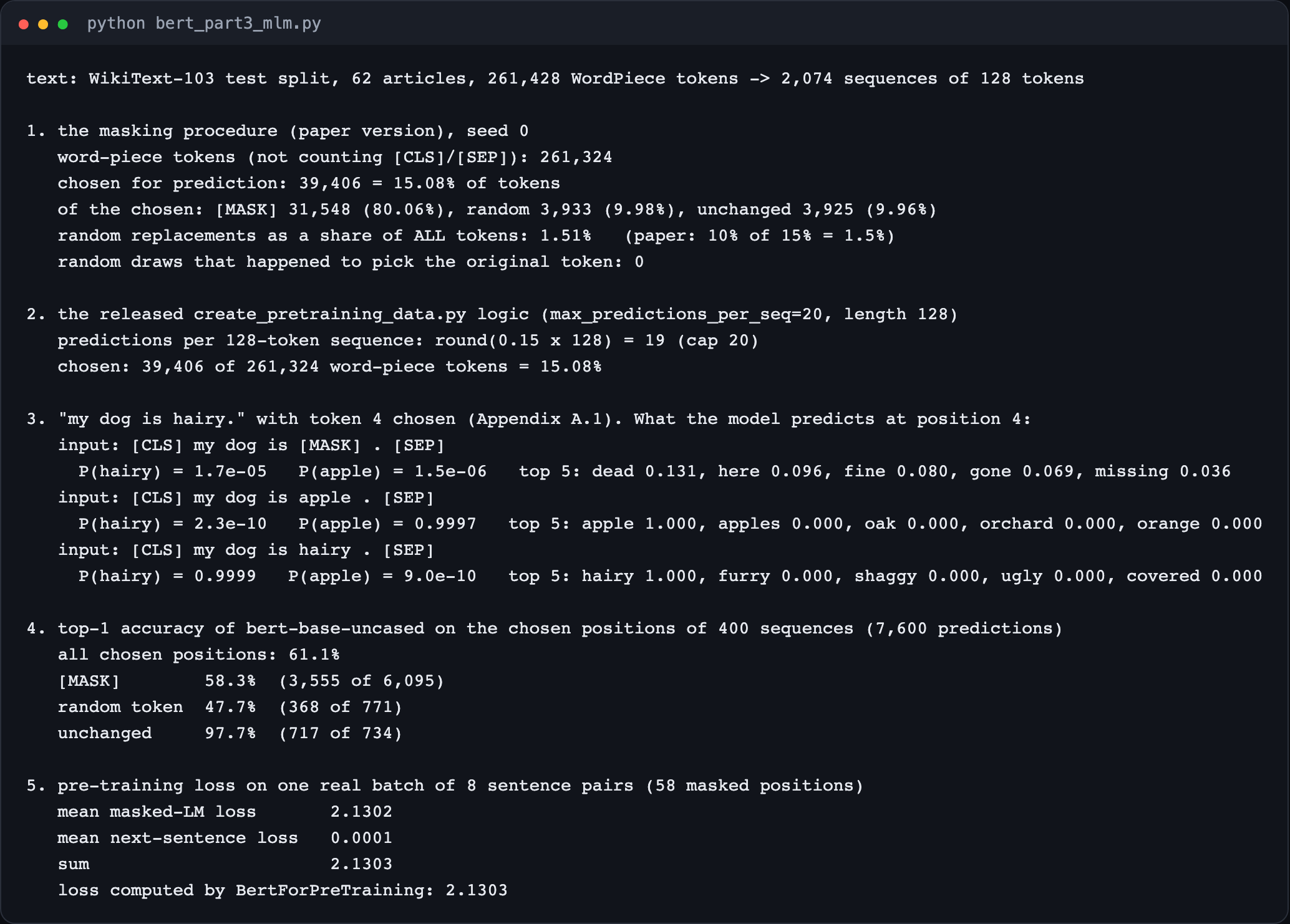
**The whole computation on one real example** ([`bert_part3_math.py`](https://github.com/ishwar6/ishwar-books/blob/main/code/papers/bert/bert_part3_math.py)). The paper's own Appendix A.1 sentence "the man went to the store to buy a gallon of milk", with "store" masked:

```text
the masked-LM head of bert-base-uncased
  transform: dense (768, 768) + GELU + LayerNorm(768)
  decoder weight (30522, 768), bias (30522,)
  decoder weight is the input token-embedding matrix (same memory): True

sentence: [CLS] the man went to the [MASK] to buy a gallon of milk . [SEP]   (masked position i = 6, original word "store")
T_i: (768,), first 4 numbers: +0.388, +0.178, -0.210, +0.139
scores z = h E^T + b: (30522,); largest score 12.814; smallest -12.503
top 5 scores and their probabilities:
  store        z =  12.814   exp(z - max) = 1.0000   p = 0.4743
  refrigerator z =  10.991   exp(z - max) = 0.1615   p = 0.0766
  fridge       z =  10.915   exp(z - max) = 0.1496   p = 0.0710
  kitchen      z =  10.707   exp(z - max) = 0.1215   p = 0.0576
  counter      z =  10.278   exp(z - max) = 0.0792   p = 0.0375
log of the softmax denominator, log sum_v exp(z_v) = 13.5602
p("store") = exp(12.814 - 13.560) = 0.4743
cross-entropy = -log p("store") = 0.7459   (library: 0.7459)
for scale: a uniform guess over 30,522 tokens gives -log(1/30522) = 10.3262
```

Follow it by hand. The softmax needs $$\sum_v e^{z_v}$$ over all 30,522 scores, and its log is 13.5602. So

$$
P(\text{store}) = e^{12.814 - 13.560} = e^{-0.746} = 0.474, \qquad \mathcal{L} = -\log 0.474 = 0.746
$$

Two useful reference points: a model that guessed uniformly would get $$-\log(1/30{,}522) = 10.33$$, and a perfect model 0. Notice that refrigerator, fridge and kitchen also score high: places where milk lives. The model knows the scene, not just the word.

<figure class="fig"><svg viewBox="0 0 760 320" role="img" aria-label="The cross-entropy loss, minus the log of the probability given to the right word, with real predictions from this part. A sure, right answer costs almost nothing ("of": 0.0014). "store" at 0.474 costs 0.75. A uniform guess over the whole vocabulary costs 10.33."><defs><marker id="ah" viewBox="0 0 10 10" refX="9" refY="5" markerWidth="7" markerHeight="7" orient="auto-start-reverse"><path class="arrow" d="M0,0L10,5L0,10z"/></marker><marker id="ah-on" viewBox="0 0 10 10" refX="9" refY="5" markerWidth="6" markerHeight="6" orient="auto-start-reverse"><path class="arrow-on" d="M0,0L10,5L0,10z"/></marker><marker id="ah-2" viewBox="0 0 10 10" refX="9" refY="5" markerWidth="6" markerHeight="6" orient="auto-start-reverse"><path class="arrow-2" d="M0,0L10,5L0,10z"/></marker></defs><text class="t-title" x="20.0" y="24.0" text-anchor="start">Cross-entropy: the loss is −log of the probability given to the right word</text><line class="grid" x1="70" y1="270.0" x2="590" y2="270.0"/><text class="t-tick" x="62.0" y="274.0" text-anchor="end">0</text><line class="grid" x1="70" y1="217.5" x2="590" y2="217.5"/><text class="t-tick" x="62.0" y="221.5" text-anchor="end">3</text><line class="grid" x1="70" y1="165.0" x2="590" y2="165.0"/><text class="t-tick" x="62.0" y="169.0" text-anchor="end">6</text><line class="grid" x1="70" y1="112.5" x2="590" y2="112.5"/><text class="t-tick" x="62.0" y="116.5" text-anchor="end">9</text><line class="grid" x1="70" y1="60.0" x2="590" y2="60.0"/><text class="t-tick" x="62.0" y="64.0" text-anchor="end">12</text><line class="axis" x1="70" y1="270" x2="590" y2="270"/><text class="t-tick" x="70.0" y="288.0" text-anchor="middle">0.00001</text><text class="t-tick" x="174.0" y="288.0" text-anchor="middle">0.0001</text><text class="t-tick" x="278.0" y="288.0" text-anchor="middle">0.001</text><text class="t-tick" x="382.0" y="288.0" text-anchor="middle">0.01</text><text class="t-tick" x="486.0" y="288.0" text-anchor="middle">0.1</text><text class="t-tick" x="590.0" y="288.0" text-anchor="middle">1</text><polyline class="l1" points="70.0,68.5 72.6,69.5 75.2,70.5 77.8,71.5 80.4,72.6 83.0,73.6 85.6,74.6 88.2,75.6 90.8,76.6 93.4,77.6 96.0,78.6 98.6,79.6 101.2,80.6 103.8,81.6 106.4,82.6 109.0,83.6 111.6,84.6 114.2,85.6 116.8,86.7 119.4,87.7 122.0,88.7 124.6,89.7 127.2,90.7 129.8,91.7 132.4,92.7 135.0,93.7 137.6,94.7 140.2,95.7 142.8,96.7 145.4,97.7 148.0,98.7 150.6,99.8 153.2,100.8 155.8,101.8 158.4,102.8 161.0,103.8 163.6,104.8 166.2,105.8 168.8,106.8 171.4,107.8 174.0,108.8 176.6,109.8 179.2,110.8 181.8,111.8 184.4,112.8 187.0,113.9 189.6,114.9 192.2,115.9 194.8,116.9 197.4,117.9 200.0,118.9 202.6,119.9 205.2,120.9 207.8,121.9 210.4,122.9 213.0,123.9 215.6,124.9 218.2,125.9 220.8,127.0 223.4,128.0 226.0,129.0 228.6,130.0 231.2,131.0 233.8,132.0 236.4,133.0 239.0,134.0 241.6,135.0 244.2,136.0 246.8,137.0 249.4,138.0 252.0,139.0 254.6,140.0 257.2,141.1 259.8,142.1 262.4,143.1 265.0,144.1 267.6,145.1 270.2,146.1 272.8,147.1 275.4,148.1 278.0,149.1 280.6,150.1 283.2,151.1 285.8,152.1 288.4,153.1 291.0,154.2 293.6,155.2 296.2,156.2 298.8,157.2 301.4,158.2 304.0,159.2 306.6,160.2 309.2,161.2 311.8,162.2 314.4,163.2 317.0,164.2 319.6,165.2 322.2,166.2 324.8,167.2 327.4,168.3 330.0,169.3 332.6,170.3 335.2,171.3 337.8,172.3 340.4,173.3 343.0,174.3 345.6,175.3 348.2,176.3 350.8,177.3 353.4,178.3 356.0,179.3 358.6,180.3 361.2,181.4 363.8,182.4 366.4,183.4 369.0,184.4 371.6,185.4 374.2,186.4 376.8,187.4 379.4,188.4 382.0,189.4 384.6,190.4 387.2,191.4 389.8,192.4 392.4,193.4 395.0,194.4 397.6,195.5 400.2,196.5 402.8,197.5 405.4,198.5 408.0,199.5 410.6,200.5 413.2,201.5 415.8,202.5 418.4,203.5 421.0,204.5 423.6,205.5 426.2,206.5 428.8,207.5 431.4,208.5 434.0,209.6 436.6,210.6 439.2,211.6 441.8,212.6 444.4,213.6 447.0,214.6 449.6,215.6 452.2,216.6 454.8,217.6 457.4,218.6 460.0,219.6 462.6,220.6 465.2,221.6 467.8,222.7 470.4,223.7 473.0,224.7 475.6,225.7 478.2,226.7 480.8,227.7 483.4,228.7 486.0,229.7 488.6,230.7 491.2,231.7 493.8,232.7 496.4,233.7 499.0,234.7 501.6,235.7 504.2,236.8 506.8,237.8 509.4,238.8 512.0,239.8 514.6,240.8 517.2,241.8 519.8,242.8 522.4,243.8 525.0,244.8 527.6,245.8 530.2,246.8 532.8,247.8 535.4,248.8 538.0,249.9 540.6,250.9 543.2,251.9 545.8,252.9 548.4,253.9 551.0,254.9 553.6,255.9 556.2,256.9 558.8,257.9 561.4,258.9 564.0,259.9 566.6,260.9 569.2,261.9 571.8,262.9 574.4,264.0 577.0,265.0 579.6,266.0 582.2,267.0 584.8,268.0 587.4,269.0 590.0,270.0"/><g class="mark"><title>uniform guess: p = 3.276e-05, loss 10.326</title><circle class="s2 ring" cx="123.6" cy="89.3" r="6"/></g><text class="t-tick" x="133.6" y="81.3" text-anchor="start">uniform guess: p 3.28e-05, loss 10.33</text><g class="mark"><title>"##s" (penguins): p = 0.003165, loss 5.756</title><circle class="s2 ring" cx="330.0" cy="169.3" r="6"/></g><text class="t-tick" x="340.0" y="161.3" text-anchor="start">"##s" (penguins): p 0.00316, loss 5.76</text><g class="mark"><title>"went": p = 0.07555, loss 2.583</title><circle class="s2 ring" cx="473.3" cy="224.8" r="6"/></g><text class="t-tick" x="483.3" y="216.8" text-anchor="start">"went": p 0.0755, loss 2.58</text><g class="mark"><title>"store": p = 0.4743, loss 0.746</title><circle class="s3 ring" cx="556.3" cy="256.9" r="6"/></g><line class="edge-dim" x1="560.3" y1="252.9" x2="604.0" y2="206.9"/><text class="t-tick" x="608.0" y="210.9" text-anchor="start">"store": p 0.474</text><text class="t-tick" x="608.0" y="226.9" text-anchor="start">loss 0.75</text><g class="mark"><title>"of": p = 0.9986, loss 0.001</title><circle class="s3 ring" cx="589.9" cy="270.0" r="6"/></g><line class="edge-dim" x1="593.9" y1="266.0" x2="604.0" y2="250.0"/><text class="t-tick" x="608.0" y="254.0" text-anchor="start">"of": p 0.9986</text><text class="t-tick" x="608.0" y="270.0" text-anchor="start">loss 0.0014</text><text class="t-tick" x="330.0" y="310.0" text-anchor="middle">probability the model gave to the right word (log scale)</text><text class="t-tick" x="20.0" y="46.0" text-anchor="start">loss</text></svg><figcaption>Cross-entropy as a function of the probability the model gave the right word: loss = −log p. A uniform guess (p = 3.3 × 10⁻⁵) costs 10.33; the real examples in this part sit along the curve, from "##s" in "penguins" (p = 0.003, loss 5.76) to "of" (p = 0.9986, loss 0.0014).</figcaption></figure>

The paper's contrast with denoising auto-encoders (Vincent et al., 2008) is about *where the loss is computed*:

<figure class="fig"><svg viewBox="0 0 760 360" role="img" aria-label="Two ways to learn from damaged text. A denoising auto-encoder damages the input and is trained to rebuild every token, so all six positions have a loss. The masked LM hides some tokens and is trained to predict only those, so only the hidden position has a loss."><defs><marker id="ah" viewBox="0 0 10 10" refX="9" refY="5" markerWidth="7" markerHeight="7" orient="auto-start-reverse"><path class="arrow" d="M0,0L10,5L0,10z"/></marker><marker id="ah-on" viewBox="0 0 10 10" refX="9" refY="5" markerWidth="6" markerHeight="6" orient="auto-start-reverse"><path class="arrow-on" d="M0,0L10,5L0,10z"/></marker><marker id="ah-2" viewBox="0 0 10 10" refX="9" refY="5" markerWidth="6" markerHeight="6" orient="auto-start-reverse"><path class="arrow-2" d="M0,0L10,5L0,10z"/></marker></defs><text class="t-title" x="20.0" y="36.0" text-anchor="start">Denoising auto-encoder</text><text class="t-muted" x="20.0" y="54.0" text-anchor="start">(Vincent et al., 2008)</text><rect class="box" x="190.0" y="132.0" width="78.0" height="30.0" rx="6"/><text class="t-tick" x="229.0" y="151.5" text-anchor="middle">the</text><rect class="box-ghost" x="278.0" y="132.0" width="78.0" height="30.0" rx="6"/><text class="t-muted" x="317.0" y="151.5" text-anchor="middle">dropped</text><rect class="box" x="366.0" y="132.0" width="78.0" height="30.0" rx="6"/><text class="t-tick" x="405.0" y="151.5" text-anchor="middle">sat</text><rect class="box" x="454.0" y="132.0" width="78.0" height="30.0" rx="6"/><text class="t-tick" x="493.0" y="151.5" text-anchor="middle">on</text><rect class="box-ghost" x="542.0" y="132.0" width="78.0" height="30.0" rx="6"/><text class="t-muted" x="581.0" y="151.5" text-anchor="middle">dropped</text><rect class="box" x="630.0" y="132.0" width="78.0" height="30.0" rx="6"/><text class="t-tick" x="669.0" y="151.5" text-anchor="middle">mat</text><text class="t-tick" x="20.0" y="152.0" text-anchor="start">damaged input</text><rect class="box-1" x="190.0" y="82.0" width="518.0" height="36.0" rx="10"/><text class="t-note" x="449.0" y="105.0" text-anchor="middle">encoder, then decoder</text><line class="edge" x1="229.0" y1="130.0" x2="229.0" y2="120.0" marker-end="url(#ah)"/><line class="edge" x1="229.0" y1="80.0" x2="229.0" y2="66.0" marker-end="url(#ah)"/><rect class="box-3" x="190.0" y="34.0" width="78.0" height="30.0" rx="6"/><text class="t-tick" x="229.0" y="53.5" text-anchor="middle">the</text><line class="edge" x1="317.0" y1="130.0" x2="317.0" y2="120.0" marker-end="url(#ah)"/><line class="edge" x1="317.0" y1="80.0" x2="317.0" y2="66.0" marker-end="url(#ah)"/><rect class="box-3" x="278.0" y="34.0" width="78.0" height="30.0" rx="6"/><text class="t-tick" x="317.0" y="53.5" text-anchor="middle">cat</text><line class="edge" x1="405.0" y1="130.0" x2="405.0" y2="120.0" marker-end="url(#ah)"/><line class="edge" x1="405.0" y1="80.0" x2="405.0" y2="66.0" marker-end="url(#ah)"/><rect class="box-3" x="366.0" y="34.0" width="78.0" height="30.0" rx="6"/><text class="t-tick" x="405.0" y="53.5" text-anchor="middle">sat</text><line class="edge" x1="493.0" y1="130.0" x2="493.0" y2="120.0" marker-end="url(#ah)"/><line class="edge" x1="493.0" y1="80.0" x2="493.0" y2="66.0" marker-end="url(#ah)"/><rect class="box-3" x="454.0" y="34.0" width="78.0" height="30.0" rx="6"/><text class="t-tick" x="493.0" y="53.5" text-anchor="middle">on</text><line class="edge" x1="581.0" y1="130.0" x2="581.0" y2="120.0" marker-end="url(#ah)"/><line class="edge" x1="581.0" y1="80.0" x2="581.0" y2="66.0" marker-end="url(#ah)"/><rect class="box-3" x="542.0" y="34.0" width="78.0" height="30.0" rx="6"/><text class="t-tick" x="581.0" y="53.5" text-anchor="middle">the</text><line class="edge" x1="669.0" y1="130.0" x2="669.0" y2="120.0" marker-end="url(#ah)"/><line class="edge" x1="669.0" y1="80.0" x2="669.0" y2="66.0" marker-end="url(#ah)"/><rect class="box-3" x="630.0" y="34.0" width="78.0" height="30.0" rx="6"/><text class="t-tick" x="669.0" y="53.5" text-anchor="middle">mat</text><text class="t-tick" x="20.0" y="90.0" text-anchor="start">rebuild</text><text class="t-tick t-strong" x="20.0" y="106.0" text-anchor="start">ALL 6 tokens</text><text class="t-s3" x="229.0" y="28.0" text-anchor="middle">loss</text><text class="t-s3" x="317.0" y="28.0" text-anchor="middle">loss</text><text class="t-s3" x="405.0" y="28.0" text-anchor="middle">loss</text><text class="t-s3" x="493.0" y="28.0" text-anchor="middle">loss</text><text class="t-s3" x="581.0" y="28.0" text-anchor="middle">loss</text><text class="t-s3" x="669.0" y="28.0" text-anchor="middle">loss</text><line class="edge-dim" x1="20.0" y1="186.0" x2="740.0" y2="186.0"/><text class="t-title" x="20.0" y="216.0" text-anchor="start">Masked LM (BERT)</text><text class="t-muted" x="20.0" y="234.0" text-anchor="start">(Devlin et al., 2018)</text><rect class="box" x="190.0" y="312.0" width="78.0" height="30.0" rx="6"/><text class="t-tick" x="229.0" y="331.5" text-anchor="middle">the</text><rect class="box-mask" x="278.0" y="312.0" width="78.0" height="30.0" rx="6"/><text class="t-tick" x="317.0" y="331.5" text-anchor="middle">[MASK]</text><rect class="box" x="366.0" y="312.0" width="78.0" height="30.0" rx="6"/><text class="t-tick" x="405.0" y="331.5" text-anchor="middle">sat</text><rect class="box" x="454.0" y="312.0" width="78.0" height="30.0" rx="6"/><text class="t-tick" x="493.0" y="331.5" text-anchor="middle">on</text><rect class="box" x="542.0" y="312.0" width="78.0" height="30.0" rx="6"/><text class="t-tick" x="581.0" y="331.5" text-anchor="middle">the</text><rect class="box" x="630.0" y="312.0" width="78.0" height="30.0" rx="6"/><text class="t-tick" x="669.0" y="331.5" text-anchor="middle">mat</text><text class="t-tick" x="20.0" y="332.0" text-anchor="start">masked input</text><rect class="box-1" x="190.0" y="262.0" width="518.0" height="36.0" rx="10"/><text class="t-note" x="449.0" y="285.0" text-anchor="middle">encoder only (12 layers)</text><line class="edge" x1="229.0" y1="310.0" x2="229.0" y2="300.0" marker-end="url(#ah)"/><text class="t-muted" x="229.0" y="238.0" text-anchor="middle">no loss</text><line class="edge" x1="317.0" y1="310.0" x2="317.0" y2="300.0" marker-end="url(#ah)"/><line class="edge" x1="317.0" y1="260.0" x2="317.0" y2="246.0" marker-end="url(#ah)"/><rect class="box-on" x="278.0" y="214.0" width="78.0" height="30.0" rx="6"/><text class="t-note" x="317.0" y="233.5" text-anchor="middle">cat</text><text class="t-on" x="317.0" y="208.0" text-anchor="middle">loss</text><line class="edge" x1="405.0" y1="310.0" x2="405.0" y2="300.0" marker-end="url(#ah)"/><text class="t-muted" x="405.0" y="238.0" text-anchor="middle">no loss</text><line class="edge" x1="493.0" y1="310.0" x2="493.0" y2="300.0" marker-end="url(#ah)"/><text class="t-muted" x="493.0" y="238.0" text-anchor="middle">no loss</text><line class="edge" x1="581.0" y1="310.0" x2="581.0" y2="300.0" marker-end="url(#ah)"/><text class="t-muted" x="581.0" y="238.0" text-anchor="middle">no loss</text><line class="edge" x1="669.0" y1="310.0" x2="669.0" y2="300.0" marker-end="url(#ah)"/><text class="t-muted" x="669.0" y="238.0" text-anchor="middle">no loss</text><text class="t-tick" x="20.0" y="270.0" text-anchor="start">predict only</text><text class="t-tick t-strong" x="20.0" y="286.0" text-anchor="start">the hidden one</text></svg><figcaption>Where the loss is. A denoising auto-encoder (Vincent et al., 2008) rebuilds the whole input, so every position has a loss. BERT's masked LM puts a loss only on the hidden position; the other positions produce no loss.</figcaption></figure>

> [!DEFINITION] Denoising auto-encoder
> A model that gets a damaged input and must rebuild the **whole** clean input. BERT differs: it only predicts the damaged positions. The other 85% of positions produce no loss at all.

**Use case.** This is the same "fill in the blank" you saw in Part 1, where BERT put 0.901 on "bank". The same masked-LM head is still a quick way to probe what a model knows: give it "The capital of France is [MASK]." and read its guesses.

## The [MASK] problem and the 80/10/10 rule {§3.1}

> [!PAPER] · §3.1, Task #1
> [![A downside is a mismatch between pre-training and fine-tuning, since the MASK token does not appear during fine-tuning. The training data generator chooses 15 percent of the token positions at random for prediction. If the i-th token is chosen, it is replaced by the MASK token 80 percent of the time, a random token 10 percent of the time, and the unchanged i-th token 10 percent of the time. Then T_i is used to predict the original token with cross entropy loss](https://ishwarj.com/img/papers/bert/p3-mlm-8010.pngert/p3-mlm-8010.png)](/img/papers/bert/p3-mlm-8010.png)
>
> **What it says:** "the [MASK] token does not appear during fine-tuning", so there is "a mismatch between pre-training and fine-tuning". To soften it, the chosen 15% of positions are not always masked: "(1) the [MASK] token 80% of the time (2) a random token 10% of the time (3) the unchanged i-th token 10% of the time". In every case, $$T_i$$ must predict the original token.
>
> **What it means:**
>
> Think of a pilot who trains only in a simulator with a red warning light. On a real flight there is no red light, and the habits may not fit. `[MASK]` is that red light: it appears in pre-training but never in fine-tuning.
>
> So the authors do not always show the `[MASK]`. Sometimes the chosen word is swapped for a random word, and sometimes it stays as it is. The model must give the original word in every case, so it cannot rely on the `[MASK]` sign.
>
> This small rule is one of the most copied details in the paper. Part 5 shows the paper's own test of other ratios (Table 8).

> [!DEFINITION] Pre-train/fine-tune mismatch
> When the input during pre-training looks different from the input during real use. BERT pre-trains with `[MASK]` tokens everywhere, but a sentiment classifier never sees `[MASK]`. A model that only learned "work hard at [MASK] positions" might put less effort into normal words.

Appendix A.1 walks through the rule on one sentence, and explains the reasons.

> [!PAPER] · Appendix A.1
> [![Appendix A.1, Masked LM and the Masking Procedure: assuming the sentence is my dog is hairy and the 4th token is chosen: 80 percent of the time replace it with MASK, giving my dog is MASK; 10 percent of the time replace it with a random word, giving my dog is apple; 10 percent of the time keep it unchanged, my dog is hairy. The purpose of this is to bias the representation towards the actual observed word](https://ishwarj.com/img/papers/bert/p3-a1-mlm.png/bert/p3-a1-mlm.png)](/img/papers/bert/p3-a1-mlm.png)
>
> **What it says:** with "my dog is hairy" and the 4th token chosen: 80% of the time "my dog is [MASK]", 10% "my dog is apple", 10% "my dog is hairy". Keeping the word unchanged is meant "to bias the representation towards the actual observed word".
>
> **What it means:**
>
> One sentence, three versions. The model sees one of them, and it must always answer "hairy". From the inside, it cannot tell which version it got.
>
> Each case does its own job. The `[MASK]` version (80%) is the main exercise: fill in a blank from both sides. The random word (10%) teaches that a visible word might be wrong, so the model must check every word against its context. The unchanged word (10%) teaches that a visible word is usually right. So the model's vector for a normal word should stay close to that word.
>
> The last case keeps the model useful when there are no `[MASK]` tokens at all, as in fine-tuning.

> [!PAPER] · Appendix A.1
> [![The advantage of this procedure is that the Transformer encoder does not know which words it will be asked to predict or which have been replaced by random words, so it is forced to keep a distributional contextual representation of every input token. Because random replacement only occurs for 1.5 percent of all tokens, 10 percent of 15 percent, this does not seem to harm the model's language understanding capability](https://ishwarj.com/img/papers/bert/p3-a1-why.png/bert/p3-a1-why.png)](/img/papers/bert/p3-a1-why.png)
>
> **What it says:** the encoder "does not know which words it will be asked to predict or which have been replaced by random words", so it must keep "a distributional contextual representation of every input token". And random replacement happens to only "1.5% of all tokens (i.e., 10% of 15%)", too rarely to hurt.
>
> **What it means:**
>
> Think of a teacher who might test any student at any moment, with no warning. No student can relax. The encoder is in the same place: it does not know which tokens will be tested, or which ones are false.
>
> So it must keep a good vector for every token, not only for the `[MASK]` ones. This is the real reason for the rule: any token might be a test.
>
> The cost is small. Random words make up only 1.5% of all tokens, so the text the model reads stays almost clean.

<figure class="fig"><svg viewBox="0 0 760 290" role="img" aria-label="The 80/10/10 rule of Section 3.1 and Appendix A.1. A chosen token becomes [MASK] 80% of the time, a random word 10% of the time, and stays itself 10% of the time. The model must predict the original word in every case."><defs><marker id="ah" viewBox="0 0 10 10" refX="9" refY="5" markerWidth="7" markerHeight="7" orient="auto-start-reverse"><path class="arrow" d="M0,0L10,5L0,10z"/></marker><marker id="ah-on" viewBox="0 0 10 10" refX="9" refY="5" markerWidth="6" markerHeight="6" orient="auto-start-reverse"><path class="arrow-on" d="M0,0L10,5L0,10z"/></marker><marker id="ah-2" viewBox="0 0 10 10" refX="9" refY="5" markerWidth="6" markerHeight="6" orient="auto-start-reverse"><path class="arrow-2" d="M0,0L10,5L0,10z"/></marker></defs><text class="t-title" x="20.0" y="24.0" text-anchor="start">For each chosen position (15% of tokens), roll the dice once</text><rect class="box-on" x="30.0" y="120.0" width="150.0" height="36.0" rx="6"/><text class="t-note" x="105.0" y="142.5" text-anchor="middle">hairy (chosen)</text><line class="edge" x1="182.0" y1="138.0" x2="236.0" y2="72.0" marker-end="url(#ah)"/><text class="t-val" x="244.0" y="64.0" text-anchor="start">80%</text><text class="t-note" x="286.0" y="64.0" text-anchor="start">replace with [MASK]</text><rect class="box-mask" x="244.0" y="72.0" width="190.0" height="30.0" rx="6"/><text class="t-mono" x="339.0" y="92.0" text-anchor="middle">my dog is [MASK]</text><text class="t-tick" x="452.0" y="92.0" text-anchor="start">learn to fill blanks</text><line class="edge" x1="182.0" y1="138.0" x2="236.0" y2="146.0" marker-end="url(#ah)"/><text class="t-val" x="244.0" y="138.0" text-anchor="start">10%</text><text class="t-note" x="286.0" y="138.0" text-anchor="start">replace with a random word</text><rect class="box-2" x="244.0" y="146.0" width="190.0" height="30.0" rx="6"/><text class="t-mono" x="339.0" y="166.0" text-anchor="middle">my dog is apple</text><text class="t-tick" x="452.0" y="166.0" text-anchor="start">never fully trust the input</text><line class="edge" x1="182.0" y1="138.0" x2="236.0" y2="220.0" marker-end="url(#ah)"/><text class="t-val" x="244.0" y="212.0" text-anchor="start">10%</text><text class="t-note" x="286.0" y="212.0" text-anchor="start">keep the word unchanged</text><rect class="box-3" x="244.0" y="220.0" width="190.0" height="30.0" rx="6"/><text class="t-mono" x="339.0" y="240.0" text-anchor="middle">my dog is hairy</text><text class="t-tick" x="452.0" y="240.0" text-anchor="start">learn about real, unmasked words</text><text class="t-tick" x="30.0" y="270.0" text-anchor="start">In all three cases the target is the same: predict "hairy" at position 4.</text></svg><figcaption>The 80/10/10 rule. Each chosen token becomes [MASK] 80% of the time, a random word 10% of the time, and stays itself 10% of the time. The target is always the original word.</figcaption></figure>

**What share of all tokens ends up in each state?** Combine the two random choices. A token is first chosen with probability 0.15, and a chosen token is then masked with probability 0.8, replaced with 0.1, or kept with 0.1:

$$
P(\text{[MASK]}) = 0.15 \times 0.8 = 0.12, \qquad P(\text{random}) = 0.15 \times 0.1 = 0.015, \qquad P(\text{same, predicted}) = 0.15 \times 0.1 = 0.015
$$

and the other $$1 - 0.15 = 0.85$$ are untouched and not predicted. So in a typical batch, 12% of tokens are `[MASK]`, 1.5% are wrong words, 1.5% are unchanged but still predicted, and 85% are plain context. The model sees $$85\% + 1.5\% = 86.5\%$$ of tokens exactly as they were written. For one 512-token sequence that is about 76.8 predictions: 61.4 masks, 7.7 random and 7.7 unchanged.

<figure class="fig"><svg viewBox="0 0 760 482" role="img" aria-label="The 80/10/10 rule as a share of all tokens, drawn as 200 squares. 170 are never touched and have no loss. 24 become [MASK], 3 become a random token and 3 stay unchanged but must still be predicted. So 15% of tokens carry a loss, and 86.5% look like the original text."><defs><marker id="ah" viewBox="0 0 10 10" refX="9" refY="5" markerWidth="7" markerHeight="7" orient="auto-start-reverse"><path class="arrow" d="M0,0L10,5L0,10z"/></marker><marker id="ah-on" viewBox="0 0 10 10" refX="9" refY="5" markerWidth="6" markerHeight="6" orient="auto-start-reverse"><path class="arrow-on" d="M0,0L10,5L0,10z"/></marker><marker id="ah-2" viewBox="0 0 10 10" refX="9" refY="5" markerWidth="6" markerHeight="6" orient="auto-start-reverse"><path class="arrow-2" d="M0,0L10,5L0,10z"/></marker></defs><text class="t-title" x="20.0" y="24.0" text-anchor="start">Every 200 tokens of training text, on average</text><rect class="box" x="82.0" y="42.0" width="26.0" height="26.0" rx="4"/><rect class="box" x="112.0" y="42.0" width="26.0" height="26.0" rx="4"/><rect class="box" x="142.0" y="42.0" width="26.0" height="26.0" rx="4"/><rect class="box" x="172.0" y="42.0" width="26.0" height="26.0" rx="4"/><rect class="box" x="202.0" y="42.0" width="26.0" height="26.0" rx="4"/><rect class="box" x="232.0" y="42.0" width="26.0" height="26.0" rx="4"/><rect class="box" x="262.0" y="42.0" width="26.0" height="26.0" rx="4"/><rect class="box" x="292.0" y="42.0" width="26.0" height="26.0" rx="4"/><rect class="box" x="322.0" y="42.0" width="26.0" height="26.0" rx="4"/><rect class="box" x="352.0" y="42.0" width="26.0" height="26.0" rx="4"/><rect class="box" x="382.0" y="42.0" width="26.0" height="26.0" rx="4"/><rect class="box" x="412.0" y="42.0" width="26.0" height="26.0" rx="4"/><rect class="box" x="442.0" y="42.0" width="26.0" height="26.0" rx="4"/><rect class="box" x="472.0" y="42.0" width="26.0" height="26.0" rx="4"/><rect class="box" x="502.0" y="42.0" width="26.0" height="26.0" rx="4"/><rect class="box" x="532.0" y="42.0" width="26.0" height="26.0" rx="4"/><rect class="box" x="562.0" y="42.0" width="26.0" height="26.0" rx="4"/><rect class="box" x="592.0" y="42.0" width="26.0" height="26.0" rx="4"/><rect class="box" x="622.0" y="42.0" width="26.0" height="26.0" rx="4"/><rect class="box" x="652.0" y="42.0" width="26.0" height="26.0" rx="4"/><rect class="box" x="82.0" y="72.0" width="26.0" height="26.0" rx="4"/><rect class="box" x="112.0" y="72.0" width="26.0" height="26.0" rx="4"/><rect class="box" x="142.0" y="72.0" width="26.0" height="26.0" rx="4"/><rect class="box" x="172.0" y="72.0" width="26.0" height="26.0" rx="4"/><rect class="box" x="202.0" y="72.0" width="26.0" height="26.0" rx="4"/><rect class="box" x="232.0" y="72.0" width="26.0" height="26.0" rx="4"/><rect class="box" x="262.0" y="72.0" width="26.0" height="26.0" rx="4"/><rect class="box" x="292.0" y="72.0" width="26.0" height="26.0" rx="4"/><rect class="box" x="322.0" y="72.0" width="26.0" height="26.0" rx="4"/><rect class="box" x="352.0" y="72.0" width="26.0" height="26.0" rx="4"/><rect class="box" x="382.0" y="72.0" width="26.0" height="26.0" rx="4"/><rect class="box" x="412.0" y="72.0" width="26.0" height="26.0" rx="4"/><rect class="box" x="442.0" y="72.0" width="26.0" height="26.0" rx="4"/><rect class="box" x="472.0" y="72.0" width="26.0" height="26.0" rx="4"/><rect class="box" x="502.0" y="72.0" width="26.0" height="26.0" rx="4"/><rect class="box" x="532.0" y="72.0" width="26.0" height="26.0" rx="4"/><rect class="box" x="562.0" y="72.0" width="26.0" height="26.0" rx="4"/><rect class="box" x="592.0" y="72.0" width="26.0" height="26.0" rx="4"/><rect class="box" x="622.0" y="72.0" width="26.0" height="26.0" rx="4"/><rect class="box" x="652.0" y="72.0" width="26.0" height="26.0" rx="4"/><rect class="box" x="82.0" y="102.0" width="26.0" height="26.0" rx="4"/><rect class="box" x="112.0" y="102.0" width="26.0" height="26.0" rx="4"/><rect class="box" x="142.0" y="102.0" width="26.0" height="26.0" rx="4"/><rect class="box" x="172.0" y="102.0" width="26.0" height="26.0" rx="4"/><rect class="box" x="202.0" y="102.0" width="26.0" height="26.0" rx="4"/><rect class="box" x="232.0" y="102.0" width="26.0" height="26.0" rx="4"/><rect class="box" x="262.0" y="102.0" width="26.0" height="26.0" rx="4"/><rect class="box" x="292.0" y="102.0" width="26.0" height="26.0" rx="4"/><rect class="box" x="322.0" y="102.0" width="26.0" height="26.0" rx="4"/><rect class="box" x="352.0" y="102.0" width="26.0" height="26.0" rx="4"/><rect class="box" x="382.0" y="102.0" width="26.0" height="26.0" rx="4"/><rect class="box" x="412.0" y="102.0" width="26.0" height="26.0" rx="4"/><rect class="box" x="442.0" y="102.0" width="26.0" height="26.0" rx="4"/><rect class="box" x="472.0" y="102.0" width="26.0" height="26.0" rx="4"/><rect class="box" x="502.0" y="102.0" width="26.0" height="26.0" rx="4"/><rect class="box" x="532.0" y="102.0" width="26.0" height="26.0" rx="4"/><rect class="box" x="562.0" y="102.0" width="26.0" height="26.0" rx="4"/><rect class="box" x="592.0" y="102.0" width="26.0" height="26.0" rx="4"/><rect class="box" x="622.0" y="102.0" width="26.0" height="26.0" rx="4"/><rect class="box" x="652.0" y="102.0" width="26.0" height="26.0" rx="4"/><rect class="box" x="82.0" y="132.0" width="26.0" height="26.0" rx="4"/><rect class="box" x="112.0" y="132.0" width="26.0" height="26.0" rx="4"/><rect class="box" x="142.0" y="132.0" width="26.0" height="26.0" rx="4"/><rect class="box" x="172.0" y="132.0" width="26.0" height="26.0" rx="4"/><rect class="box" x="202.0" y="132.0" width="26.0" height="26.0" rx="4"/><rect class="box" x="232.0" y="132.0" width="26.0" height="26.0" rx="4"/><rect class="box" x="262.0" y="132.0" width="26.0" height="26.0" rx="4"/><rect class="box" x="292.0" y="132.0" width="26.0" height="26.0" rx="4"/><rect class="box" x="322.0" y="132.0" width="26.0" height="26.0" rx="4"/><rect class="box" x="352.0" y="132.0" width="26.0" height="26.0" rx="4"/><rect class="box" x="382.0" y="132.0" width="26.0" height="26.0" rx="4"/><rect class="box" x="412.0" y="132.0" width="26.0" height="26.0" rx="4"/><rect class="box" x="442.0" y="132.0" width="26.0" height="26.0" rx="4"/><rect class="box" x="472.0" y="132.0" width="26.0" height="26.0" rx="4"/><rect class="box" x="502.0" y="132.0" width="26.0" height="26.0" rx="4"/><rect class="box" x="532.0" y="132.0" width="26.0" height="26.0" rx="4"/><rect class="box" x="562.0" y="132.0" width="26.0" height="26.0" rx="4"/><rect class="box" x="592.0" y="132.0" width="26.0" height="26.0" rx="4"/><rect class="box" x="622.0" y="132.0" width="26.0" height="26.0" rx="4"/><rect class="box" x="652.0" y="132.0" width="26.0" height="26.0" rx="4"/><rect class="box" x="82.0" y="162.0" width="26.0" height="26.0" rx="4"/><rect class="box" x="112.0" y="162.0" width="26.0" height="26.0" rx="4"/><rect class="box" x="142.0" y="162.0" width="26.0" height="26.0" rx="4"/><rect class="box" x="172.0" y="162.0" width="26.0" height="26.0" rx="4"/><rect class="box" x="202.0" y="162.0" width="26.0" height="26.0" rx="4"/><rect class="box" x="232.0" y="162.0" width="26.0" height="26.0" rx="4"/><rect class="box" x="262.0" y="162.0" width="26.0" height="26.0" rx="4"/><rect class="box" x="292.0" y="162.0" width="26.0" height="26.0" rx="4"/><rect class="box" x="322.0" y="162.0" width="26.0" height="26.0" rx="4"/><rect class="box" x="352.0" y="162.0" width="26.0" height="26.0" rx="4"/><rect class="box" x="382.0" y="162.0" width="26.0" height="26.0" rx="4"/><rect class="box" x="412.0" y="162.0" width="26.0" height="26.0" rx="4"/><rect class="box" x="442.0" y="162.0" width="26.0" height="26.0" rx="4"/><rect class="box" x="472.0" y="162.0" width="26.0" height="26.0" rx="4"/><rect class="box" x="502.0" y="162.0" width="26.0" height="26.0" rx="4"/><rect class="box" x="532.0" y="162.0" width="26.0" height="26.0" rx="4"/><rect class="box" x="562.0" y="162.0" width="26.0" height="26.0" rx="4"/><rect class="box" x="592.0" y="162.0" width="26.0" height="26.0" rx="4"/><rect class="box" x="622.0" y="162.0" width="26.0" height="26.0" rx="4"/><rect class="box" x="652.0" y="162.0" width="26.0" height="26.0" rx="4"/><rect class="box" x="82.0" y="192.0" width="26.0" height="26.0" rx="4"/><rect class="box" x="112.0" y="192.0" width="26.0" height="26.0" rx="4"/><rect class="box" x="142.0" y="192.0" width="26.0" height="26.0" rx="4"/><rect class="box" x="172.0" y="192.0" width="26.0" height="26.0" rx="4"/><rect class="box" x="202.0" y="192.0" width="26.0" height="26.0" rx="4"/><rect class="box" x="232.0" y="192.0" width="26.0" height="26.0" rx="4"/><rect class="box" x="262.0" y="192.0" width="26.0" height="26.0" rx="4"/><rect class="box" x="292.0" y="192.0" width="26.0" height="26.0" rx="4"/><rect class="box" x="322.0" y="192.0" width="26.0" height="26.0" rx="4"/><rect class="box" x="352.0" y="192.0" width="26.0" height="26.0" rx="4"/><rect class="box" x="382.0" y="192.0" width="26.0" height="26.0" rx="4"/><rect class="box" x="412.0" y="192.0" width="26.0" height="26.0" rx="4"/><rect class="box" x="442.0" y="192.0" width="26.0" height="26.0" rx="4"/><rect class="box" x="472.0" y="192.0" width="26.0" height="26.0" rx="4"/><rect class="box" x="502.0" y="192.0" width="26.0" height="26.0" rx="4"/><rect class="box" x="532.0" y="192.0" width="26.0" height="26.0" rx="4"/><rect class="box" x="562.0" y="192.0" width="26.0" height="26.0" rx="4"/><rect class="box" x="592.0" y="192.0" width="26.0" height="26.0" rx="4"/><rect class="box" x="622.0" y="192.0" width="26.0" height="26.0" rx="4"/><rect class="box" x="652.0" y="192.0" width="26.0" height="26.0" rx="4"/><rect class="box" x="82.0" y="222.0" width="26.0" height="26.0" rx="4"/><rect class="box" x="112.0" y="222.0" width="26.0" height="26.0" rx="4"/><rect class="box" x="142.0" y="222.0" width="26.0" height="26.0" rx="4"/><rect class="box" x="172.0" y="222.0" width="26.0" height="26.0" rx="4"/><rect class="box" x="202.0" y="222.0" width="26.0" height="26.0" rx="4"/><rect class="box" x="232.0" y="222.0" width="26.0" height="26.0" rx="4"/><rect class="box" x="262.0" y="222.0" width="26.0" height="26.0" rx="4"/><rect class="box" x="292.0" y="222.0" width="26.0" height="26.0" rx="4"/><rect class="box" x="322.0" y="222.0" width="26.0" height="26.0" rx="4"/><rect class="box" x="352.0" y="222.0" width="26.0" height="26.0" rx="4"/><rect class="box" x="382.0" y="222.0" width="26.0" height="26.0" rx="4"/><rect class="box" x="412.0" y="222.0" width="26.0" height="26.0" rx="4"/><rect class="box" x="442.0" y="222.0" width="26.0" height="26.0" rx="4"/><rect class="box" x="472.0" y="222.0" width="26.0" height="26.0" rx="4"/><rect class="box" x="502.0" y="222.0" width="26.0" height="26.0" rx="4"/><rect class="box" x="532.0" y="222.0" width="26.0" height="26.0" rx="4"/><rect class="box" x="562.0" y="222.0" width="26.0" height="26.0" rx="4"/><rect class="box" x="592.0" y="222.0" width="26.0" height="26.0" rx="4"/><rect class="box" x="622.0" y="222.0" width="26.0" height="26.0" rx="4"/><rect class="box" x="652.0" y="222.0" width="26.0" height="26.0" rx="4"/><rect class="box" x="82.0" y="252.0" width="26.0" height="26.0" rx="4"/><rect class="box" x="112.0" y="252.0" width="26.0" height="26.0" rx="4"/><rect class="box" x="142.0" y="252.0" width="26.0" height="26.0" rx="4"/><rect class="box" x="172.0" y="252.0" width="26.0" height="26.0" rx="4"/><rect class="box" x="202.0" y="252.0" width="26.0" height="26.0" rx="4"/><rect class="box" x="232.0" y="252.0" width="26.0" height="26.0" rx="4"/><rect class="box" x="262.0" y="252.0" width="26.0" height="26.0" rx="4"/><rect class="box" x="292.0" y="252.0" width="26.0" height="26.0" rx="4"/><rect class="box" x="322.0" y="252.0" width="26.0" height="26.0" rx="4"/><rect class="box" x="352.0" y="252.0" width="26.0" height="26.0" rx="4"/><rect class="box" x="382.0" y="252.0" width="26.0" height="26.0" rx="4"/><rect class="box" x="412.0" y="252.0" width="26.0" height="26.0" rx="4"/><rect class="box" x="442.0" y="252.0" width="26.0" height="26.0" rx="4"/><rect class="box" x="472.0" y="252.0" width="26.0" height="26.0" rx="4"/><rect class="box" x="502.0" y="252.0" width="26.0" height="26.0" rx="4"/><rect class="box" x="532.0" y="252.0" width="26.0" height="26.0" rx="4"/><rect class="box" x="562.0" y="252.0" width="26.0" height="26.0" rx="4"/><rect class="box" x="592.0" y="252.0" width="26.0" height="26.0" rx="4"/><rect class="box" x="622.0" y="252.0" width="26.0" height="26.0" rx="4"/><rect class="box" x="652.0" y="252.0" width="26.0" height="26.0" rx="4"/><rect class="box" x="82.0" y="282.0" width="26.0" height="26.0" rx="4"/><rect class="box" x="112.0" y="282.0" width="26.0" height="26.0" rx="4"/><rect class="box" x="142.0" y="282.0" width="26.0" height="26.0" rx="4"/><rect class="box" x="172.0" y="282.0" width="26.0" height="26.0" rx="4"/><rect class="box" x="202.0" y="282.0" width="26.0" height="26.0" rx="4"/><rect class="box" x="232.0" y="282.0" width="26.0" height="26.0" rx="4"/><rect class="box" x="262.0" y="282.0" width="26.0" height="26.0" rx="4"/><rect class="box" x="292.0" y="282.0" width="26.0" height="26.0" rx="4"/><rect class="box" x="322.0" y="282.0" width="26.0" height="26.0" rx="4"/><rect class="box" x="352.0" y="282.0" width="26.0" height="26.0" rx="4"/><rect class="s-mask" x="382" y="282" width="26" height="26" rx="4"/><rect class="s-mask" x="412" y="282" width="26" height="26" rx="4"/><rect class="s-mask" x="442" y="282" width="26" height="26" rx="4"/><rect class="s-mask" x="472" y="282" width="26" height="26" rx="4"/><rect class="s-mask" x="502" y="282" width="26" height="26" rx="4"/><rect class="s-mask" x="532" y="282" width="26" height="26" rx="4"/><rect class="s-mask" x="562" y="282" width="26" height="26" rx="4"/><rect class="s-mask" x="592" y="282" width="26" height="26" rx="4"/><rect class="s-mask" x="622" y="282" width="26" height="26" rx="4"/><rect class="s-mask" x="652" y="282" width="26" height="26" rx="4"/><rect class="s-mask" x="82" y="312" width="26" height="26" rx="4"/><rect class="s-mask" x="112" y="312" width="26" height="26" rx="4"/><rect class="s-mask" x="142" y="312" width="26" height="26" rx="4"/><rect class="s-mask" x="172" y="312" width="26" height="26" rx="4"/><rect class="s-mask" x="202" y="312" width="26" height="26" rx="4"/><rect class="s-mask" x="232" y="312" width="26" height="26" rx="4"/><rect class="s-mask" x="262" y="312" width="26" height="26" rx="4"/><rect class="s-mask" x="292" y="312" width="26" height="26" rx="4"/><rect class="s-mask" x="322" y="312" width="26" height="26" rx="4"/><rect class="s-mask" x="352" y="312" width="26" height="26" rx="4"/><rect class="s-mask" x="382" y="312" width="26" height="26" rx="4"/><rect class="s-mask" x="412" y="312" width="26" height="26" rx="4"/><rect class="s-mask" x="442" y="312" width="26" height="26" rx="4"/><rect class="s-mask" x="472" y="312" width="26" height="26" rx="4"/><rect class="s2" x="502" y="312" width="26" height="26" rx="4"/><rect class="s2" x="532" y="312" width="26" height="26" rx="4"/><rect class="s2" x="562" y="312" width="26" height="26" rx="4"/><rect class="s3" x="592" y="312" width="26" height="26" rx="4"/><rect class="s3" x="622" y="312" width="26" height="26" rx="4"/><rect class="s3" x="652" y="312" width="26" height="26" rx="4"/><rect class="box" x="30.0" y="366.0" width="18.0" height="18.0" rx="4"/><text class="t-note" x="58.0" y="379.0" text-anchor="start">85% untouched</text><text class="t-tick" x="58.0" y="396.0" text-anchor="start">170 of 200: no loss, look original</text><rect class="s-mask" x="400" y="366" width="18" height="18" rx="4"/><text class="t-note" x="428.0" y="379.0" text-anchor="start">12% [MASK]</text><text class="t-tick" x="428.0" y="396.0" text-anchor="start">15% × 80% = 24 of 200</text><rect class="s2" x="30" y="410" width="18" height="18" rx="4"/><text class="t-note" x="58.0" y="423.0" text-anchor="start">1.5% random token</text><text class="t-tick" x="58.0" y="440.0" text-anchor="start">15% × 10% = 3 of 200</text><rect class="s3" x="400" y="410" width="18" height="18" rx="4"/><text class="t-note" x="428.0" y="423.0" text-anchor="start">1.5% unchanged, predicted</text><text class="t-tick" x="428.0" y="440.0" text-anchor="start">15% × 10% = 3 of 200</text><text class="t-on" x="30.0" y="466.0" text-anchor="start">carry a loss: 12 + 1.5 + 1.5 = 15%</text><text class="t-on" x="400.0" y="466.0" text-anchor="start">look like the real text: 85 + 1.5 = 86.5%</text></svg><figcaption>Every 200 tokens of training text, on average. 170 untouched (no loss), 24 [MASK], 3 random words and 3 unchanged-but-predicted. A loss on 12 + 1.5 + 1.5 = 15%; 85 + 1.5 = 86.5% look like the original text.</figcaption></figure>

<figure class="fig"><svg viewBox="0 0 760 638" role="img" aria-label="The masking procedure in four frames. Frame 1: choose 15% of positions, here 3 of 20 tokens. Frame 2: 80% of chosen tokens become [MASK]. Frame 3: 10% become a random token. Frame 4: 10% stay unchanged. The model must then predict the original word at all three chosen positions, and only there."><defs><marker id="ah" viewBox="0 0 10 10" refX="9" refY="5" markerWidth="7" markerHeight="7" orient="auto-start-reverse"><path class="arrow" d="M0,0L10,5L0,10z"/></marker><marker id="ah-on" viewBox="0 0 10 10" refX="9" refY="5" markerWidth="6" markerHeight="6" orient="auto-start-reverse"><path class="arrow-on" d="M0,0L10,5L0,10z"/></marker><marker id="ah-2" viewBox="0 0 10 10" refX="9" refY="5" markerWidth="6" markerHeight="6" orient="auto-start-reverse"><path class="arrow-2" d="M0,0L10,5L0,10z"/></marker></defs><rect class="box" x="20.0" y="10.0" width="720.0" height="140.0" rx="12"/><circle class="node on" cx="38.0" cy="28.0" r="11"/><text class="t-note" x="38.0" y="32.5" text-anchor="middle">1</text><text class="t-title" x="56.0" y="33.0" text-anchor="start">Choose 15% of the positions: 3 of these 20 tokens</text><rect class="box" x="34.0" y="50.0" width="62.0" height="30.0" rx="6"/><text class="t-tick" x="65.0" y="69.5" text-anchor="middle">the</text><rect class="box" x="104.0" y="50.0" width="62.0" height="30.0" rx="6"/><text class="t-tick" x="135.0" y="69.5" text-anchor="middle">man</text><rect class="box" x="174.0" y="50.0" width="62.0" height="30.0" rx="6"/><text class="t-tick" x="205.0" y="69.5" text-anchor="middle">went</text><rect class="box" x="244.0" y="50.0" width="62.0" height="30.0" rx="6"/><text class="t-tick" x="275.0" y="69.5" text-anchor="middle">to</text><rect class="box" x="314.0" y="50.0" width="62.0" height="30.0" rx="6"/><text class="t-tick" x="345.0" y="69.5" text-anchor="middle">the</text><rect class="box-on" x="384.0" y="50.0" width="62.0" height="30.0" rx="6"/><text class="t-tick" x="415.0" y="69.5" text-anchor="middle">store</text><rect class="box" x="454.0" y="50.0" width="62.0" height="30.0" rx="6"/><text class="t-tick" x="485.0" y="69.5" text-anchor="middle">to</text><rect class="box" x="524.0" y="50.0" width="62.0" height="30.0" rx="6"/><text class="t-tick" x="555.0" y="69.5" text-anchor="middle">buy</text><rect class="box-on" x="594.0" y="50.0" width="62.0" height="30.0" rx="6"/><text class="t-tick" x="625.0" y="69.5" text-anchor="middle">milk</text><rect class="box" x="664.0" y="50.0" width="62.0" height="30.0" rx="6"/><text class="t-tick" x="695.0" y="69.5" text-anchor="middle">and</text><rect class="box" x="34.0" y="98.0" width="62.0" height="30.0" rx="6"/><text class="t-tick" x="65.0" y="117.5" text-anchor="middle">he</text><rect class="box" x="104.0" y="98.0" width="62.0" height="30.0" rx="6"/><text class="t-tick" x="135.0" y="117.5" text-anchor="middle">came</text><rect class="box" x="174.0" y="98.0" width="62.0" height="30.0" rx="6"/><text class="t-tick" x="205.0" y="117.5" text-anchor="middle">home</text><rect class="box" x="244.0" y="98.0" width="62.0" height="30.0" rx="6"/><text class="t-tick" x="275.0" y="117.5" text-anchor="middle">with</text><rect class="box" x="314.0" y="98.0" width="62.0" height="30.0" rx="6"/><text class="t-tick" x="345.0" y="117.5" text-anchor="middle">a</text><rect class="box" x="384.0" y="98.0" width="62.0" height="30.0" rx="6"/><text class="t-tick" x="415.0" y="117.5" text-anchor="middle">big</text><rect class="box-on" x="454.0" y="98.0" width="62.0" height="30.0" rx="6"/><text class="t-tick" x="485.0" y="117.5" text-anchor="middle">bag</text><rect class="box" x="524.0" y="98.0" width="62.0" height="30.0" rx="6"/><text class="t-tick" x="555.0" y="117.5" text-anchor="middle">of</text><rect class="box" x="594.0" y="98.0" width="62.0" height="30.0" rx="6"/><text class="t-tick" x="625.0" y="117.5" text-anchor="middle">bread</text><rect class="box" x="664.0" y="98.0" width="62.0" height="30.0" rx="6"/><text class="t-tick" x="695.0" y="117.5" text-anchor="middle">.</text><rect class="box" x="20.0" y="162.0" width="720.0" height="140.0" rx="12"/><circle class="node on" cx="38.0" cy="180.0" r="11"/><text class="t-note" x="38.0" y="184.5" text-anchor="middle">2</text><text class="t-title" x="56.0" y="185.0" text-anchor="start">80% of the chosen: replace with [MASK]   (here "store")</text><rect class="box" x="34.0" y="202.0" width="62.0" height="30.0" rx="6"/><text class="t-tick" x="65.0" y="221.5" text-anchor="middle">the</text><rect class="box" x="104.0" y="202.0" width="62.0" height="30.0" rx="6"/><text class="t-tick" x="135.0" y="221.5" text-anchor="middle">man</text><rect class="box" x="174.0" y="202.0" width="62.0" height="30.0" rx="6"/><text class="t-tick" x="205.0" y="221.5" text-anchor="middle">went</text><rect class="box" x="244.0" y="202.0" width="62.0" height="30.0" rx="6"/><text class="t-tick" x="275.0" y="221.5" text-anchor="middle">to</text><rect class="box" x="314.0" y="202.0" width="62.0" height="30.0" rx="6"/><text class="t-tick" x="345.0" y="221.5" text-anchor="middle">the</text><rect class="box-mask" x="384.0" y="202.0" width="62.0" height="30.0" rx="6"/><text class="t-note" x="415.0" y="221.5" text-anchor="middle">[MASK]</text><rect class="box" x="454.0" y="202.0" width="62.0" height="30.0" rx="6"/><text class="t-tick" x="485.0" y="221.5" text-anchor="middle">to</text><rect class="box" x="524.0" y="202.0" width="62.0" height="30.0" rx="6"/><text class="t-tick" x="555.0" y="221.5" text-anchor="middle">buy</text><rect class="box-on" x="594.0" y="202.0" width="62.0" height="30.0" rx="6"/><text class="t-tick" x="625.0" y="221.5" text-anchor="middle">milk</text><rect class="box" x="664.0" y="202.0" width="62.0" height="30.0" rx="6"/><text class="t-tick" x="695.0" y="221.5" text-anchor="middle">and</text><rect class="box" x="34.0" y="250.0" width="62.0" height="30.0" rx="6"/><text class="t-tick" x="65.0" y="269.5" text-anchor="middle">he</text><rect class="box" x="104.0" y="250.0" width="62.0" height="30.0" rx="6"/><text class="t-tick" x="135.0" y="269.5" text-anchor="middle">came</text><rect class="box" x="174.0" y="250.0" width="62.0" height="30.0" rx="6"/><text class="t-tick" x="205.0" y="269.5" text-anchor="middle">home</text><rect class="box" x="244.0" y="250.0" width="62.0" height="30.0" rx="6"/><text class="t-tick" x="275.0" y="269.5" text-anchor="middle">with</text><rect class="box" x="314.0" y="250.0" width="62.0" height="30.0" rx="6"/><text class="t-tick" x="345.0" y="269.5" text-anchor="middle">a</text><rect class="box" x="384.0" y="250.0" width="62.0" height="30.0" rx="6"/><text class="t-tick" x="415.0" y="269.5" text-anchor="middle">big</text><rect class="box-on" x="454.0" y="250.0" width="62.0" height="30.0" rx="6"/><text class="t-tick" x="485.0" y="269.5" text-anchor="middle">bag</text><rect class="box" x="524.0" y="250.0" width="62.0" height="30.0" rx="6"/><text class="t-tick" x="555.0" y="269.5" text-anchor="middle">of</text><rect class="box" x="594.0" y="250.0" width="62.0" height="30.0" rx="6"/><text class="t-tick" x="625.0" y="269.5" text-anchor="middle">bread</text><rect class="box" x="664.0" y="250.0" width="62.0" height="30.0" rx="6"/><text class="t-tick" x="695.0" y="269.5" text-anchor="middle">.</text><rect class="box" x="20.0" y="314.0" width="720.0" height="140.0" rx="12"/><circle class="node on" cx="38.0" cy="332.0" r="11"/><text class="t-note" x="38.0" y="336.5" text-anchor="middle">3</text><text class="t-title" x="56.0" y="337.0" text-anchor="start">10% of the chosen: replace with a random token   (here "milk" → "piano")</text><rect class="box" x="34.0" y="354.0" width="62.0" height="30.0" rx="6"/><text class="t-tick" x="65.0" y="373.5" text-anchor="middle">the</text><rect class="box" x="104.0" y="354.0" width="62.0" height="30.0" rx="6"/><text class="t-tick" x="135.0" y="373.5" text-anchor="middle">man</text><rect class="box" x="174.0" y="354.0" width="62.0" height="30.0" rx="6"/><text class="t-tick" x="205.0" y="373.5" text-anchor="middle">went</text><rect class="box" x="244.0" y="354.0" width="62.0" height="30.0" rx="6"/><text class="t-tick" x="275.0" y="373.5" text-anchor="middle">to</text><rect class="box" x="314.0" y="354.0" width="62.0" height="30.0" rx="6"/><text class="t-tick" x="345.0" y="373.5" text-anchor="middle">the</text><rect class="box-mask" x="384.0" y="354.0" width="62.0" height="30.0" rx="6"/><text class="t-note" x="415.0" y="373.5" text-anchor="middle">[MASK]</text><rect class="box" x="454.0" y="354.0" width="62.0" height="30.0" rx="6"/><text class="t-tick" x="485.0" y="373.5" text-anchor="middle">to</text><rect class="box" x="524.0" y="354.0" width="62.0" height="30.0" rx="6"/><text class="t-tick" x="555.0" y="373.5" text-anchor="middle">buy</text><rect class="box-2" x="594.0" y="354.0" width="62.0" height="30.0" rx="6"/><text class="t-note" x="625.0" y="373.5" text-anchor="middle">piano</text><rect class="box" x="664.0" y="354.0" width="62.0" height="30.0" rx="6"/><text class="t-tick" x="695.0" y="373.5" text-anchor="middle">and</text><rect class="box" x="34.0" y="402.0" width="62.0" height="30.0" rx="6"/><text class="t-tick" x="65.0" y="421.5" text-anchor="middle">he</text><rect class="box" x="104.0" y="402.0" width="62.0" height="30.0" rx="6"/><text class="t-tick" x="135.0" y="421.5" text-anchor="middle">came</text><rect class="box" x="174.0" y="402.0" width="62.0" height="30.0" rx="6"/><text class="t-tick" x="205.0" y="421.5" text-anchor="middle">home</text><rect class="box" x="244.0" y="402.0" width="62.0" height="30.0" rx="6"/><text class="t-tick" x="275.0" y="421.5" text-anchor="middle">with</text><rect class="box" x="314.0" y="402.0" width="62.0" height="30.0" rx="6"/><text class="t-tick" x="345.0" y="421.5" text-anchor="middle">a</text><rect class="box" x="384.0" y="402.0" width="62.0" height="30.0" rx="6"/><text class="t-tick" x="415.0" y="421.5" text-anchor="middle">big</text><rect class="box-on" x="454.0" y="402.0" width="62.0" height="30.0" rx="6"/><text class="t-tick" x="485.0" y="421.5" text-anchor="middle">bag</text><rect class="box" x="524.0" y="402.0" width="62.0" height="30.0" rx="6"/><text class="t-tick" x="555.0" y="421.5" text-anchor="middle">of</text><rect class="box" x="594.0" y="402.0" width="62.0" height="30.0" rx="6"/><text class="t-tick" x="625.0" y="421.5" text-anchor="middle">bread</text><rect class="box" x="664.0" y="402.0" width="62.0" height="30.0" rx="6"/><text class="t-tick" x="695.0" y="421.5" text-anchor="middle">.</text><rect class="box" x="20.0" y="466.0" width="720.0" height="140.0" rx="12"/><circle class="node on" cx="38.0" cy="484.0" r="11"/><text class="t-note" x="38.0" y="488.5" text-anchor="middle">4</text><text class="t-title" x="56.0" y="489.0" text-anchor="start">10% of the chosen: keep it unchanged   (here "bag"); predict the 3 originals</text><rect class="box" x="34.0" y="506.0" width="62.0" height="30.0" rx="6"/><text class="t-tick" x="65.0" y="525.5" text-anchor="middle">the</text><rect class="box" x="104.0" y="506.0" width="62.0" height="30.0" rx="6"/><text class="t-tick" x="135.0" y="525.5" text-anchor="middle">man</text><rect class="box" x="174.0" y="506.0" width="62.0" height="30.0" rx="6"/><text class="t-tick" x="205.0" y="525.5" text-anchor="middle">went</text><rect class="box" x="244.0" y="506.0" width="62.0" height="30.0" rx="6"/><text class="t-tick" x="275.0" y="525.5" text-anchor="middle">to</text><rect class="box" x="314.0" y="506.0" width="62.0" height="30.0" rx="6"/><text class="t-tick" x="345.0" y="525.5" text-anchor="middle">the</text><rect class="box-mask" x="384.0" y="506.0" width="62.0" height="30.0" rx="6"/><text class="t-note" x="415.0" y="525.5" text-anchor="middle">[MASK]</text><rect class="box" x="454.0" y="506.0" width="62.0" height="30.0" rx="6"/><text class="t-tick" x="485.0" y="525.5" text-anchor="middle">to</text><rect class="box" x="524.0" y="506.0" width="62.0" height="30.0" rx="6"/><text class="t-tick" x="555.0" y="525.5" text-anchor="middle">buy</text><rect class="box-2" x="594.0" y="506.0" width="62.0" height="30.0" rx="6"/><text class="t-note" x="625.0" y="525.5" text-anchor="middle">piano</text><rect class="box" x="664.0" y="506.0" width="62.0" height="30.0" rx="6"/><text class="t-tick" x="695.0" y="525.5" text-anchor="middle">and</text><rect class="box" x="34.0" y="554.0" width="62.0" height="30.0" rx="6"/><text class="t-tick" x="65.0" y="573.5" text-anchor="middle">he</text><rect class="box" x="104.0" y="554.0" width="62.0" height="30.0" rx="6"/><text class="t-tick" x="135.0" y="573.5" text-anchor="middle">came</text><rect class="box" x="174.0" y="554.0" width="62.0" height="30.0" rx="6"/><text class="t-tick" x="205.0" y="573.5" text-anchor="middle">home</text><rect class="box" x="244.0" y="554.0" width="62.0" height="30.0" rx="6"/><text class="t-tick" x="275.0" y="573.5" text-anchor="middle">with</text><rect class="box" x="314.0" y="554.0" width="62.0" height="30.0" rx="6"/><text class="t-tick" x="345.0" y="573.5" text-anchor="middle">a</text><rect class="box" x="384.0" y="554.0" width="62.0" height="30.0" rx="6"/><text class="t-tick" x="415.0" y="573.5" text-anchor="middle">big</text><rect class="box-3" x="454.0" y="554.0" width="62.0" height="30.0" rx="6"/><text class="t-note" x="485.0" y="573.5" text-anchor="middle">bag</text><rect class="box" x="524.0" y="554.0" width="62.0" height="30.0" rx="6"/><text class="t-tick" x="555.0" y="573.5" text-anchor="middle">of</text><rect class="box" x="594.0" y="554.0" width="62.0" height="30.0" rx="6"/><text class="t-tick" x="625.0" y="573.5" text-anchor="middle">bread</text><rect class="box" x="664.0" y="554.0" width="62.0" height="30.0" rx="6"/><text class="t-tick" x="695.0" y="573.5" text-anchor="middle">.</text><text class="t-on" x="415.0" y="550.0" text-anchor="middle">→ store</text><text class="t-on" x="625.0" y="550.0" text-anchor="middle">→ milk</text><text class="t-on" x="485.0" y="598.0" text-anchor="middle">→ bag</text><text class="t-muted" x="380.0" y="626.0" text-anchor="middle">Each chosen token rolls its own dice, so a real sequence can have any mix. The other 17 tokens have no loss.</text></svg><figcaption>The procedure on two real sentences, step by step. Choose 15% of positions (here "store", "milk" and "bag"). Of the chosen ones, one becomes [MASK], one becomes a random word ("piano"), and one stays the same. The model must predict all three originals; the other 17 tokens carry no loss.</figcaption></figure>

### The procedure in code, measured on real text

Here is the rule exactly as Section 3.1 states it:

```python
def mask_tokens(ids, rng, rate=0.15):
    """Choose 15% of the positions. Each chosen one: 80% [MASK], 10% random token, 10% unchanged."""
    cand = [i for i, t in enumerate(ids) if t not in SPECIAL]     # never [CLS], [SEP] or padding
    chosen = sorted(rng.sample(cand, max(1, round(len(cand) * rate))))
    out, case = list(ids), {}
    for i in chosen:
        r = rng.random()
        if r < 0.8:
            out[i], case[i] = tok.mask_token_id, "mask"
        elif r < 0.9:
            out[i], case[i] = rng.randrange(VOCAB_SIZE), "random"   # any id in the vocabulary
        else:
            case[i] = "same"                                        # left as it is, but still predicted
    return out, chosen, case
```

I ran it over the whole test split of WikiText-103 (62 Wikipedia articles), cut into sequences of 128 WordPiece tokens, with a fixed random seed:

```text
1. the masking procedure (paper version), seed 0
   word-piece tokens (not counting [CLS]/[SEP]): 261,324
   chosen for prediction: 39,406 = 15.08% of tokens
   of the chosen: [MASK] 31,548 (80.06%), random 3,933 (9.98%), unchanged 3,925 (9.96%)
   random replacements as a share of ALL tokens: 1.51%   (paper: 10% of 15% = 1.5%)
```

<figure class="fig"><svg viewBox="0 0 760 260" role="img" aria-label="The masking procedure, measured. Every share lands within 0.1 points of the paper: 15% of tokens are chosen; of those, 80% become [MASK], 10% a random token and 10% stay the same; so 1.5% of all tokens are random replacements. The dashed lines mark the paper's numbers."><defs><marker id="ah" viewBox="0 0 10 10" refX="9" refY="5" markerWidth="7" markerHeight="7" orient="auto-start-reverse"><path class="arrow" d="M0,0L10,5L0,10z"/></marker><marker id="ah-on" viewBox="0 0 10 10" refX="9" refY="5" markerWidth="6" markerHeight="6" orient="auto-start-reverse"><path class="arrow-on" d="M0,0L10,5L0,10z"/></marker><marker id="ah-2" viewBox="0 0 10 10" refX="9" refY="5" markerWidth="6" markerHeight="6" orient="auto-start-reverse"><path class="arrow-2" d="M0,0L10,5L0,10z"/></marker></defs><text class="t-title" x="20.0" y="24.0" text-anchor="start">Measured over 261,324 word pieces of real Wikipedia text (seed 0)</text><text class="t-tick" x="160.0" y="63.0" text-anchor="end">chosen / all tokens</text><g class="mark"><title>chosen / all tokens: 15.08% (paper: 15%)</title><rect class="s1" x="170" y="50" width="72.4" height="20" rx="3"/></g><line class="base-line" x1="242.0" y1="46" x2="242.0" y2="74"/><text class="t-val" x="250.4" y="64.0" text-anchor="start">15.08%</text><text class="t-tick" x="312.4" y="64.0" text-anchor="start">paper: 15%</text><text class="t-tick" x="160.0" y="103.0" text-anchor="end">[MASK] / chosen</text><g class="mark"><title>[MASK] / chosen: 80.06% (paper: 80%)</title><rect class="s1" x="170" y="90" width="384.3" height="20" rx="3"/></g><line class="base-line" x1="554.0" y1="86" x2="554.0" y2="114"/><text class="t-val" x="562.3" y="104.0" text-anchor="start">80.06%</text><text class="t-tick" x="624.3" y="104.0" text-anchor="start">paper: 80%</text><text class="t-tick" x="160.0" y="143.0" text-anchor="end">random / chosen</text><g class="mark"><title>random / chosen: 9.98% (paper: 10%)</title><rect class="s1" x="170" y="130" width="47.9" height="20" rx="3"/></g><line class="base-line" x1="218.0" y1="126" x2="218.0" y2="154"/><text class="t-val" x="225.9" y="144.0" text-anchor="start">9.98%</text><text class="t-tick" x="287.9" y="144.0" text-anchor="start">paper: 10%</text><text class="t-tick" x="160.0" y="183.0" text-anchor="end">unchanged / chosen</text><g class="mark"><title>unchanged / chosen: 9.96% (paper: 10%)</title><rect class="s1" x="170" y="170" width="47.8" height="20" rx="3"/></g><line class="base-line" x1="218.0" y1="166" x2="218.0" y2="194"/><text class="t-val" x="225.8" y="184.0" text-anchor="start">9.96%</text><text class="t-tick" x="287.8" y="184.0" text-anchor="start">paper: 10%</text><text class="t-tick" x="160.0" y="223.0" text-anchor="end">random / all tokens</text><g class="mark"><title>random / all tokens: 1.51% (paper: 1.5%)</title><rect class="s1" x="170" y="210" width="7.2" height="20" rx="3"/></g><line class="base-line" x1="177.2" y1="206" x2="177.2" y2="234"/><text class="t-val" x="185.2" y="224.0" text-anchor="start">1.51%</text><text class="t-tick" x="247.2" y="224.0" text-anchor="start">paper: 1.5%</text></svg><figcaption>The procedure, measured. Every share lands within 0.1 points of the paper's numbers (the dashed lines): 15% chosen; of those 80% [MASK], 10% random and 10% unchanged; 1.5% of all tokens replaced at random.</figcaption></figure>

How does this compare with Google's released code (`create_pretraining_data.py` in the BERT repository)? I read it line by line. It does the same thing, with three small differences that the paper does not mention:

- It picks an **exact count** per sequence, $$\text{round}(0.15 \times \text{length})$$, which for 128 tokens is 19. Re-running its logic on the same text chose exactly the same number of tokens as above, 39,406.
- It has a **cap**, `max_predictions_per_seq` (20 in the README's example for length 128). The README says to set it to about length × 15%, so the cap and the rate agree.
- It **never** masks `[CLS]` or `[SEP]`, and the random replacement is drawn from the **whole** vocabulary file, special tokens included.

### "my dog is hairy" on the real model

Now the three cases of Appendix A.1, on the real `bert-base-uncased`. One honest change: the paper writes the sentence without a full stop. Without it, the model spends its guess at position 4 on the missing full stop (real sentences end with punctuation), so I added one.

```text
3. "my dog is hairy." with token 4 chosen (Appendix A.1). What the model predicts at position 4:
   input: [CLS] my dog is [MASK] . [SEP]
     P(hairy) = 1.7e-05   P(apple) = 1.5e-06   top 5: dead 0.131, here 0.096, fine 0.080, gone 0.069, missing 0.036
   input: [CLS] my dog is apple . [SEP]
     P(hairy) = 2.3e-10   P(apple) = 0.9997   top 5: apple 1.000, apples 0.000, oak 0.000, orchard 0.000, orange 0.000
   input: [CLS] my dog is hairy . [SEP]
     P(hairy) = 0.9999   P(apple) = 9.0e-10   top 5: hairy 1.000, furry 0.000, shaggy 0.000, ugly 0.000, covered 0.000
```

This short example teaches more than it seems:

- **[MASK]:** "hairy" gets a probability of only 0.000017. That is correct behaviour: nothing in "my dog is ___." points to "hairy". The model offers sensible guesses ("dead", "here", "fine").
- **Random word:** the model believes "apple" (0.9997). In a four-word sentence there is no context to overrule it, and in pre-training only 1.5% of all tokens were random replacements, so a visible word is almost always the real one.
- **Unchanged:** "hairy" gets 0.9999. This is the "bias towards the actual observed word" that the appendix describes.

### How often does BERT recover the original word?

On a short sentence the model has little to go on. On real paragraphs it has a lot. I masked 400 of the 128-token sequences above with the same procedure and checked how often the real model's top guess is the original token:

```text
4. top-1 accuracy of bert-base-uncased on the chosen positions of 400 sequences (7,600 predictions)
   all chosen positions: 61.1%
   [MASK]        58.3%  (3,555 of 6,095)
   random token  47.7%  (368 of 771)
   unchanged     97.7%  (717 of 734)
```

<figure class="fig"><svg viewBox="0 0 760 200" role="img" aria-label="How often the real model's top guess is the original word, split by what the chosen position showed. It recovers words hidden by [MASK] most of the time, nearly half of the words replaced by a random token, and almost all unchanged words."><defs><marker id="ah" viewBox="0 0 10 10" refX="9" refY="5" markerWidth="7" markerHeight="7" orient="auto-start-reverse"><path class="arrow" d="M0,0L10,5L0,10z"/></marker><marker id="ah-on" viewBox="0 0 10 10" refX="9" refY="5" markerWidth="6" markerHeight="6" orient="auto-start-reverse"><path class="arrow-on" d="M0,0L10,5L0,10z"/></marker><marker id="ah-2" viewBox="0 0 10 10" refX="9" refY="5" markerWidth="6" markerHeight="6" orient="auto-start-reverse"><path class="arrow-2" d="M0,0L10,5L0,10z"/></marker></defs><text class="t-title" x="20.0" y="24.0" text-anchor="start">bert-base-uncased, top-1 accuracy on 7,600 chosen positions</text><text class="t-tick" x="152.0" y="71.0" text-anchor="end">[MASK]</text><g class="mark"><title>[MASK]: 58.3%</title><rect class="s1" x="160.0" y="53.0" width="256.6" height="26.0" rx="3"/></g><text class="t-val" x="422.6" y="71.0" text-anchor="start">58.3%</text><text class="t-tick" x="152.0" y="105.0" text-anchor="end">random token</text><g class="mark"><title>random token: 47.7%</title><rect class="s1" x="160.0" y="87.0" width="210.0" height="26.0" rx="3"/></g><text class="t-val" x="376.0" y="105.0" text-anchor="start">47.7%</text><text class="t-tick" x="152.0" y="139.0" text-anchor="end">unchanged</text><g class="mark"><title>unchanged: 97.7%</title><rect class="s1" x="160.0" y="121.0" width="429.8" height="26.0" rx="3"/></g><text class="t-val" x="595.8" y="139.0" text-anchor="start">97.7%</text><text class="t-tick" x="152.0" y="173.0" text-anchor="end">all chosen</text><g class="mark"><title>all chosen: 61.1%</title><rect class="s1" x="160.0" y="155.0" width="268.6" height="26.0" rx="3"/></g><text class="t-val" x="434.6" y="173.0" text-anchor="start">61.1%</text></svg><figcaption>Top-1 accuracy of the real model on 7,600 chosen positions, split by what the position showed.</figcaption></figure>

With a whole paragraph of context, BERT finds the hidden word 58.3% of the time, out of 30,522 possible tokens. And it corrects almost half of the random replacements (47.7%), which is exactly the skill the 10% random case trains. One caution: WikiText is made of Wikipedia articles, and BERT was pre-trained on Wikipedia, so the model may have seen some of this text. These numbers show the mechanism, not a clean test score.

### The cost: only 15% of tokens teach anything

> [!PAPER] · Appendix A.1
> [![Compared to standard language model training, the masked LM only makes predictions on 15 percent of tokens in each batch, which suggests that more pre-training steps may be required for the model to converge](https://ishwarj.com/img/papers/bert/p3-a1-cost.pngbert/p3-a1-cost.png)](/img/papers/bert/p3-a1-cost.png)
> [![In Section C.1 we demonstrate that MLM does converge marginally slower than a left-to-right model, which predicts every token, but the empirical improvements of the MLM model far outweigh the increased training cost](https://ishwarj.com/img/papers/bert/p3-a1-cost2.pngert/p3-a1-cost2.png)](/img/papers/bert/p3-a1-cost2.png)
>
> **What it says:** a normal language model learns from every token; the masked LM "only make[s] predictions on 15% of tokens in each batch", so it may need more training. It does "converge marginally slower", but "the empirical improvements of the MLM model far outweigh the increased training cost".
>
> **What it means:**
>
> A left-to-right model gets a lesson at every token. The masked LM gets a lesson at only 15% of them, like a student who checks only about one answer in seven. So it may need more practice to reach the same level.
>
> The authors say the extra cost is small and worth paying. This is the price of bidirectionality. Part 5 shows the measurement (Figure 5), and Part 6 shows that later work (ELECTRA) attacked exactly this waste.

> [!DEFINITION] Converge
> A model has converged when more training stops improving it much. "Converges slower" means it needs more steps to reach the same quality.

## Task 2: next sentence prediction {§3.1}

> [!PAPER] · §3.1, Task #2
> [![Task 2, Next Sentence Prediction: question answering and natural language inference are based on understanding the relationship between two sentences, which is not directly captured by language modeling. When choosing sentences A and B, 50 percent of the time B is the actual next sentence that follows A, labeled IsNext, and 50 percent of the time it is a random sentence from the corpus, labeled NotNext. C is used for next sentence prediction](https://ishwarj.com/img/papers/bert/p3-nsp.pngers/bert/p3-nsp.png)](/img/papers/bert/p3-nsp.png)
>
> **What it says:** many tasks, like question answering and natural language inference, depend on "the relationship between two sentences", which language modelling does not teach. So BERT also learns a yes/no task: "50% of the time B is the actual next sentence that follows A (labeled as IsNext), and 50% of the time it is a random sentence from the corpus (labeled as NotNext)". The vector $$C$$ makes the decision.
>
> **What it means:**
>
> Fill-in-the-blank teaches the words inside one text. It does not teach how two texts relate: does this passage answer that question? So the authors add a second game: is B really the sentence after A?
>
> The game has two side effects. It gives the `[CLS]` position a job during pre-training, because its vector $$C$$ makes the decision. And it practises the "two pieces of text" format that many tasks use.

> [!DEFINITION] Binary classification
> Picking one of two answers. The paper calls NSP "binarized": IsNext or NotNext.

> [!DEFINITION] The vector C
> The final output vector of the `[CLS]` token, the first token of every input (Part 2). BERT uses it as a summary of the whole input for classification.

<figure class="fig"><svg viewBox="0 0 760 310" role="img" aria-label="How next sentence prediction examples are made. Sentence A comes from a document; half of the time B is the real next sentence (IsNext), half of the time a sentence from a random document (NotNext). The final vector C of the [CLS] token makes the two-way decision."><defs><marker id="ah" viewBox="0 0 10 10" refX="9" refY="5" markerWidth="7" markerHeight="7" orient="auto-start-reverse"><path class="arrow" d="M0,0L10,5L0,10z"/></marker><marker id="ah-on" viewBox="0 0 10 10" refX="9" refY="5" markerWidth="6" markerHeight="6" orient="auto-start-reverse"><path class="arrow-on" d="M0,0L10,5L0,10z"/></marker><marker id="ah-2" viewBox="0 0 10 10" refX="9" refY="5" markerWidth="6" markerHeight="6" orient="auto-start-reverse"><path class="arrow-2" d="M0,0L10,5L0,10z"/></marker></defs><text class="t-title" x="20.0" y="24.0" text-anchor="start">Building one next-sentence example</text><rect class="box" x="20.0" y="44.0" width="200.0" height="120.0" rx="10"/><text class="t-tick" x="120.0" y="64.0" text-anchor="middle">document 1</text><rect class="box-1" x="34.0" y="76.0" width="172.0" height="26.0" rx="5"/><text class="t-tick" x="120.0" y="94.0" text-anchor="middle">sentence A</text><rect class="box-3" x="34.0" y="108.0" width="172.0" height="26.0" rx="5"/><text class="t-tick" x="120.0" y="126.0" text-anchor="middle">the real next sentence</text><rect class="box" x="20.0" y="186.0" width="200.0" height="70.0" rx="10"/><text class="t-tick" x="120.0" y="206.0" text-anchor="middle">document 2 (random)</text><rect class="box-2" x="34.0" y="218.0" width="172.0" height="26.0" rx="5"/><text class="t-tick" x="120.0" y="236.0" text-anchor="middle">some other sentence</text><line class="edge-3" x1="208.0" y1="121.0" x2="236.0" y2="146.0"/><text class="t-val" x="226.0" y="112.0" text-anchor="middle">50%</text><line class="edge-2" x1="208.0" y1="231.0" x2="236.0" y2="166.0"/><text class="t-val" x="226.0" y="226.0" text-anchor="middle">50%</text><rect class="box-on" x="236.0" y="140.0" width="56.0" height="32.0" rx="6"/><text class="t-tick" x="264.0" y="160.0" text-anchor="middle">pick B</text><line class="edge" x1="294.0" y1="140.0" x2="304.0" y2="134.0" marker-end="url(#ah)"/><rect class="box-4" x="306.0" y="116.0" width="56.0" height="30.0" rx="6"/><text class="t-tick" x="334.0" y="135.5" text-anchor="middle">[CLS]</text><rect class="box-1" x="368.0" y="116.0" width="56.0" height="30.0" rx="6"/><text class="t-tick" x="396.0" y="135.5" text-anchor="middle">A</text><rect class="box-4" x="430.0" y="116.0" width="56.0" height="30.0" rx="6"/><text class="t-tick" x="458.0" y="135.5" text-anchor="middle">[SEP]</text><rect class="box" x="492.0" y="116.0" width="56.0" height="30.0" rx="6"/><text class="t-tick" x="520.0" y="135.5" text-anchor="middle">B</text><rect class="box-4" x="554.0" y="116.0" width="56.0" height="30.0" rx="6"/><text class="t-tick" x="582.0" y="135.5" text-anchor="middle">[SEP]</text><rect class="box-1" x="306.0" y="186.0" width="302.0" height="40.0" rx="10"/><text class="t-note" x="457.0" y="211.0" text-anchor="middle">BERT</text><line class="edge" x1="334.0" y1="148.0" x2="334.0" y2="184.0" marker-end="url(#ah)"/><line class="edge" x1="396.0" y1="148.0" x2="396.0" y2="184.0" marker-end="url(#ah)"/><line class="edge" x1="458.0" y1="148.0" x2="458.0" y2="184.0" marker-end="url(#ah)"/><line class="edge" x1="520.0" y1="148.0" x2="520.0" y2="184.0" marker-end="url(#ah)"/><line class="edge" x1="582.0" y1="148.0" x2="582.0" y2="184.0" marker-end="url(#ah)"/><line class="edge" x1="334.0" y1="228.0" x2="334.0" y2="262.0" marker-end="url(#ah)"/><rect class="box-on" x="312.0" y="264.0" width="44.0" height="26.0" rx="6"/><text class="t-math" x="334.0" y="282.0" text-anchor="middle">C</text><line class="edge" x1="358.0" y1="277.0" x2="420.0" y2="277.0" marker-end="url(#ah)"/><rect class="box" x="424.0" y="262.0" width="300.0" height="30.0" rx="8"/><text class="t-tick" x="574.0" y="282.0" text-anchor="middle">IsNext or NotNext? (2 classes)</text></svg><figcaption>How one next-sentence example is made. Sentence A comes from a document. Half of the time B is the real next sentence (IsNext); half of the time it is a sentence from a random document (NotNext). The vector C of the [CLS] token makes the two-way decision.</figcaption></figure>

Here is where NSP lives in the paper's Figure 1: the left-most output, $$C$$, feeds the box marked NSP.

> [!PAPER] · §3, Figure 1
> [![Figure 1 of the BERT paper: in pre-training, the output C of the [CLS] token feeds the NSP head and the output vectors at masked positions feed the Mask LM heads; the caption says the same architectures are used in both pre-training and fine-tuning](https://ishwarj.com/img/papers/bert/p3-figure1.pngbert/p3-figure1.png)](/img/papers/bert/p3-figure1.png)
>
> **What it says:** on the left (pre-training), two kinds of red arrow leave BERT: "NSP" from $$C$$, and "Mask LM" from the output vectors of the masked positions. "The same architectures are used in both pre-training and fine-tuning."
>
> **What it means:**
>
> Think of one camera with two small lenses that clip on top. The camera does almost all the work, and each lens only shapes the result for one job.
>
> Both tasks share one encoder and one forward pass. Only the tiny heads on top differ, and both heads are thrown away at fine-tuning time. What the encoder learned for them stays.

The NSP loss is cross-entropy over two classes:

$$
\mathcal{L}_{\text{NSP}} = -\log P(y \mid C), \qquad P(\cdot \mid C) = \operatorname{softmax}(W_{\text{NSP}}\, C)
$$

where:

- $$y$$ is the true label, IsNext or NotNext;
- $$C$$ is the final vector of `[CLS]`, with 768 numbers in BERT-base;
- $$W_{\text{NSP}}$$ is a small learned matrix with 2 rows (one score per class) and 768 columns.

(In the released model, $$C$$ first passes through one extra layer, called the **pooler**, a 768-by-768 dense layer with a tanh function, and the classifier has a bias. The idea is the same.)

Appendix A.1 shows two examples:

> [!PAPER] · Appendix A.1
> [![Two next sentence prediction examples. Input: CLS the man went to MASK store SEP he bought a gallon MASK milk SEP, Label IsNext. Input: CLS the man MASK to the store SEP penguin MASK are flight less birds SEP, Label NotNext](https://ishwarj.com/img/papers/bert/p3-a1-nsp.png/bert/p3-a1-nsp.png)](/img/papers/bert/p3-a1-nsp.png)
>
> **What it says:** "the man went to [MASK] store" followed by "he bought a gallon [MASK] milk" is IsNext. "the man [MASK] to the store" followed by "penguin [MASK] are flight ##less birds" is NotNext.
>
> **What it means:**
>
> The first pair tells a small story: a man goes to the store and buys milk. The second pair jumps from a man at the store to penguins. A reader sees at once which pair belongs together.
>
> Notice that both tasks run on the same input at the same time: the sentences are already masked. `##less` is a WordPiece fragment (Part 2): "flightless" was split into "flight" and "##less".

### The real NSP head

The released `bert-base-uncased` still contains its trained NSP layer, so we can ask it. Here are the paper's two examples and four pairs of my own:

```text
1. the pre-trained NSP head on single pairs: probability of IsNext
    0.9999  [paper A.1, labelled IsNext]  A: the man went to [MASK] store  |  B: he bought a gallon [MASK] milk
    0.0011  [paper A.1, labelled NotNext]  A: the man [MASK] to the store  |  B: penguin [MASK] are flight ##less birds
    1.0000  [ours, true next]  A: she opened the fridge.  |  B: there was nothing left but an old lemon.
   3.5e-06  [ours, random]  A: she opened the fridge.  |  B: the treaty was signed in 1648 by both parties.
    1.0000  [ours, true next]  A: the match was delayed by rain.  |  B: play finally started two hours late.
   1.1e-05  [ours, random]  A: the match was delayed by rain.  |  B: photosynthesis turns light into chemical energy.
```

All six are right, and very confident. The paper reports how good the final model is in a footnote:

> [!PAPER] · §3.1, footnotes 5 and 6
> [![Footnote 5: the final model achieves 97 to 98 percent accuracy on NSP. Footnote 6: the vector C is not a meaningful sentence representation without fine-tuning, since it was trained with NSP](https://ishwarj.com/img/papers/bert/p3-footnotes.pngrt/p3-footnotes.png)](/img/papers/bert/p3-footnotes.png)
>
> **What it says:** footnote 5: "The final model achieves 97%-98% accuracy on NSP." Footnote 6: "The vector C is not a meaningful sentence representation without fine-tuning, since it was trained with NSP."
>
> **What it means:**
>
> Footnote 5 says the task is easy for the model: 97% to 98% right. An easy game may teach less than it seems, and Part 5 tests how much NSP really helps.
>
> Footnote 6 is a warning that many people later ignored: do not use raw $$C$$ as a sentence embedding. $$C$$ was trained to answer one yes/no question, not to describe meaning. The checks below test both footnotes on the real model.

**The NSP head, worked by hand.** In the released model, $$C$$ first passes through the **pooler** (Part 2), then a two-way linear classifier:

$$
c = \tanh(C\, W_p + b_p), \qquad s = c\, W^\top + b, \qquad P(\text{IsNext}) = \frac{e^{s_0}}{e^{s_0} + e^{s_1}}
$$

where $$W_p$$ is $$768 \times 768$$, $$W$$ is $$2 \times 768$$ (one row per class: row 0 IsNext, row 1 NotNext), $$s = (s_0, s_1)$$ are the two scores, and $$\tanh$$ squeezes every number into the range -1 to 1. The loss is $$-\log$$ of the right class's probability. On the paper's two Appendix A.1 examples:

```text
A: the man went to [MASK] store | B: he bought a gallon [MASK] milk | label IsNext
  scores W C + b = [5.111, -4.188]   (library: [5.111, -4.188])
  softmax: P(IsNext) = 0.999908, P(NotNext) = 0.000092; loss -log P(IsNext) = 0.000092
A: the man [MASK] to the store | B: penguin [MASK] are flightless birds | label NotNext
  scores W C + b = [-2.080, 4.691]   (library: [-2.080, 4.691])
  softmax: P(IsNext) = 0.001145, P(NotNext) = 0.998855; loss -log P(NotNext) = 0.001146
```

For the first pair, the gap between the two scores is $$5.111 - (-4.188) = 9.299$$, so

$$
P(\text{IsNext}) = \frac{1}{1 + e^{-9.299}} = \frac{1}{1 + 0.000092} = 0.999908
$$

(A two-way softmax only depends on the difference of the two scores, which is why it can be written with a single exponential.)

<figure class="fig"><svg viewBox="0 0 760 296" role="img" aria-label="The next-sentence head on the paper's two examples. The 768 numbers of C (after the pooler layer) are multiplied by W, which has 2 rows, and a bias is added: two scores. Softmax gives P(IsNext) 0.99991 for the first example and P(NotNext) 0.99885 for the second."><defs><marker id="ah" viewBox="0 0 10 10" refX="9" refY="5" markerWidth="7" markerHeight="7" orient="auto-start-reverse"><path class="arrow" d="M0,0L10,5L0,10z"/></marker><marker id="ah-on" viewBox="0 0 10 10" refX="9" refY="5" markerWidth="6" markerHeight="6" orient="auto-start-reverse"><path class="arrow-on" d="M0,0L10,5L0,10z"/></marker><marker id="ah-2" viewBox="0 0 10 10" refX="9" refY="5" markerWidth="6" markerHeight="6" orient="auto-start-reverse"><path class="arrow-2" d="M0,0L10,5L0,10z"/></marker></defs><text class="t-title" x="20.0" y="24.0" text-anchor="start">Next sentence prediction reads one vector, C, and makes 2 scores</text><rect class="box-ghost" x="27.0" y="53.0" width="18.0" height="172.0" rx="4"/><g class="mark"><rect class="s1" x="30.0" y="56.0" width="12" height="12" rx="2" style="fill-opacity:0.91"/></g><g class="mark"><rect class="s1" x="30.0" y="70.0" width="12" height="12" rx="2" style="fill-opacity:0.62"/></g><g class="mark"><rect class="s1" x="30.0" y="84.0" width="12" height="12" rx="2" style="fill-opacity:0.82"/></g><g class="mark"><rect class="s1" x="30.0" y="98.0" width="12" height="12" rx="2" style="fill-opacity:0.83"/></g><g class="mark"><rect class="s1" x="30.0" y="112.0" width="12" height="12" rx="2" style="fill-opacity:0.70"/></g><g class="mark"><rect class="s1" x="30.0" y="126.0" width="12" height="12" rx="2" style="fill-opacity:0.39"/></g><g class="mark"><rect class="s1" x="30.0" y="140.0" width="12" height="12" rx="2" style="fill-opacity:0.94"/></g><g class="mark"><rect class="s1" x="30.0" y="154.0" width="12" height="12" rx="2" style="fill-opacity:0.56"/></g><g class="mark"><rect class="s1" x="30.0" y="168.0" width="12" height="12" rx="2" style="fill-opacity:0.72"/></g><g class="mark"><rect class="s1" x="30.0" y="182.0" width="12" height="12" rx="2" style="fill-opacity:0.95"/></g><g class="mark"><rect class="s1" x="30.0" y="196.0" width="12" height="12" rx="2" style="fill-opacity:0.51"/></g><g class="mark"><rect class="s1" x="30.0" y="210.0" width="12" height="12" rx="2" style="fill-opacity:0.89"/></g><text class="t-math" x="36.0" y="44.0" text-anchor="middle">C</text><text class="t-tick" x="36.0" y="240.0" text-anchor="middle">768</text><line class="edge" x1="52.0" y1="138.0" x2="80.0" y2="138.0" marker-end="url(#ah)"/><rect class="box-ghost" x="92.0" y="122.0" width="174.0" height="31.0" rx="5"/><rect class="s3" x="96.0" y="126.0" width="10" height="10" rx="2" style="fill-opacity:0.42"/><rect class="s3" x="109.0" y="126.0" width="10" height="10" rx="2" style="fill-opacity:0.62"/><rect class="s3" x="122.0" y="126.0" width="10" height="10" rx="2" style="fill-opacity:0.49"/><rect class="s3" x="135.0" y="126.0" width="10" height="10" rx="2" style="fill-opacity:0.69"/><rect class="s3" x="148.0" y="126.0" width="10" height="10" rx="2" style="fill-opacity:0.55"/><rect class="s3" x="161.0" y="126.0" width="10" height="10" rx="2" style="fill-opacity:0.42"/><rect class="s3" x="174.0" y="126.0" width="10" height="10" rx="2" style="fill-opacity:0.62"/><rect class="s3" x="187.0" y="126.0" width="10" height="10" rx="2" style="fill-opacity:0.49"/><rect class="s3" x="200.0" y="126.0" width="10" height="10" rx="2" style="fill-opacity:0.69"/><rect class="s3" x="213.0" y="126.0" width="10" height="10" rx="2" style="fill-opacity:0.55"/><rect class="s3" x="226.0" y="126.0" width="10" height="10" rx="2" style="fill-opacity:0.42"/><rect class="s3" x="239.0" y="126.0" width="10" height="10" rx="2" style="fill-opacity:0.62"/><rect class="s3" x="252.0" y="126.0" width="10" height="10" rx="2" style="fill-opacity:0.49"/><rect class="s3" x="96.0" y="139.0" width="10" height="10" rx="2" style="fill-opacity:0.55"/><rect class="s3" x="109.0" y="139.0" width="10" height="10" rx="2" style="fill-opacity:0.42"/><rect class="s3" x="122.0" y="139.0" width="10" height="10" rx="2" style="fill-opacity:0.62"/><rect class="s3" x="135.0" y="139.0" width="10" height="10" rx="2" style="fill-opacity:0.49"/><rect class="s3" x="148.0" y="139.0" width="10" height="10" rx="2" style="fill-opacity:0.69"/><rect class="s3" x="161.0" y="139.0" width="10" height="10" rx="2" style="fill-opacity:0.55"/><rect class="s3" x="174.0" y="139.0" width="10" height="10" rx="2" style="fill-opacity:0.42"/><rect class="s3" x="187.0" y="139.0" width="10" height="10" rx="2" style="fill-opacity:0.62"/><rect class="s3" x="200.0" y="139.0" width="10" height="10" rx="2" style="fill-opacity:0.49"/><rect class="s3" x="213.0" y="139.0" width="10" height="10" rx="2" style="fill-opacity:0.69"/><rect class="s3" x="226.0" y="139.0" width="10" height="10" rx="2" style="fill-opacity:0.55"/><rect class="s3" x="239.0" y="139.0" width="10" height="10" rx="2" style="fill-opacity:0.42"/><rect class="s3" x="252.0" y="139.0" width="10" height="10" rx="2" style="fill-opacity:0.62"/><text class="t-math" x="179.0" y="114.0" text-anchor="middle">W</text><text class="t-tick" x="179.0" y="169.0" text-anchor="middle">2 × 768</text><text class="t-muted" x="179.0" y="196.0" text-anchor="middle">C first goes through the</text><text class="t-muted" x="179.0" y="212.0" text-anchor="middle">pooler: 768 × 768, tanh</text><text class="t-math" x="284.0" y="144.0" text-anchor="middle">+ b</text><line class="edge" x1="302.0" y1="138.0" x2="326.0" y2="138.0" marker-end="url(#ah)"/><text class="t-tick t-strong" x="334.0" y="58.0" text-anchor="start">two scores</text><text class="t-tick t-strong" x="504.0" y="58.0" text-anchor="start">softmax</text><text class="t-muted" x="334.0" y="82.0" text-anchor="start">A.1 example 1, label IsNext</text><text class="t-tick" x="334.0" y="102.0" text-anchor="start">IsNext  +5.111</text><g class="mark"><title>P(IsNext) = 0.999908</title><rect class="s3" x="504" y="92" width="150.0" height="14" rx="3"/></g><text class="t-val" x="660.0" y="103.0" text-anchor="start">0.99991</text><text class="t-tick" x="334.0" y="124.0" text-anchor="start">NotNext  -4.188</text><g class="mark"><title>P(NotNext) = 0.000092</title><rect class="s2" x="504" y="114" width="2.0" height="14" rx="3"/></g><text class="t-val" x="512.0" y="125.0" text-anchor="start">0.00009</text><text class="t-muted" x="334.0" y="164.0" text-anchor="start">A.1 example 2 (penguins), label NotNext</text><text class="t-tick" x="334.0" y="184.0" text-anchor="start">IsNext  -2.080</text><g class="mark"><title>P(IsNext) = 0.001145</title><rect class="s3" x="504" y="174" width="2.0" height="14" rx="3"/></g><text class="t-val" x="512.0" y="185.0" text-anchor="start">0.00115</text><text class="t-tick" x="334.0" y="206.0" text-anchor="start">NotNext  +4.691</text><g class="mark"><title>P(NotNext) = 0.998855</title><rect class="s2" x="504" y="196" width="149.8" height="14" rx="3"/></g><text class="t-val" x="659.8" y="207.0" text-anchor="start">0.99885</text><text class="t-muted" x="20.0" y="280.0" text-anchor="start">Both examples: the scores come out exactly as the library computes them; the loss is −log of the right class (0.00009 and 0.0011).</text></svg><figcaption>Next sentence prediction reads one vector, C, and makes two scores. C goes through the pooler, then W (2 × 768) and a bias. Softmax over the two scores gives IsNext 0.99991 for the first A.1 example and NotNext 0.99885 for the second, exactly as the library computes them.</figcaption></figure>
**Checking footnote 5.** I built 1,000 pairs from real Wikipedia text: for 500, B is the true next sentence; for 500, B is a random sentence from a different article. One sentence on each side, no masks.

```text
2. NSP accuracy on 1000 real sentence pairs from 61 WikiText-103 test articles (one sentence each side, no masks)
   IsNext pairs:  486 of 500 right (97.2%)
   NotNext pairs: 478 of 500 right (95.6%)
   overall:       96.4%
```

96.4% is close to the paper's 97% to 98%, but the two numbers are not the same test. The paper does not say what data its figure comes from, and its "sentences" are long spans of text, while mine are single sentences cut by a simple splitter. Treat it as "the same ballpark", nothing more. Note also that a random sentence from another article is usually about a different topic, which makes NotNext easy to spot. Part 6 comes back to this.

**Checking footnote 6.** If $$C$$ were a good summary of a sentence's meaning, similar sentences would get similar vectors. I compared the raw $$C$$ vectors with **cosine similarity**:

> [!DEFINITION] Cosine similarity
> A number between -1 and 1 that says how much two vectors point the same way. 1 means the same direction. It is the standard way to compare sentence embeddings.

```text
3. cosine similarity of the raw final [CLS] vectors (no fine-tuning)
   0.923  related    A man is playing a guitar on stage.  |  A musician performs a song for the crowd.
   0.909  related    The stock market fell sharply today.  |  Share prices dropped a lot this afternoon.
   0.766  unrelated  A man is playing a guitar on stage.  |  The stock market fell sharply today.
   0.807  unrelated  Penguins cannot fly.  |  The invoice is due next Monday.
   0.977  opposite   I loved this movie.  |  I hated this movie.
```

<figure class="fig"><svg viewBox="0 0 760 240" role="img" aria-label="Footnote 6, measured. Without fine-tuning, the [CLS] vectors of any two sentences point in nearly the same direction. "I loved this movie" and "I hated this movie" score the highest similarity of all."><defs><marker id="ah" viewBox="0 0 10 10" refX="9" refY="5" markerWidth="7" markerHeight="7" orient="auto-start-reverse"><path class="arrow" d="M0,0L10,5L0,10z"/></marker><marker id="ah-on" viewBox="0 0 10 10" refX="9" refY="5" markerWidth="6" markerHeight="6" orient="auto-start-reverse"><path class="arrow-on" d="M0,0L10,5L0,10z"/></marker><marker id="ah-2" viewBox="0 0 10 10" refX="9" refY="5" markerWidth="6" markerHeight="6" orient="auto-start-reverse"><path class="arrow-2" d="M0,0L10,5L0,10z"/></marker></defs><text class="t-title" x="20.0" y="24.0" text-anchor="start">Cosine similarity of raw [CLS] vectors (1 = same direction)</text><text class="t-tick" x="312.0" y="69.0" text-anchor="end">related: guitar on stage / musician</text><g class="mark"><title>related: guitar on stage / musician: 0.923</title><rect class="s2" x="320.0" y="51.0" width="304.7" height="26.0" rx="3"/></g><text class="t-val" x="630.7" y="69.0" text-anchor="start">0.923</text><text class="t-tick" x="312.0" y="103.0" text-anchor="end">related: stocks fell / prices dropped</text><g class="mark"><title>related: stocks fell / prices dropped: 0.909</title><rect class="s2" x="320.0" y="85.0" width="300.1" height="26.0" rx="3"/></g><text class="t-val" x="626.1" y="103.0" text-anchor="start">0.909</text><text class="t-tick" x="312.0" y="137.0" text-anchor="end">unrelated: guitar / stock market</text><g class="mark"><title>unrelated: guitar / stock market: 0.766</title><rect class="s2" x="320.0" y="119.0" width="252.7" height="26.0" rx="3"/></g><text class="t-val" x="578.7" y="137.0" text-anchor="start">0.766</text><text class="t-tick" x="312.0" y="171.0" text-anchor="end">unrelated: penguins / invoice</text><g class="mark"><title>unrelated: penguins / invoice: 0.807</title><rect class="s2" x="320.0" y="153.0" width="266.2" height="26.0" rx="3"/></g><text class="t-val" x="592.2" y="171.0" text-anchor="start">0.807</text><text class="t-tick" x="312.0" y="205.0" text-anchor="end">opposite: loved it / hated it</text><g class="mark"><title>opposite: loved it / hated it: 0.977</title><rect class="s2" x="320.0" y="187.0" width="322.4" height="26.0" rx="3"/></g><text class="t-val" x="648.4" y="205.0" text-anchor="start">0.977</text></svg><figcaption>Footnote 6, measured. Raw [CLS] vectors of any two sentences point in nearly the same direction. "I loved this movie" and "I hated this movie" get the highest similarity of all.</figcaption></figure>

Every pair scores above 0.76, and the two sentences with **opposite** meanings score highest of all (0.977). Related pairs do score a bit higher than unrelated ones, but the gaps are small and unreliable. Footnote 6 is right: without fine-tuning, $$C$$ is not a meaning vector. (Part 6 shows models fine-tuned specially to fix this.)

### NSP and earlier work {§3.1}

> [!PAPER] · §3.1
> [![The NSP task is closely related to representation-learning objectives used in Jernite et al. 2017 and Logeswaran and Lee 2018. However, in prior work, only sentence embeddings are transferred to down-stream tasks, where BERT transfers all parameters to initialize end-task model parameters](https://ishwarj.com/img/papers/bert/p3-nsp-prior.pngrt/p3-nsp-prior.png)](/img/papers/bert/p3-nsp-prior.png)
>
> **What it says:** the idea of learning from "which sentence comes next" is not new (Jernite et al., 2017; Logeswaran and Lee, 2018). The difference: earlier work transferred "only sentence embeddings" to new tasks, while "BERT transfers all parameters".
>
> **What it means:**
>
> Think of two schools that teach the same skill. One sends out a single certificate for each student. The other sends out the whole student. Earlier work kept only one vector per sentence; BERT keeps the whole network.
>
> This is the fine-tuning idea from Part 1 again. The whole network is reused, not just one vector per sentence.

The two cited papers, in their own words:

> [!PAPER] Jernite, Bowman, Sontag (2017), Discourse-Based Objectives · §3
> [![The NEXT task of Jernite et al.: two adjacent sentences will generally be more coherent than two more distant ones, so given the first three sentences of a paragraph and five candidates from later in the paragraph, the model must decide which candidate immediately follows the initial three](https://ishwarj.com/img/papers/bert/p3-jernite.pngbert/p3-jernite.png)](/img/papers/bert/p3-jernite.png)
>
> **What it says:** this is one of three "discourse" training tasks in that paper. Its idea: "two adjacent sentences will generally be more coherent than two more distant ones". So the model must "decide which candidate immediately follows the initial three" sentences, out of five.
>
> **What it means:**
>
> The same intuition as NSP, with harder negatives: the wrong candidates come from the same paragraph, not from a random document.
>
> That makes the test harder in a useful way. A wrong sentence from the same paragraph is on the same topic, so the model cannot win by spotting a change of topic. BERT's random sentences are easier to reject, a point Part 6 comes back to.

> [!PAPER] Logeswaran and Lee (2018), An efficient framework for learning sentence representations · Abstract
> [![The quick-thought abstract: reformulate the problem of predicting the context in which a sentence appears as a classification problem; given a sentence and its context, a classifier distinguishes context sentences from other contrastive sentences based on their vector representations](https://ishwarj.com/img/papers/bert/p3-logeswaran.pngt/p3-logeswaran.png)](/img/papers/bert/p3-logeswaran.png)
>
> **What it says:** this is the quick-thought paper from Part 2. They "reformulate the problem of predicting the context in which a sentence appears as a classification problem": a classifier "distinguishes context sentences from other contrastive sentences".
>
> **What it means:**
>
> NSP is this classification in its simplest form. Quick-thought picks the true neighbour out of many sentences; NSP only asks yes or no about one.
>
> The difference, as the BERT paragraph says, is what gets reused afterwards: one sentence vector there, the whole network here.

## The pre-training data {§3.1}

> [!PAPER] · §3.1
> [![Pre-training data: the BooksCorpus, 800 million words, and English Wikipedia, 2,500 million words. For Wikipedia only the text passages are extracted, ignoring lists, tables and headers. It is critical to use a document-level corpus rather than a shuffled sentence-level corpus such as the Billion Word Benchmark in order to extract long contiguous sequences](https://ishwarj.com/img/papers/bert/p3-data.pngrs/bert/p3-data.png)](/img/papers/bert/p3-data.png)
>
> **What it says:** two sources: "the BooksCorpus (800M words)" and "English Wikipedia (2,500M words)". From Wikipedia, "only the text passages", without "lists, tables, and headers". And "it is critical to use a document-level corpus rather than a shuffled sentence-level corpus such as the Billion Word Benchmark".
>
> **What it means:**
>
> 800 million plus 2,500 million is the 3.3 billion words in the training arithmetic below.
>
> The last sentence explains why the *kind* of text matters, not just the amount. Think of a novel whose pages are shuffled and mixed with pages of other books. You can still learn words from it, but not how one page leads to the next.
>
> Both pre-training tasks need that order. Next sentence prediction needs a true next sentence, and long input sequences need text that stays on one topic.

> [!DEFINITION] Corpus
> A large collection of text used for training. Plural: corpora.

> [!DEFINITION] BooksCorpus
> A collection of books put together for research by Zhu et al. (2015). OpenAI GPT was trained on it too (Appendix A.4).

What is in the BooksCorpus? Its paper (Zhu et al., 2015) describes it:

> [!PAPER] Zhu et al. (2015), Aligning Books and Movies · §3 and Table 2
> [![The BookCorpus paragraph: the learning signal of the model depends on having contiguous text, where sentences follow one another in sequence, so a natural corpus is a large collection of books](https://ishwarj.com/img/papers/bert/p3-bookcorpus.pngt/p3-bookcorpus.png)](/img/papers/bert/p3-bookcorpus.png)
> [![Table 2 of the BookCorpus paper: 11,038 books, 74,004,228 sentences, 984,846,357 words, 1,316,420 unique words, mean 13 and median 11 words per sentence](https://ishwarj.com/img/papers/bert/p3-bookcorpus-table.pngookcorpus-table.png)](/img/papers/bert/p3-bookcorpus-table.png)
>
> **What it says:** the BooksCorpus was first built to train skip-thought vectors. That model "depends on having contiguous text, where sentences follow one another in sequence", so "a natural corpus is thus a large collection of books". Table 2: 11,038 books, 74 million sentences, about 985 million words.
>
> **What it means:**
>
> The same reason BERT needs it: books are long, ordered text. A chapter of a novel stays on one story for thousands of words.
>
> The table counts about 985 million words; the BERT paper reports 800 million for the version it used. The counts depend on how text is split into words, so the two numbers are not a contradiction.

And the Billion Word Benchmark, which the paper rules out, says this about itself:

> [!PAPER] Chelba et al. (2013), One Billion Word Benchmark · §2 and §4
> [![From the One Billion Word Benchmark data description: sentence order was randomized, and the data was split into 100 disjoint partitions](https://ishwarj.com/img/papers/bert/p3-billion-steps.png3-billion-steps.png)](/img/papers/bert/p3-billion-steps.png)
> [![From the One Billion Word Benchmark: because the original data had already randomized sentence order, the benchmark is not useful for experiments with models that capture long context dependencies across sentence boundaries](https://ishwarj.com/img/papers/bert/p3-billion.pngbert/p3-billion.png)](/img/papers/bert/p3-billion.png)
>
> **What it says:** "Sentence order was randomized", so the benchmark is "not useful for experiments with models that capture long context dependencies across sentence boundaries".
>
> **What it means:**
>
> This is the benchmark BERT names as the wrong kind of corpus, and its own authors give the reason. Think of a deck of cards with one sentence on each card, shuffled. Every card is real text, but the order is gone.
>
> With shuffled sentences there is no true next sentence to learn from, and no 512-token span stays on one topic.

<figure class="fig"><svg viewBox="0 0 760 360" role="img" aria-label="Why the corpus must keep whole documents. In a document-level corpus, sentence B can really be the next sentence of A, and long spans stay on one topic. In a shuffled sentence-level corpus such as the Billion Word Benchmark, neighbouring sentences come from different documents, so next sentence prediction and long contiguous sequences are impossible."><defs><marker id="ah" viewBox="0 0 10 10" refX="9" refY="5" markerWidth="7" markerHeight="7" orient="auto-start-reverse"><path class="arrow" d="M0,0L10,5L0,10z"/></marker><marker id="ah-on" viewBox="0 0 10 10" refX="9" refY="5" markerWidth="6" markerHeight="6" orient="auto-start-reverse"><path class="arrow-on" d="M0,0L10,5L0,10z"/></marker><marker id="ah-2" viewBox="0 0 10 10" refX="9" refY="5" markerWidth="6" markerHeight="6" orient="auto-start-reverse"><path class="arrow-2" d="M0,0L10,5L0,10z"/></marker></defs><text class="t-title" x="20.0" y="24.0" text-anchor="start">Document-level corpus (BooksCorpus, Wikipedia)</text><text class="t-title" x="400.0" y="24.0" text-anchor="start">Shuffled sentences (Billion Word)</text><text class="t-muted" x="30.0" y="58.0" text-anchor="start">document 1</text><rect class="box-1" x="30.0" y="66.0" width="300.0" height="24.0" rx="6"/><text class="t-tick" x="180.0" y="82.5" text-anchor="middle">sentence 1 of document 1</text><rect class="box-1" x="30.0" y="96.0" width="300.0" height="24.0" rx="6"/><text class="t-tick" x="180.0" y="112.5" text-anchor="middle">sentence 2 of document 1</text><rect class="box-1" x="30.0" y="126.0" width="300.0" height="24.0" rx="6"/><text class="t-tick" x="180.0" y="142.5" text-anchor="middle">sentence 3 of document 1</text><rect class="box-1" x="30.0" y="156.0" width="300.0" height="24.0" rx="6"/><text class="t-tick" x="180.0" y="172.5" text-anchor="middle">sentence 4 of document 1</text><text class="t-muted" x="30.0" y="212.0" text-anchor="start">document 2</text><rect class="box-3" x="30.0" y="220.0" width="300.0" height="24.0" rx="6"/><text class="t-tick" x="180.0" y="236.5" text-anchor="middle">sentence 1 of document 2</text><rect class="box-3" x="30.0" y="250.0" width="300.0" height="24.0" rx="6"/><text class="t-tick" x="180.0" y="266.5" text-anchor="middle">sentence 2 of document 2</text><rect class="box-3" x="30.0" y="280.0" width="300.0" height="24.0" rx="6"/><text class="t-tick" x="180.0" y="296.5" text-anchor="middle">sentence 3 of document 2</text><rect class="box-3" x="30.0" y="310.0" width="300.0" height="24.0" rx="6"/><text class="t-tick" x="180.0" y="326.5" text-anchor="middle">sentence 4 of document 2</text><rect class="box-ghost" x="22.0" y="62.0" width="316.0" height="54.0" rx="8"/><text class="t-on" x="345.0" y="92.0" text-anchor="start">A, B: IsNext</text><text class="t-tick" x="30.0" y="364.0" text-anchor="start">real next sentences exist, and long spans</text><text class="t-tick" x="30.0" y="380.0" text-anchor="start">of up to 512 tokens stay on one topic</text><rect class="box-1" x="410.0" y="66.0" width="300.0" height="24.0" rx="6"/><text class="t-tick" x="560.0" y="82.5" text-anchor="middle">sentence 2 of doc 1</text><rect class="box-3" x="410.0" y="96.0" width="300.0" height="24.0" rx="6"/><text class="t-tick" x="560.0" y="112.5" text-anchor="middle">sentence 4 of doc 2</text><rect class="box-4" x="410.0" y="126.0" width="300.0" height="24.0" rx="6"/><text class="t-tick" x="560.0" y="142.5" text-anchor="middle">sentence 1 of doc 7</text><rect class="box-1" x="410.0" y="156.0" width="300.0" height="24.0" rx="6"/><text class="t-tick" x="560.0" y="172.5" text-anchor="middle">sentence 4 of doc 1</text><rect class="box-2" x="410.0" y="186.0" width="300.0" height="24.0" rx="6"/><text class="t-tick" x="560.0" y="202.5" text-anchor="middle">sentence 3 of doc 5</text><rect class="box-3" x="410.0" y="216.0" width="300.0" height="24.0" rx="6"/><text class="t-tick" x="560.0" y="232.5" text-anchor="middle">sentence 1 of doc 2</text><rect class="box-4" x="410.0" y="246.0" width="300.0" height="24.0" rx="6"/><text class="t-tick" x="560.0" y="262.5" text-anchor="middle">sentence 3 of doc 7</text><rect class="box-2" x="410.0" y="276.0" width="300.0" height="24.0" rx="6"/><text class="t-tick" x="560.0" y="292.5" text-anchor="middle">sentence 1 of doc 5</text><rect class="box-ghost" x="402.0" y="62.0" width="316.0" height="58.0" rx="8"/><text class="t-bad" x="722.0" y="98.0" text-anchor="start">?</text><text class="t-tick" x="410.0" y="328.0" text-anchor="start">the "next" sentence is from another place:</text><text class="t-tick" x="410.0" y="344.0" text-anchor="start">no IsNext pairs, no long coherent spans</text></svg><figcaption>Document-level text versus shuffled sentences. In a document-level corpus, the sentence after sentence 1 really is sentence 2, so IsNext pairs and long coherent spans exist. In a shuffled corpus, the "next" sentence comes from another document.</figcaption></figure>


Why must the text be **document-level**? The Billion Word Benchmark is a big set of single sentences in **shuffled** order. In it, the sentence after "She opened the fridge." is some unrelated sentence from somewhere else. That makes next sentence prediction impossible to learn, and it stops the model from ever seeing long stretches of connected text. BERT needs sequences of up to 512 tokens that really belong together, so it needs whole documents.

## The pre-training procedure {§A.2}

Appendix A.2 gives the exact recipe. First, how one training example is built.

> [!PAPER] · Appendix A.2
> [![A.2 Pre-training Procedure: to generate each training input sequence, sample two spans of text from the corpus, called sentences even though they are typically much longer. The first receives the A embedding, the second the B embedding. 50 percent of the time B is the actual next sentence. The combined length is at most 512 tokens. The LM masking is applied after WordPiece tokenization with a uniform masking rate of 15 percent, and no special consideration given to partial word pieces](https://ishwarj.com/img/papers/bert/p3-a2-data.pngbert/p3-a2-data.png)](/img/papers/bert/p3-a2-data.png)
>
> **What it says:** each example has two "sentences" that are really spans of text, "typically much longer than single sentences". Together they are at most 512 tokens. Masking is done "after WordPiece tokenization", at 15%, with "no special consideration given to partial word pieces".
>
> **What it means:**
>
> A "sentence" here is a span of text, often several real sentences long. The pair is cut so that together it fills up to 512 tokens. This is the meaning of "sentence" that Part 2 set for this paper.
>
> The last detail means a word like "flightless" can be half-masked ("flight [MASK]"). Then predicting "##less" from "flight" is easy, which is a weaker exercise. It is like a crossword answer with half its letters already filled in.

Google noticed this too. In May 2019 the BERT repository added **Whole Word Masking** models (its README: "New May 31st, 2019: Whole Word Masking Models"), which always mask every piece of a word together. The released masking code has a switch for it, and its comment notes that the training itself does not change: each piece is still predicted on its own.

> [!DEFINITION] Span
> A stretch of consecutive text: a few words, a sentence or several sentences.

Next, the training run itself:

> [!PAPER] · Appendix A.2
> [![We train with batch size of 256 sequences, 256 sequences times 512 tokens equals 128,000 tokens per batch, for 1,000,000 steps, which is approximately 40](https://ishwarj.com/img/papers/bert/p3-a2-train0.pngrt/p3-a2-train0.png)](/img/papers/bert/p3-a2-train0.png)
> [![epochs over the 3.3 billion word corpus. Adam with learning rate 1e-4, beta1 0.9, beta2 0.999, L2 weight decay of 0.01, learning rate warmup over the first 10,000 steps, and linear decay of the learning rate. Dropout probability of 0.1 on all layers. A gelu activation rather than the standard relu, following OpenAI GPT. The training loss is the sum of the mean masked LM likelihood and the mean next sentence prediction likelihood](https://ishwarj.com/img/papers/bert/p3-a2-train.pngert/p3-a2-train.png)](/img/papers/bert/p3-a2-train.png)
>
> **What it says:** 256 sequences of 512 tokens per batch ("128,000 tokens/batch"), 1,000,000 steps, "approximately 40 epochs over the 3.3 billion word corpus". Adam with learning rate 1e-4, β₁ = 0.9, β₂ = 0.999, "L2 weight decay of 0.01", warmup over 10,000 steps then linear decay, dropout 0.1, GELU. The loss is "the sum of the mean masked LM likelihood and the mean next sentence prediction likelihood".
>
> **What it means:**
>
> This is the whole training recipe in a few lines. It is like the settings on an oven: how much goes in, for how long, and how hot. Each number was a choice, and the sections below take them one at a time.
>
> Two numbers set the scale. 1,000,000 steps of about 128,000 tokens each is about 40 passes over the 3.3 billion words. The other numbers control how each step changes the weights.

> [!DEFINITION] Batch, step and epoch
> A **batch** is the group of examples the model looks at before one update of its weights. One update is a **step**. An **epoch** is one full pass over the whole training data.

### The batch and the 40 epochs

Let us check the arithmetic (real output of [`bert_part3_schedule.py`](https://github.com/ishwar6/ishwar-books/blob/main/code/papers/bert/bert_part3_schedule.py)):

```text
batch: 256 sequences x 512 tokens = 131,072 tokens (the paper rounds this to 128,000)
1,000,000 steps x 128,000 tokens = 128,000,000,000 tokens
divided by the 3.3 billion words of BooksCorpus + Wikipedia = 38.8 passes  ("approximately 40 epochs")
with the exact 131,072 tokens per batch: 39.7 passes
```

So "approximately 40 epochs" checks out. Two honest caveats about this calculation, both from the paper itself. It divides **tokens** by **words**, and WordPiece makes slightly more tokens than words. And it assumes every step uses 512 tokens, but (as we will see in a moment) 90% of the steps used sequences of 128 tokens, and the paper does not say what batch size was used then. So the true number of tokens seen is not stated anywhere in the paper; "about 40 epochs" is the paper's own rough figure.

### Adam, warmup and decay

> [!DEFINITION] Adam
> The most common method for updating weights. For each weight, it keeps a running average of recent gradients ($$\beta_1 = 0.9$$ sets how long that memory is) and of their squares ($$\beta_2 = 0.999$$), and uses both to choose a sensible step size for that weight.

> [!DEFINITION] Learning rate, warmup and decay
> The **learning rate** scales how big each update is. **Warmup** starts it at 0 and raises it slowly, because big updates on a random, untrained model can wreck it. **Decay** lowers it again towards the end, so training settles down.

The released code (`optimization.py`) computes the learning rate at step $$s$$ like this:

$$
\eta(s) = \begin{cases} \eta_{\max} \cdot \dfrac{s}{10{,}000} & \text{if } s < 10{,}000 \\[1.2ex] \eta_{\max} \cdot \left(1 - \dfrac{s}{1{,}000{,}000}\right) & \text{otherwise} \end{cases}
$$

where $$\eta$$ (the Greek letter "eta") is the learning rate, $$\eta_{\max} = 10^{-4}$$ is the peak from the paper, and $$s$$ is the step number.

<figure class="fig"><svg viewBox="0 0 760 285" role="img" aria-label="The learning-rate schedule of Appendix A.2, as the released code computes it: it climbs linearly from 0 over the first 10,000 steps, then falls linearly to 0 at step 1,000,000."><defs><marker id="ah" viewBox="0 0 10 10" refX="9" refY="5" markerWidth="7" markerHeight="7" orient="auto-start-reverse"><path class="arrow" d="M0,0L10,5L0,10z"/></marker><marker id="ah-on" viewBox="0 0 10 10" refX="9" refY="5" markerWidth="6" markerHeight="6" orient="auto-start-reverse"><path class="arrow-on" d="M0,0L10,5L0,10z"/></marker><marker id="ah-2" viewBox="0 0 10 10" refX="9" refY="5" markerWidth="6" markerHeight="6" orient="auto-start-reverse"><path class="arrow-2" d="M0,0L10,5L0,10z"/></marker></defs><text class="t-title" x="20.0" y="24.0" text-anchor="start">Learning rate over pre-training</text><text class="t-title" x="420.0" y="24.0" text-anchor="start">Zoom: the first 20,000 steps</text><line class="grid" x1="60" y1="214.0" x2="360" y2="214.0"/><text class="t-tick" x="52.0" y="218.0" text-anchor="end">0</text><line class="grid" x1="60" y1="171.5" x2="360" y2="171.5"/><text class="t-tick" x="52.0" y="175.5" text-anchor="end">2.5e-5</text><line class="grid" x1="60" y1="129.0" x2="360" y2="129.0"/><text class="t-tick" x="52.0" y="133.0" text-anchor="end">5.0e-5</text><line class="grid" x1="60" y1="86.5" x2="360" y2="86.5"/><text class="t-tick" x="52.0" y="90.5" text-anchor="end">7.5e-5</text><line class="grid" x1="60" y1="44.0" x2="360" y2="44.0"/><text class="t-tick" x="52.0" y="48.0" text-anchor="end">1.0e-4</text><text class="t-tick" x="60.0" y="232.0" text-anchor="middle">0k</text><text class="t-tick" x="135.0" y="232.0" text-anchor="middle">250k</text><text class="t-tick" x="210.0" y="232.0" text-anchor="middle">500k</text><text class="t-tick" x="285.0" y="232.0" text-anchor="middle">750k</text><text class="t-tick" x="360.0" y="232.0" text-anchor="middle">1,000k</text><line class="axis" x1="60" y1="214" x2="360" y2="214"/><polyline class="l1" points="60.0,214.0 60.1,205.5 60.3,197.0 60.5,188.5 60.6,180.0 60.8,171.5 60.9,163.0 61.0,154.5 61.2,146.0 61.4,137.5 61.5,129.0 61.6,120.5 61.8,112.0 62.0,103.5 62.1,95.0 62.2,86.5 62.4,78.0 62.5,69.5 62.7,61.0 62.9,52.5 63.0,45.7 63.1,45.8 63.3,45.9 63.5,46.0 63.6,46.0 63.8,46.1 63.9,46.2 64.0,46.3 64.2,46.4 64.3,46.5 64.5,46.5 64.7,46.6 64.8,46.7 65.0,46.8 65.1,46.9 65.2,47.0 65.4,47.1 65.5,47.1 65.7,47.2 65.8,47.3 66.0,47.4 67.5,48.2 69.0,49.1 70.5,50.0 72.0,50.8 73.5,51.7 75.0,52.5 76.5,53.4 78.0,54.2 79.5,55.0 81.0,55.9 82.5,56.8 84.0,57.6 85.5,58.5 87.0,59.3 88.5,60.2 90.0,61.0 91.5,61.8 93.0,62.7 94.5,63.6 96.0,64.4 97.5,65.2 99.0,66.1 100.5,66.9 102.0,67.8 103.5,68.7 105.0,69.5 106.5,70.3 108.0,71.2 109.5,72.1 111.0,72.9 112.5,73.8 114.0,74.6 115.5,75.5 117.0,76.3 118.5,77.2 120.0,78.0 121.5,78.8 123.0,79.7 124.5,80.5 126.0,81.4 127.5,82.3 129.0,83.1 130.5,83.9 132.0,84.8 133.5,85.7 135.0,86.5 136.5,87.3 138.0,88.2 139.5,89.0 141.0,89.9 142.5,90.8 144.0,91.6 145.5,92.4 147.0,93.3 148.5,94.1 150.0,95.0 151.5,95.8 153.0,96.7 154.5,97.5 156.0,98.4 157.5,99.2 159.0,100.1 160.5,100.9 162.0,101.8 163.5,102.6 165.0,103.5 166.5,104.3 168.0,105.2 169.5,106.0 171.0,106.9 172.5,107.8 174.0,108.6 175.5,109.5 177.0,110.3 178.5,111.2 180.0,112.0 181.5,112.9 183.0,113.7 184.5,114.6 186.0,115.4 187.5,116.3 189.0,117.1 190.5,118.0 192.0,118.8 193.5,119.7 195.0,120.5 196.5,121.4 198.0,122.2 199.5,123.1 201.0,123.9 202.5,124.8 204.0,125.6 205.5,126.5 207.0,127.3 208.5,128.2 210.0,129.0 211.5,129.8 213.0,130.7 214.5,131.6 216.0,132.4 217.5,133.2 219.0,134.1 220.5,134.9 222.0,135.8 223.5,136.6 225.0,137.5 226.5,138.4 228.0,139.2 229.5,140.1 231.0,140.9 232.5,141.8 234.0,142.6 235.5,143.4 237.0,144.3 238.5,145.1 240.0,146.0 241.5,146.8 243.0,147.7 244.5,148.6 246.0,149.4 247.5,150.2 249.0,151.1 250.5,151.9 252.0,152.8 253.5,153.7 255.0,154.5 256.5,155.3 258.0,156.2 259.5,157.1 261.0,157.9 262.5,158.8 264.0,159.6 265.5,160.5 267.0,161.3 268.5,162.1 270.0,163.0 271.5,163.8 273.0,164.7 274.5,165.6 276.0,166.4 277.5,167.2 279.0,168.1 280.5,168.9 282.0,169.8 283.5,170.7 285.0,171.5 286.5,172.4 288.0,173.2 289.5,174.1 291.0,174.9 292.5,175.8 294.0,176.6 295.5,177.4 297.0,178.3 298.5,179.2 300.0,180.0 301.5,180.9 303.0,181.7 304.5,182.5 306.0,183.4 307.5,184.2 309.0,185.1 310.5,185.9 312.0,186.8 313.5,187.7 315.0,188.5 316.5,189.3 318.0,190.2 319.5,191.1 321.0,191.9 322.5,192.8 324.0,193.6 325.5,194.4 327.0,195.3 328.5,196.2 330.0,197.0 331.5,197.8 333.0,198.7 334.5,199.6 336.0,200.4 337.5,201.2 339.0,202.1 340.5,203.0 342.0,203.8 343.5,204.6 345.0,205.5 346.5,206.3 348.0,207.2 349.5,208.0 351.0,208.9 352.5,209.8 354.0,210.6 355.5,211.4 357.0,212.3 358.5,213.2 360.0,214.0"/><line class="grid" x1="460" y1="214.0" x2="720" y2="214.0"/><text class="t-tick" x="452.0" y="218.0" text-anchor="end">0</text><line class="grid" x1="460" y1="171.5" x2="720" y2="171.5"/><text class="t-tick" x="452.0" y="175.5" text-anchor="end">2.5e-5</text><line class="grid" x1="460" y1="129.0" x2="720" y2="129.0"/><text class="t-tick" x="452.0" y="133.0" text-anchor="end">5.0e-5</text><line class="grid" x1="460" y1="86.5" x2="720" y2="86.5"/><text class="t-tick" x="452.0" y="90.5" text-anchor="end">7.5e-5</text><line class="grid" x1="460" y1="44.0" x2="720" y2="44.0"/><text class="t-tick" x="452.0" y="48.0" text-anchor="end">1.0e-4</text><text class="t-tick" x="460.0" y="232.0" text-anchor="middle">0k</text><text class="t-tick" x="525.0" y="232.0" text-anchor="middle">5k</text><text class="t-tick" x="590.0" y="232.0" text-anchor="middle">10k</text><text class="t-tick" x="655.0" y="232.0" text-anchor="middle">15k</text><text class="t-tick" x="720.0" y="232.0" text-anchor="middle">20k</text><line class="axis" x1="460" y1="214" x2="720" y2="214"/><polyline class="l1" points="460.0,214.0 466.5,205.5 473.0,197.0 479.5,188.5 486.0,180.0 492.5,171.5 499.0,163.0 505.5,154.5 512.0,146.0 518.5,137.5 525.0,129.0 531.5,120.5 538.0,112.0 544.5,103.5 551.0,95.0 557.5,86.5 564.0,78.0 570.5,69.5 577.0,61.0 583.5,52.5 590.0,45.7 596.5,45.8 603.0,45.9 609.5,46.0 616.0,46.0 622.5,46.1 629.0,46.2 635.5,46.3 642.0,46.4 648.5,46.5 655.0,46.5 661.5,46.6 668.0,46.7 674.5,46.8 681.0,46.9 687.5,47.0 694.0,47.1 700.5,47.1 707.0,47.2 713.5,47.3 720.0,47.4"/><text class="t-tick" x="610.0" y="150.0" text-anchor="start">warmup: 0 → 1e-4</text><text class="t-tick" x="610.0" y="166.0" text-anchor="start">over 10,000 steps</text><text class="t-tick" x="200.0" y="270.0" text-anchor="middle">step</text><text class="t-tick" x="590.0" y="270.0" text-anchor="middle">step</text></svg><figcaption>The learning-rate schedule as the released code computes it: a straight climb from 0 over the first 10,000 steps, then a straight fall to 0 at step 1,000,000.</figcaption></figure>

A small detail you only see in code: the decay is counted from step 0, so when warmup ends at step 10,000 the rate is already $$10^{-4} \times 0.99 = 9.9 \times 10^{-5}$$, not quite the peak.

> [!DEFINITION] Weight decay
> A gentle pull of every weight towards 0 at each step, which discourages the model from relying on a few huge weights. 0.01 sets how strong the pull is.

The paper calls it "L2 weight decay". The released optimizer does not add a squared-weight penalty to the loss (a code comment explains that this interacts badly with Adam). Instead it subtracts a small fraction of each weight directly at every update, and it skips LayerNorm weights and biases. This later became known as decoupled weight decay, the "W" in the name of the AdamW optimizer.

> [!DEFINITION] Dropout
> During training, randomly switch off a share of the numbers inside the network (here 10%) at every step. The model cannot rely on any single path, so it generalises better. Dropout is turned off when the model is used.

### GELU instead of ReLU

> [!DEFINITION] Activation function
> A simple function applied to every number inside the network's feed-forward layers. Without one, a stack of layers would collapse into a single matrix multiplication and could learn much less.

The usual choice was **ReLU**, which keeps positive numbers and turns negative ones into 0. BERT uses **GELU** (Hendrycks and Gimpel, 2016), as OpenAI GPT did:

$$
\text{ReLU}(x) = \max(0, x), \qquad \text{GELU}(x) = x \cdot \Phi(x)
$$

where:

- $$x$$ is the input number;
- $$\Phi(x)$$ (the Greek letter "phi") is the probability that a random number from a standard bell curve (a normal distribution with mean 0 and spread 1) is smaller than $$x$$. It goes smoothly from 0 (for very negative $$x$$) to 1 (for very positive $$x$$).

So GELU keeps $$x$$ in proportion to how large $$x$$ is. Big positive inputs pass almost unchanged, big negative inputs become almost 0, and small inputs are scaled down smoothly.

> [!PAPER] Hendrycks and Gimpel (2016), Gaussian Error Linear Units (GELUs) · Abstract
> [![The GELU abstract: the GELU activation function is x times Phi of x, where Phi of x is the standard Gaussian cumulative distribution function; the GELU nonlinearity weights inputs by their value, rather than gates inputs by their sign as in ReLUs](https://ishwarj.com/img/papers/bert/p3-gelu-paper.pngt/p3-gelu-paper.png)](/img/papers/bert/p3-gelu-paper.png)
>
> **What it says:** this is the paper the BERT appendix cites for "gelu". "The GELU activation function is $$x\Phi(x)$$, where $$\Phi(x)$$ the standard Gaussian cumulative distribution function." It "weights inputs by their value, rather than gates inputs by their sign as in ReLUs".
>
> **What it means:**
>
> ReLU is a gate: a number passes if it is positive and stops if it is negative. GELU is more like a dimmer: it lets each number through in part, more for large numbers and less for small ones.
>
> "Weights by value, not by sign" is the one-line difference from ReLU, and it is easy to see in the numbers below.

$$\Phi$$ has no simple closed form, so the released code uses a fast approximation based on tanh:

$$
\Phi(x) = \frac{1}{2}\left(1 + \operatorname{erf}\frac{x}{\sqrt{2}}\right), \qquad \text{GELU}(x) \approx \frac{x}{2}\left(1 + \tanh\!\left(\sqrt{2/\pi}\,\big(x + 0.044715\,x^3\big)\right)\right)
$$

where $$\operatorname{erf}$$ is the "error function" of statistics. Worked values:

```text
x = -1.0: Phi(x) = 0.1587, GELU = -1.0 x 0.1587 = -0.1587; tanh formula -0.1588; ReLU +0.0
x = -0.5: Phi(x) = 0.3085, GELU = -0.5 x 0.3085 = -0.1543; tanh formula -0.1543; ReLU +0.0
x = +0.5: Phi(x) = 0.6915, GELU = +0.5 x 0.6915 = +0.3457; tanh formula +0.3457; ReLU +0.5
x = +1.0: Phi(x) = 0.8413, GELU = +1.0 x 0.8413 = +0.8413; tanh formula +0.8412; ReLU +1.0
```

Read the $$x = +0.5$$ row: a standard bell-curve number is below 0.5 with probability 0.6915, so GELU lets 69% of the input through: $$0.5 \times 0.6915 = 0.346$$. ReLU would pass all of it.

<figure class="fig"><svg viewBox="0 0 760 310" role="img" aria-label="ReLU and GELU. For large positive inputs they agree. GELU bends smoothly through zero and lets small negative inputs pass as small negative outputs, instead of cutting them to exactly 0."><defs><marker id="ah" viewBox="0 0 10 10" refX="9" refY="5" markerWidth="7" markerHeight="7" orient="auto-start-reverse"><path class="arrow" d="M0,0L10,5L0,10z"/></marker><marker id="ah-on" viewBox="0 0 10 10" refX="9" refY="5" markerWidth="6" markerHeight="6" orient="auto-start-reverse"><path class="arrow-on" d="M0,0L10,5L0,10z"/></marker><marker id="ah-2" viewBox="0 0 10 10" refX="9" refY="5" markerWidth="6" markerHeight="6" orient="auto-start-reverse"><path class="arrow-2" d="M0,0L10,5L0,10z"/></marker></defs><text class="t-title" x="20.0" y="24.0" text-anchor="start">Two activation functions</text><line class="grid" x1="70" y1="260.0" x2="490" y2="260.0"/><text class="t-tick" x="62.0" y="264.0" text-anchor="end">-1</text><line class="grid" x1="70" y1="216.0" x2="490" y2="216.0"/><text class="t-tick" x="62.0" y="220.0" text-anchor="end">0</text><line class="grid" x1="70" y1="172.0" x2="490" y2="172.0"/><text class="t-tick" x="62.0" y="176.0" text-anchor="end">1</text><line class="grid" x1="70" y1="128.0" x2="490" y2="128.0"/><text class="t-tick" x="62.0" y="132.0" text-anchor="end">2</text><line class="grid" x1="70" y1="84.0" x2="490" y2="84.0"/><text class="t-tick" x="62.0" y="88.0" text-anchor="end">3</text><line class="grid" x1="70" y1="40.0" x2="490" y2="40.0"/><text class="t-tick" x="62.0" y="44.0" text-anchor="end">4</text><text class="t-tick" x="70.0" y="278.0" text-anchor="middle">-4</text><text class="t-tick" x="175.0" y="278.0" text-anchor="middle">-2</text><text class="t-tick" x="280.0" y="278.0" text-anchor="middle">0</text><text class="t-tick" x="385.0" y="278.0" text-anchor="middle">2</text><text class="t-tick" x="490.0" y="278.0" text-anchor="middle">4</text><line class="axis" x1="70" y1="260" x2="490" y2="260"/><polyline class="l2" points="70.0,216.0 72.6,216.0 75.2,216.0 77.9,216.0 80.5,216.0 83.1,216.0 85.7,216.0 88.4,216.0 91.0,216.0 93.6,216.0 96.2,216.0 98.9,216.0 101.5,216.0 104.1,216.0 106.8,216.0 109.4,216.0 112.0,216.0 114.6,216.0 117.3,216.0 119.9,216.0 122.5,216.0 125.1,216.0 127.7,216.0 130.4,216.0 133.0,216.0 135.6,216.0 138.2,216.0 140.9,216.0 143.5,216.0 146.1,216.0 148.8,216.0 151.4,216.0 154.0,216.0 156.6,216.0 159.3,216.0 161.9,216.0 164.5,216.0 167.1,216.0 169.8,216.0 172.4,216.0 175.0,216.0 177.6,216.0 180.3,216.0 182.9,216.0 185.5,216.0 188.1,216.0 190.8,216.0 193.4,216.0 196.0,216.0 198.6,216.0 201.2,216.0 203.9,216.0 206.5,216.0 209.1,216.0 211.8,216.0 214.4,216.0 217.0,216.0 219.6,216.0 222.3,216.0 224.9,216.0 227.5,216.0 230.1,216.0 232.8,216.0 235.4,216.0 238.0,216.0 240.6,216.0 243.3,216.0 245.9,216.0 248.5,216.0 251.1,216.0 253.8,216.0 256.4,216.0 259.0,216.0 261.6,216.0 264.3,216.0 266.9,216.0 269.5,216.0 272.1,216.0 274.8,216.0 277.4,216.0 280.0,216.0 282.6,213.8 285.2,211.6 287.9,209.4 290.5,207.2 293.1,205.0 295.7,202.8 298.4,200.6 301.0,198.4 303.6,196.2 306.2,194.0 308.9,191.8 311.5,189.6 314.1,187.4 316.7,185.2 319.4,183.0 322.0,180.8 324.6,178.6 327.2,176.4 329.9,174.2 332.5,172.0 335.1,169.8 337.7,167.6 340.4,165.4 343.0,163.2 345.6,161.0 348.2,158.8 350.9,156.6 353.5,154.4 356.1,152.2 358.8,150.0 361.4,147.8 364.0,145.6 366.6,143.4 369.2,141.2 371.9,139.0 374.5,136.8 377.1,134.6 379.7,132.4 382.4,130.2 385.0,128.0 387.6,125.8 390.2,123.6 392.9,121.4 395.5,119.2 398.1,117.0 400.7,114.8 403.4,112.6 406.0,110.4 408.6,108.2 411.2,106.0 413.9,103.8 416.5,101.6 419.1,99.4 421.8,97.2 424.4,95.0 427.0,92.8 429.6,90.6 432.3,88.4 434.9,86.2 437.5,84.0 440.1,81.8 442.7,79.6 445.4,77.4 448.0,75.2 450.6,73.0 453.2,70.8 455.9,68.6 458.5,66.4 461.1,64.2 463.8,62.0 466.4,59.8 469.0,57.6 471.6,55.4 474.3,53.2 476.9,51.0 479.5,48.8 482.1,46.6 484.8,44.4 487.4,42.2 490.0,40.0"/><polyline class="l1" points="70.0,216.0 72.6,216.0 75.2,216.0 77.9,216.0 80.5,216.0 83.1,216.0 85.7,216.0 88.4,216.0 91.0,216.0 93.6,216.0 96.2,216.0 98.9,216.0 101.5,216.1 104.1,216.1 106.8,216.1 109.4,216.1 112.0,216.1 114.6,216.1 117.3,216.1 119.9,216.2 122.5,216.2 125.1,216.2 127.7,216.2 130.4,216.3 133.0,216.3 135.6,216.4 138.2,216.4 140.9,216.5 143.5,216.5 146.1,216.6 148.8,216.7 151.4,216.8 154.0,216.9 156.6,217.0 159.3,217.1 161.9,217.2 164.5,217.3 167.1,217.5 169.8,217.7 172.4,217.8 175.0,218.0 177.6,218.2 180.3,218.4 182.9,218.6 185.5,218.8 188.1,219.1 190.8,219.3 193.4,219.6 196.0,219.9 198.6,220.1 201.2,220.4 203.9,220.7 206.5,221.0 209.1,221.3 211.8,221.5 214.4,221.8 217.0,222.1 219.6,222.3 222.3,222.6 224.9,222.8 227.5,223.0 230.1,223.2 232.8,223.3 235.4,223.4 238.0,223.5 240.6,223.5 243.3,223.5 245.9,223.4 248.5,223.2 251.1,223.0 253.8,222.8 256.4,222.5 259.0,222.1 261.6,221.6 264.3,221.0 266.9,220.4 269.5,219.7 272.1,218.9 274.8,218.0 277.4,217.1 280.0,216.0 282.6,214.9 285.2,213.6 287.9,212.3 290.5,210.9 293.1,209.4 295.7,207.8 298.4,206.2 301.0,204.5 303.6,202.7 306.2,200.8 308.9,198.8 311.5,196.8 314.1,194.8 316.7,192.7 319.4,190.5 322.0,188.3 324.6,186.0 327.2,183.7 329.9,181.4 332.5,179.0 335.1,176.6 337.7,174.2 340.4,171.7 343.0,169.3 345.6,166.8 348.2,164.3 350.9,161.9 353.5,159.4 356.1,156.9 358.8,154.4 361.4,151.9 364.0,149.5 366.6,147.0 369.2,144.5 371.9,142.1 374.5,139.6 377.1,137.2 379.7,134.8 382.4,132.4 385.0,130.0 387.6,127.6 390.2,125.3 392.9,122.9 395.5,120.5 398.1,118.2 400.7,115.9 403.4,113.6 406.0,111.3 408.6,109.0 411.2,106.7 413.9,104.4 416.5,102.1 419.1,99.9 421.8,97.6 424.4,95.4 427.0,93.1 429.6,90.9 432.3,88.6 434.9,86.4 437.5,84.2 440.1,82.0 442.7,79.7 445.4,77.5 448.0,75.3 450.6,73.1 453.2,70.9 455.9,68.7 458.5,66.5 461.1,64.2 463.8,62.0 466.4,59.8 469.0,57.6 471.6,55.4 474.3,53.2 476.9,51.0 479.5,48.8 482.1,46.6 484.8,44.4 487.4,42.2 490.0,40.0"/><rect class="s2" x="514" y="70" width="10" height="10" rx="2"/><text class="t-note" x="530.0" y="79.0" text-anchor="start">ReLU: max(0, x)</text><text class="t-tick" x="530.0" y="96.0" text-anchor="start">a sharp corner at 0</text><rect class="s1" x="514" y="126" width="10" height="10" rx="2"/><text class="t-note" x="530.0" y="135.0" text-anchor="start">GELU: x · Φ(x)</text><text class="t-tick" x="530.0" y="152.0" text-anchor="start">smooth; slightly negative</text><text class="t-tick" x="530.0" y="168.0" text-anchor="start">for x &lt; 0 (lowest -0.17)</text><text class="t-tick" x="280.0" y="300.0" text-anchor="middle">input x</text></svg><figcaption>ReLU and GELU. For large positive inputs they agree. GELU bends smoothly through zero and lets small negative inputs out as small negative numbers.</figcaption></figure>

```text
GELU: largest gap between the exact form x*Phi(x) and the tanh formula of the released code: 4.7e-04
   x = -3.0: ReLU +0.000   GELU -0.0040
   x = -1.0: ReLU +0.000   GELU -0.1587
   x = -0.5: ReLU +0.000   GELU -0.1543
   x = +0.0: ReLU +0.000   GELU +0.0000
   x = +0.5: ReLU +0.500   GELU +0.3457
   x = +1.0: ReLU +1.000   GELU +0.8413
   x = +3.0: ReLU +3.000   GELU +2.9960
```

The released code computes $$\Phi$$ with a fast formula based on tanh. It differs from the exact GELU by at most 0.00047.

### One loss for both tasks

The training loss is the sum of the two tasks' average losses:

$$
\mathcal{L} = \mathcal{L}_{\text{MLM}} + \mathcal{L}_{\text{NSP}}
$$

where $$\mathcal{L}_{\text{MLM}}$$ is the mean cross-entropy over all masked positions in the batch and $$\mathcal{L}_{\text{NSP}}$$ is the mean cross-entropy over all sentence pairs. (The paper says "likelihood"; training minimises the negative log-likelihood, which is the same cross-entropy.)

I checked this on a real batch: 8 sentence pairs from Wikipedia (half IsNext, half NotNext), masked with the procedure above, through `BertForPreTraining`:

```text
5. pre-training loss on one real batch of 8 sentence pairs (58 masked positions)
   mean masked-LM loss       2.1302
   mean next-sentence loss   0.0001
   sum                       2.1303
   loss computed by BertForPreTraining: 2.1303
```

The two parts add up exactly to the loss the library computes. Notice how lopsided they are: next sentence prediction is nearly solved (0.0001), while filling in blanks is still hard (2.1302). After pre-training, almost all of the remaining learning signal comes from the masked LM.

The same check on the paper's own two Appendix A.1 examples, where every number can be followed:

```text
pair 1, position  5, target "the": p = 0.8087, loss 0.2123
pair 1, position 12, target "of": p = 0.9986, loss 0.0014
pair 2, position  3, target "went": p = 0.0755, loss 2.5830
pair 2, position  9, target "##s": p = 0.0032, loss 5.7557
mean MLM loss over 4 masked positions: 2.1381
NSP loss per pair: 0.000092, 0.001146; mean 0.000619
total = 2.1381 + 0.000619 = 2.1387   (BertForPreTraining: 2.1387)
```

$$
\mathcal{L}_{\text{MLM}} = \frac{0.2123 + 0.0014 + 2.5830 + 5.7557}{4} = 2.1381, \qquad \mathcal{L}_{\text{NSP}} = \frac{0.000092 + 0.001146}{2} = 0.000619
$$

(The paper does not print the hidden words in A.1; the script restores the obvious ones. "##s" is the last piece of "penguins": its probability is low because, seeing "penguin [MASK]", the model mostly expects other continuations.)

<figure class="fig"><svg viewBox="0 0 760 414" role="img" aria-label="The pre-training loss is the mean masked-LM loss plus the mean next-sentence loss. On the two Appendix A.1 examples: four hidden tokens with losses from 0.0014 to 5.7557 average to 2.1381; the two next-sentence losses average to 0.000619; the sum 2.1387 is exactly what the library computes."><defs><marker id="ah" viewBox="0 0 10 10" refX="9" refY="5" markerWidth="7" markerHeight="7" orient="auto-start-reverse"><path class="arrow" d="M0,0L10,5L0,10z"/></marker><marker id="ah-on" viewBox="0 0 10 10" refX="9" refY="5" markerWidth="6" markerHeight="6" orient="auto-start-reverse"><path class="arrow-on" d="M0,0L10,5L0,10z"/></marker><marker id="ah-2" viewBox="0 0 10 10" refX="9" refY="5" markerWidth="6" markerHeight="6" orient="auto-start-reverse"><path class="arrow-2" d="M0,0L10,5L0,10z"/></marker></defs><text class="t-title" x="20.0" y="24.0" text-anchor="start">The training loss for one tiny batch (the two examples of Appendix A.1)</text><text class="t-title" x="20.0" y="50.0" text-anchor="start">masked LM: one loss per hidden token</text><text class="t-tick" x="182.0" y="79.0" text-anchor="end">pair 1: "the"</text><g class="mark"><title>pair 1: "the": 0.2123</title><rect class="s2" x="190.0" y="63.0" width="11.7" height="22.0" rx="3"/></g><text class="t-val" x="207.7" y="79.0" text-anchor="start">0.2123</text><text class="t-tick" x="182.0" y="109.0" text-anchor="end">pair 1: "of"</text><g class="mark"><title>pair 1: "of": 0.0014</title><rect class="s2" x="190.0" y="93.0" width="2.0" height="22.0" rx="3"/></g><text class="t-val" x="198.0" y="109.0" text-anchor="start">0.0014</text><text class="t-tick" x="182.0" y="139.0" text-anchor="end">pair 2: "went"</text><g class="mark"><title>pair 2: "went": 2.5830</title><rect class="s2" x="190.0" y="123.0" width="142.1" height="22.0" rx="3"/></g><text class="t-val" x="338.1" y="139.0" text-anchor="start">2.5830</text><text class="t-tick" x="182.0" y="169.0" text-anchor="end">pair 2: "##s"</text><g class="mark"><title>pair 2: "##s": 5.7557</title><rect class="s2" x="190.0" y="153.0" width="316.6" height="22.0" rx="3"/></g><text class="t-val" x="512.6" y="169.0" text-anchor="start">5.7557</text><line class="edge-dim" x1="190.0" y1="188.0" x2="560.0" y2="188.0"/><text class="t-tick t-strong" x="180.0" y="210.0" text-anchor="end">mean of 4</text><text class="t-val" x="190.0" y="210.0" text-anchor="start">2.1381</text><text class="t-title" x="20.0" y="244.0" text-anchor="start">next sentence: one loss per pair</text><text class="t-tick" x="182.0" y="273.0" text-anchor="end">pair 1: IsNext</text><g class="mark"><title>pair 1: IsNext: 0.000092</title><rect class="s3" x="190.0" y="257.0" width="2.0" height="22.0" rx="3"/></g><text class="t-val" x="198.0" y="273.0" text-anchor="start">0.000092</text><text class="t-tick" x="182.0" y="303.0" text-anchor="end">pair 2: NotNext</text><g class="mark"><title>pair 2: NotNext: 0.001146</title><rect class="s3" x="190.0" y="287.0" width="2.0" height="22.0" rx="3"/></g><text class="t-val" x="198.0" y="303.0" text-anchor="start">0.001146</text><line class="edge-dim" x1="190.0" y1="322.0" x2="560.0" y2="322.0"/><text class="t-tick t-strong" x="180.0" y="344.0" text-anchor="end">mean of 2</text><text class="t-val" x="190.0" y="344.0" text-anchor="start">0.000619</text><rect class="box-on" x="20.0" y="362.0" width="720.0" height="40.0" rx="10"/><text class="t-note" x="380.0" y="388.0" text-anchor="middle">total = 2.1381 + 0.000619 = 2.1387   (BertForPreTraining: 2.1387)</text></svg><figcaption>The pre-training loss for the two A.1 examples as one batch. Four masked-LM losses, averaged to 2.1381; two NSP losses, averaged to 0.000619; their sum, 2.1387, is exactly what BertForPreTraining reports.</figcaption></figure>

### Hardware and the two sequence lengths

> [!PAPER] · Appendix A.2
> [![Training of BERT-base was performed on 4 Cloud TPUs in Pod configuration, 16 TPU chips total; BERT-large on 16 Cloud TPUs, 64 TPU chips total. Each pre-training took 4 days. Longer sequences are disproportionately expensive because attention is quadratic to the sequence length. We pre-train with sequence length of 128 for 90 percent of the steps, then the rest 10 percent of the steps with sequence of 512 to learn the positional embeddings](https://ishwarj.com/img/papers/bert/p3-a2-tpu.png/bert/p3-a2-tpu.png)](/img/papers/bert/p3-a2-tpu.png)
>
> **What it says:** BERT-base trained on "16 TPU chips total", BERT-large on "64 TPU chips total", and "each pre-training took 4 days". Because "attention is quadratic to the sequence length", they used "sequence length of 128 for 90% of the steps", and length 512 only for the last 10%, "to learn the positional embeddings".
>
> **What it means:**
>
> Think of a driving school. Learners practise first on short, quiet roads, and take the long motorway trip only near the end. BERT trains on sequences of 128 tokens for 90% of the steps, and on 512 tokens only at the end.
>
> The reason is cost: attention compares every token with every other token, so a sequence 4 times longer needs 16 times as many attention scores. The last 10% of steps is still needed, "to learn the positional embeddings" of the far positions.
>
> This is a practical trick that most later models copied: train short first, long at the end.

> [!DEFINITION] TPU
> Tensor Processing Unit: a chip designed by Google to run neural-network maths fast, similar in purpose to a GPU. A "pod" links many of them together.

> [!DEFINITION] Quadratic
> Growing with the square. If the sequence is 4 times longer, attention compares every token with every other token, so there are $$4^2 = 16$$ times as many comparisons.

```text
attention scores per sequence: 128^2 = 16,384, 512^2 = 262,144 -> 16x more for a 4x longer sequence
per token: 4x more attention work at length 512
```

The other parts of the model (the feed-forward layers) cost the same per token at any length, so attention is the part that blows up. Training mostly at length 128 saves a lot. But the position embeddings for positions 128 to 511 (Part 2) are only trained in the final 10% of steps, which is the reason for that last phase.

How big is the effect for BERT-base, exactly? Count multiply-adds per layer for a sequence of $$n$$ tokens with $$H = 768$$:

$$
\underbrace{12\, n H^2}_{\text{Q, K, V, O and the feed-forward}} \;+\; \underbrace{2\, n^2 H}_{\text{scores } QK^\top \text{ and mixing } AV}
$$

where the first term grows like $$n$$ (each token does the same matrix work) and the second like $$n^2$$ (every pair of tokens).

```text
n = 128: projections + feed-forward 905,969,664; attention scores and mixing 25,165,824
         attention share of a layer's work: 2.7%; work per token 7,274,496
n = 512: projections + feed-forward 3,623,878,656; attention scores and mixing 402,653,184
         attention share of a layer's work: 10.0%; work per token 7,864,320
512 vs 128: score matrix 16x, whole-sequence work 4.32x (4x the tokens), work per token 1.08x
```

<figure class="fig"><svg viewBox="0 0 760 290" role="img" aria-label="Attention is quadratic. One head in one layer fills a 128 by 128 table of scores (16,384 numbers) at length 128, but a 512 by 512 table (262,144 numbers, 16 times more) at length 512. In BERT-base the n-squared part is 2.7% of a layer's multiply-adds at length 128 and 10.0% at length 512."><defs><marker id="ah" viewBox="0 0 10 10" refX="9" refY="5" markerWidth="7" markerHeight="7" orient="auto-start-reverse"><path class="arrow" d="M0,0L10,5L0,10z"/></marker><marker id="ah-on" viewBox="0 0 10 10" refX="9" refY="5" markerWidth="6" markerHeight="6" orient="auto-start-reverse"><path class="arrow-on" d="M0,0L10,5L0,10z"/></marker><marker id="ah-2" viewBox="0 0 10 10" refX="9" refY="5" markerWidth="6" markerHeight="6" orient="auto-start-reverse"><path class="arrow-2" d="M0,0L10,5L0,10z"/></marker></defs><text class="t-title" x="20.0" y="24.0" text-anchor="start">One head, one layer: an n × n table of attention scores</text><rect class="cell" x="40" y="192" width="44" height="44" rx="3" style="fill-opacity:0.7"/><text class="t-note" x="62.0" y="256.0" text-anchor="middle">128 × 128</text><text class="t-tick" x="62.0" y="274.0" text-anchor="middle">16,384</text><rect class="cell" x="140" y="60" width="42" height="42" rx="3" style="fill-opacity:0.7"/><rect class="cell" x="184" y="60" width="42" height="42" rx="3" style="fill-opacity:0.3"/><rect class="cell" x="228" y="60" width="42" height="42" rx="3" style="fill-opacity:0.3"/><rect class="cell" x="272" y="60" width="42" height="42" rx="3" style="fill-opacity:0.3"/><rect class="cell" x="140" y="104" width="42" height="42" rx="3" style="fill-opacity:0.3"/><rect class="cell" x="184" y="104" width="42" height="42" rx="3" style="fill-opacity:0.3"/><rect class="cell" x="228" y="104" width="42" height="42" rx="3" style="fill-opacity:0.3"/><rect class="cell" x="272" y="104" width="42" height="42" rx="3" style="fill-opacity:0.3"/><rect class="cell" x="140" y="148" width="42" height="42" rx="3" style="fill-opacity:0.3"/><rect class="cell" x="184" y="148" width="42" height="42" rx="3" style="fill-opacity:0.3"/><rect class="cell" x="228" y="148" width="42" height="42" rx="3" style="fill-opacity:0.3"/><rect class="cell" x="272" y="148" width="42" height="42" rx="3" style="fill-opacity:0.3"/><rect class="cell" x="140" y="192" width="42" height="42" rx="3" style="fill-opacity:0.3"/><rect class="cell" x="184" y="192" width="42" height="42" rx="3" style="fill-opacity:0.3"/><rect class="cell" x="228" y="192" width="42" height="42" rx="3" style="fill-opacity:0.3"/><rect class="cell" x="272" y="192" width="42" height="42" rx="3" style="fill-opacity:0.3"/><text class="t-note" x="228.0" y="256.0" text-anchor="middle">512 × 512</text><text class="t-tick" x="228.0" y="274.0" text-anchor="middle">262,144 = 16 ×</text><text class="t-title" x="380.0" y="66.0" text-anchor="start">Share of one layer's multiply-adds</text><text class="t-muted" x="380.0" y="84.0" text-anchor="start">spent on the n × n attention part (BERT-base)</text><text class="t-tick" x="440.0" y="120.0" text-anchor="end">n = 128</text><rect class="box" x="450.0" y="106.0" width="280.0" height="20.0" rx="4"/><rect class="s2" x="450" y="106" width="7.6" height="20" rx="4"/><text class="t-val" x="465.6" y="121.0" text-anchor="start">2.7%</text><text class="t-tick" x="440.0" y="164.0" text-anchor="end">n = 512</text><rect class="box" x="450.0" y="150.0" width="280.0" height="20.0" rx="4"/><rect class="s2" x="450" y="150" width="28.0" height="20" rx="4"/><text class="t-val" x="486.0" y="165.0" text-anchor="start">10.0%</text><text class="t-tick" x="380.0" y="214.0" text-anchor="start">whole sequence, 512 vs 128: 4.32× the work for 4× the tokens</text><text class="t-tick" x="380.0" y="232.0" text-anchor="start">per token: 1.08× the work</text><text class="t-tick" x="380.0" y="250.0" text-anchor="start">attention weights to store per layer: 16× as many</text></svg><figcaption>Attention cost at the two lengths. One head's score table grows from 128 × 128 = 16,384 to 512 × 512 = 262,144 entries (16 times). But for BERT-base the n² part is only 2.7% of a layer's work at length 128 and 10.0% at 512, so the work per token grows by just 1.08 times.</figcaption></figure>

So the paper's statement is true (the $$n^2$$ part does grow 16-fold), but at $$n \le 512$$ it is a modest share of the total. The bigger practical costs of long sequences on 2018 hardware were memory (every layer stores $$n \times n$$ attention weights per head for the backward pass) and the 4 times larger batch in tokens. The short-then-long schedule saves time either way:

<figure class="fig"><svg viewBox="0 0 760 310" role="img" aria-label="The pre-training schedule of Appendix A.2. The first 900,000 steps use sequences of 128 tokens; the last 100,000 steps use 512 tokens. Position embeddings 0 to 127 are trained all the time; positions 128 to 511 only appear, and so only learn, in the final 10% of steps."><defs><marker id="ah" viewBox="0 0 10 10" refX="9" refY="5" markerWidth="7" markerHeight="7" orient="auto-start-reverse"><path class="arrow" d="M0,0L10,5L0,10z"/></marker><marker id="ah-on" viewBox="0 0 10 10" refX="9" refY="5" markerWidth="6" markerHeight="6" orient="auto-start-reverse"><path class="arrow-on" d="M0,0L10,5L0,10z"/></marker><marker id="ah-2" viewBox="0 0 10 10" refX="9" refY="5" markerWidth="6" markerHeight="6" orient="auto-start-reverse"><path class="arrow-2" d="M0,0L10,5L0,10z"/></marker></defs><text class="t-title" x="20.0" y="24.0" text-anchor="start">Pre-training schedule (Appendix A.2)</text><rect class="box-1" x="60.0" y="60.0" width="576.0" height="46.0" rx="8"/><text class="t-note" x="348.0" y="80.0" text-anchor="middle">sequences of 128 tokens</text><text class="t-tick" x="348.0" y="97.0" text-anchor="middle">900,000 steps (90%)</text><rect class="box-2" x="636.0" y="60.0" width="64.0" height="46.0" rx="8"/><text class="t-note" x="668.0" y="80.0" text-anchor="middle">512</text><text class="t-tick" x="668.0" y="97.0" text-anchor="middle">100,000</text><text class="t-tick" x="60.0" y="126.0" text-anchor="middle">0k</text><text class="t-tick" x="220.0" y="126.0" text-anchor="middle">250k</text><text class="t-tick" x="380.0" y="126.0" text-anchor="middle">500k</text><text class="t-tick" x="540.0" y="126.0" text-anchor="middle">750k</text><text class="t-tick" x="700.0" y="126.0" text-anchor="middle">1,000k</text><text class="t-muted" x="380.0" y="144.0" text-anchor="middle">training step</text><text class="t-title" x="20.0" y="190.0" text-anchor="start">Which position embeddings get trained</text><text class="t-tick" x="54.0" y="222.0" text-anchor="end">0-127</text><rect class="box-3" x="60.0" y="208.0" width="640.0" height="22.0" rx="5"/><text class="t-tick" x="380.0" y="224.0" text-anchor="middle">trained the whole time</text><text class="t-tick" x="54.0" y="254.0" text-anchor="end">128-511</text><rect class="box-ghost" x="60.0" y="240.0" width="576.0" height="22.0" rx="5"/><text class="t-muted" x="348.0" y="256.0" text-anchor="middle">never used yet: no training signal</text><rect class="box-3" x="636.0" y="240.0" width="64.0" height="22.0" rx="5"/><text class="t-muted" x="20.0" y="290.0" text-anchor="start">The paper's reason for the last phase: "to learn the positional embeddings" of positions 128 to 511.</text></svg><figcaption>The pre-training schedule of Appendix A.2. Steps 0 to 900,000 use sequences of 128 tokens; the last 100,000 steps use 512. Position embeddings 0 to 127 are trained the whole time; positions 128 to 511 only get a training signal in the last 10%.</figcaption></figure>

> [!TAKEAWAYS] Key takeaways
> - A normal language model cannot simply look both ways: with two or more layers, **each word can see itself through a neighbour**. In a real experiment, a two-layer "both sides" model reached a loss of 0.90 on unseen text by cheating, against 4.37 for the honest one-layer version.
> - **Masked LM:** choose 15% of WordPiece tokens, hide them, and predict only them with cross-entropy over the whole vocabulary. Hidden words cannot leak, so every layer can use both sides.
> - **80/10/10:** a chosen token becomes [MASK] 80% of the time, a random token 10%, and stays the same 10%. Measured on 261,324 real tokens: 15.08% chosen, 80.06 / 9.98 / 9.96 split, 1.51% random overall.
> - The real model recovers 58.3% of masked words and 47.7% of randomly replaced ones on Wikipedia text, and copies unchanged words 97.7% of the time.
> - **Next sentence prediction:** half real next sentences, half random ones, decided from the [CLS] vector C. The released model scored 96.4% on 1,000 real pairs (paper: 97% to 98%). Raw C is **not** a sentence meaning vector: "I loved this movie" and "I hated this movie" scored 0.977.
> - **Data:** BooksCorpus (800M words) and English Wikipedia (2,500M words), as whole documents.
> - **Recipe:** batch 256 × 512 tokens, 1,000,000 steps (about 40 epochs), Adam at 1e-4 with 10,000 warmup steps and linear decay, weight decay 0.01, dropout 0.1, GELU; length 128 for 90% of steps and 512 for the rest; 4 days on 16 TPU chips (base) or 64 (large). The loss is MLM plus NSP.

**Next, in Part 4:** fine-tuning. How the same pre-trained BERT becomes a classifier, a question-answering system and a multiple-choice solver, the paper's results tables, and a real fine-tuning run.

<details>
<summary>Run it yourself</summary>

The scripts behind every number in this part are in [`code/papers/bert/`](https://github.com/ishwar6/ishwar-books/tree/main/code/papers/bert). They need Python with `torch`, `transformers` and `datasets`, and download `bert-base-uncased` (about 440 MB) and the WikiText data the first time.

```bash
pip install torch transformers datasets
python bert_part3_seeitself.py   # the three tiny models (about 6 minutes per model on the M5 Pro)
python bert_part3_mlm.py         # masking statistics, "my dog is hairy", MLM accuracy, the loss on a batch
python bert_part3_nsp.py         # the NSP head, 1,000 real pairs, raw [CLS] similarities
python bert_part3_schedule.py    # batch arithmetic, learning rate, GELU, attention cost
```

<figure><img src="/img/papers/bert/part3-seeitself-run.png" alt="Terminal output of bert_part3_seeitself.py: training and validation losses of the left-to-right model, the one-layer both-sides model and the two-layer both-sides model" loading="lazy" /><figcaption>The real output of bert_part3_seeitself.py. The run times depend on what else the GPU is doing.</figcaption></figure>

<figure><img src="/img/papers/bert/part3-mlm-run.png" alt="Terminal output of bert_part3_mlm.py: masking statistics, the released code comparison, the three my dog is hairy cases, top-1 accuracy by case and the two parts of the pre-training loss" loading="lazy" /><figcaption>The real output of bert_part3_mlm.py.</figcaption></figure>

<figure><img src="/img/papers/bert/part3-nsp-run.png" alt="Terminal output of bert_part3_nsp.py: IsNext probabilities for six pairs, accuracy on 1,000 real pairs, and cosine similarities of raw CLS vectors" loading="lazy" /><figcaption>The real output of bert_part3_nsp.py.</figcaption></figure>

<figure><img src="/img/papers/bert/part3-schedule-run.png" alt="Terminal output of bert_part3_schedule.py: batch and epoch arithmetic, the learning rate at several steps, GELU and ReLU values and the attention cost ratio" loading="lazy" /><figcaption>The real output of bert_part3_schedule.py.</figcaption></figure>

</details>

## References

**The BERT paper**

1. J. Devlin, M.-W. Chang, K. Lee, K. Toutanova. [*BERT: Pre-training of Deep Bidirectional Transformers for Language Understanding*](https://arxiv.org/abs/1810.04805). NAACL 2019 ([ACL Anthology](https://aclanthology.org/N19-1423/)).
2. Google Research. [BERT code and models](https://github.com/google-research/bert), including `create_pretraining_data.py`, `run_pretraining.py`, `optimization.py` and the Whole Word Masking models.

**Papers the BERT paper cites in this part**

3. W. L. Taylor. [*"Cloze Procedure": A New Tool for Measuring Readability*](https://doi.org/10.1177/107769905303000401). Journalism Quarterly 30(4), 1953.
4. P. Vincent, H. Larochelle, Y. Bengio, P.-A. Manzagol. [*Extracting and composing robust features with denoising autoencoders*](https://doi.org/10.1145/1390156.1390294). ICML 2008.
5. Y. Jernite, S. R. Bowman, D. Sontag. [*Discourse-Based Objectives for Fast Unsupervised Sentence Representation Learning*](https://arxiv.org/abs/1705.00557). arXiv 2017.
6. L. Logeswaran, H. Lee. [*An efficient framework for learning sentence representations*](https://arxiv.org/abs/1803.02893). ICLR 2018.
7. Y. Zhu, R. Kiros, R. Zemel, R. Salakhutdinov, R. Urtasun, A. Torralba, S. Fidler. [*Aligning Books and Movies: Towards Story-like Visual Explanations by Watching Movies and Reading Books*](https://arxiv.org/abs/1506.06724) (BooksCorpus). ICCV 2015.
8. C. Chelba, T. Mikolov, M. Schuster, Q. Ge, T. Brants, P. Koehn, T. Robinson. [*One Billion Word Benchmark for Measuring Progress in Statistical Language Modeling*](https://arxiv.org/abs/1312.3005). arXiv 2013.
9. D. Hendrycks, K. Gimpel. [*Gaussian Error Linear Units (GELUs)*](https://arxiv.org/abs/1606.08415). arXiv 2016.
10. A. Radford, K. Narasimhan, T. Salimans, I. Sutskever. [*Improving Language Understanding by Generative Pre-Training*](https://cdn.openai.com/research-covers/language-unsupervised/language_understanding_paper.pdf) (OpenAI GPT, which also used GELU and the BooksCorpus). OpenAI, 2018.

**Other sources used in this part**

11. S. Merity, C. Xiong, J. Bradbury, R. Socher. [*Pointer Sentinel Mixture Models*](https://arxiv.org/abs/1609.07843) (the WikiText data used in our measurements). ICLR 2017.
12. Code for this part: [`bert_part3_seeitself.py`](https://github.com/ishwar6/ishwar-books/blob/main/code/papers/bert/bert_part3_seeitself.py), [`bert_part3_mlm.py`](https://github.com/ishwar6/ishwar-books/blob/main/code/papers/bert/bert_part3_mlm.py), [`bert_part3_nsp.py`](https://github.com/ishwar6/ishwar-books/blob/main/code/papers/bert/bert_part3_nsp.py), [`bert_part3_schedule.py`](https://github.com/ishwar6/ishwar-books/blob/main/code/papers/bert/bert_part3_schedule.py), [`bert_part3_math.py`](https://github.com/ishwar6/ishwar-books/blob/main/code/papers/bert/bert_part3_math.py).